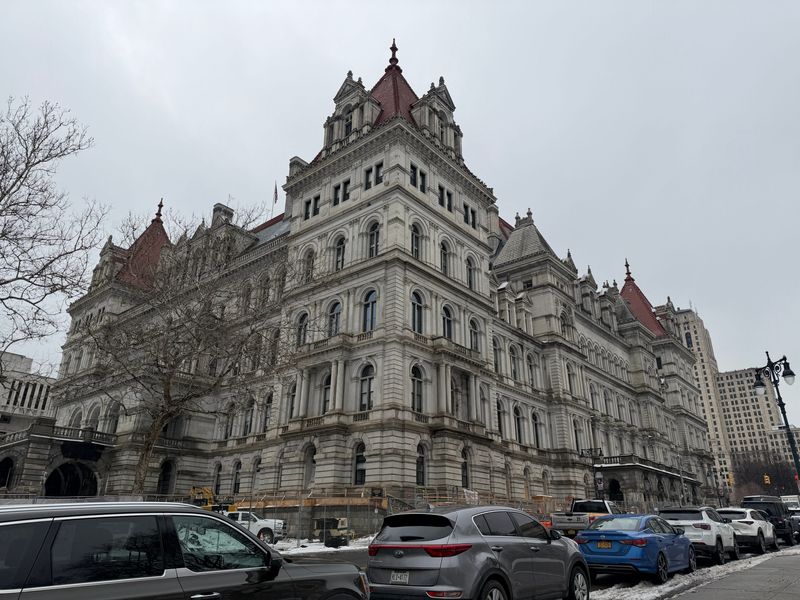
New York’s state budget process in 2026 continued a historic trend of being shrouded in secrecy and uneven representation, despite its vitally important role in shaping life for all New Yorkers, businesses and state agencies.
Budget discussions, which focus heavily on policy measures the governor wants to see implemented, happen primarily behind closed doors, hidden from public view as well as from the media and legislators on both sides of the aisle.

The state’s Republican legislators, who are often kept completely in the dark on budget issues being the minority party, have repeatedly voiced their concerns with the way New York’s budget process unfolds — calling it “not good government.”
And now, some of the Democrats directly involved in decision making are starting to scrutinize the system as well.
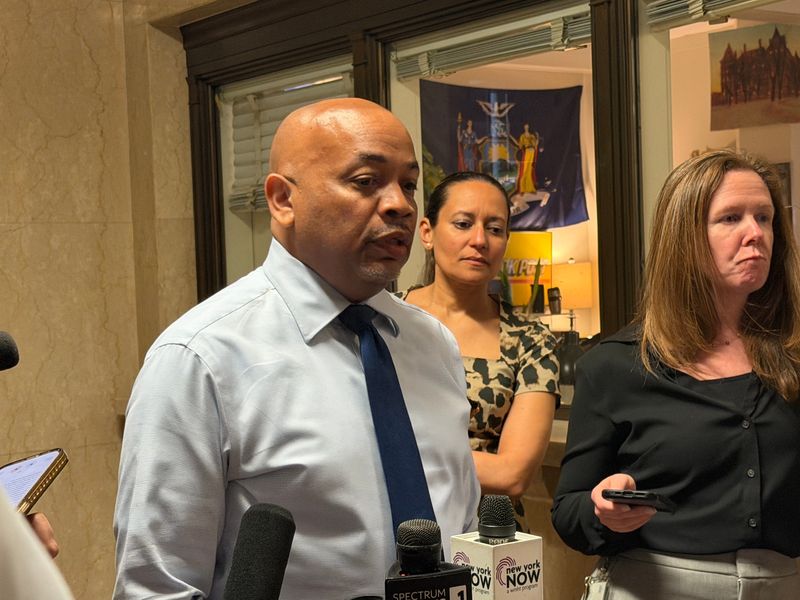
“People gotta start to say, I don’t think this is the way government should be set up,” Assembly Speaker Carl Heastie said recently, before asserting a power imbalance tilting in the governor’s favor over the Legislature is harming the process.
Why is New York’s budget process so secretive?
It’s a good question. For those familiar with the process, they say it’s always been that way. In fact, New York Public Interest Research Group senior policy advisor Blair Horner says “it’s part of Albany’s DNA to operate behind closed doors.”
However, he also said he thinks this is the most secretive budget process he’s ever seen.
“What it should look like is the governor releases a budget, the Legislature holds hearings, the public provides input, the Legislature gives their response, and then the governor and the Legislature, of course, have to negotiate and meet in the middle of their proposal,” says Rachel Fauss, Reinvent Albany’s senior policy advisor.
“Then the budget should be passed roughly on time and reflect the public input that’s been given,” Fauss added.
It’s not what’s happening though. Long after the public comment period has ended in February, the governor often throws additional policy issues into the mix — this year it’s climate law adjustments and a tax on New York City second homes — that will never be open to public input. And even those that have been subject to external discussions often undergo changes seen only by the “three people in the room,” or the governor, the Senate majority leader and the Assembly speaker.
An additional layer is the current Democratic control of all three pillars of the budget process, which has been repeatedly pointed out by Republican lawmakers left on the outside looking in, with Assembly Minority Leader Ed Ra referring to the system as “single-party Albany” earlier this week.
So, why are closed-door talks the Albany way to do government? It’s a relatively simple answer that might build further frustration.
“The state constitution gives the governor and the legislative leaders enormous power over the legislative process, and that’s why the budget is negotiated by them, and they choose to do it behind closed doors,” Horner said.
What is Silver v. Pataki and why does it matter?
A large reason why the governor has so much power over the state budget process is because of Silver v. Pataki, or two cases decided in the Court of Appeals at the same time in 2004 — Silver v. Pataki and Pataki v. Assembly. The former was set in motion in 1998 and the latter in 2001.
Its namesake — Silver v. Pataki — involved a lawsuit by then-Assembly Speaker Sheldon Silver against then-Gov. George Pataki over the 1998 state budget process as the governor vetoed certain budget bills he says the legislature unconstitutionally changed. The Legislature argued the governor’s veto power didn’t apply to that specific type of bill.
And on both sides of Pataki v. Assembly, they argued the other was overstepping their role’s constitutional limits after legislators removed language from budget bills as well as entire bills and replaced them with their own versions. The court ruled the Legislature’s actions in both cases were unconstitutional, however, they left the door open for future discussions on what the governor can and can’t include in budget bills.
The decisions have had heavy influence on all budget processes thereafter, allowing budget discussions to be weighed down by policy issues of importance to the governor rather than fiscal elements.
“Silver v. Pataki put the governor in the driver’s seat,” Horner says, and he believes Hochul has abused the power afforded to her through it.
Several current assemblymembers are starting to speak out about what they feel is the “outsized power” and “executive overreach” of the governor in the state budget process. And both Horner and Fauss are pointing to issues with interest groups running the game as a result, since they say they’re the only ones who can get in the governor’s ear during the closed-door talks.
“They speak with a megaphone, and the average New Yorker is left to speak with a whisper,” Horner said.
Hochul’s office did not directly respond to the recent calls from state legislators for reforms to how much influence the governor has over the state’s budget process but said the governor “has consistently used the budget process to deliver real wins for New Yorkers.”
“The governor looks forward to working with her partners in the Legislature once again to pass a state budget that makes New York safer and more affordable for working families,” a spokesperson for Hochul’s office added.
Can the process be changed and would it help New Yorkers?
Theoretically, yes. A constitutional amendment would allow the Legislature to pass a bill, which would then receive input from voters, all without approval from the governor.
Assemblymember J. Gary Pretlow, who is the Assembly’s finance chair, hasn’t been quiet about his preference to focus solely on the money in the budget process and is seemly on board with changes to Silver v. Pataki.
“That’s a time-consuming process that I think that maybe we should undertake,” Pretlow said on the Assembly floor last week.
Heastie has also shared his support for changes in recent days but doesn’t want to point fingers at Hochul, saying she’s “just been using the tools in her tool shed,” even though he also acknowledged “the governor’s budget quite possibly takes up 80% of the session.”
“In a few days, we’re going to be into May,” Heastie told reporters on Wednesday, April 22. “And then I gotta try to pass all of the priority bills that members want in a month.”
Albany’s Republican legislators have previously introduced the New York State Budget Transparency Act, which would limit “messages of necessity,” or calls for the immediate vote on a bill, and prevent legislative proceedings to happen between midnight and 8 a.m., which often happens toward the end of the budget process. It’s a measure Fauss, in part, says would increase transparency.
“There’s no way that members of the Legislature can read hundreds of pages of a budget bill and vote on it the same day and have an informed opinion,” Fauss said.
“I think that there shouldn’t be messages of necessity used because the public should be able to know what is in the legislation and the legislators should have the ability to fully understand it,” Fauss added.
Ultimately, it’s the public’s money, according to Horner, and “the public should have every right to know how it’s being spent before the decisions are made, not after.”
Unless you change the root of the problem though, which is deep-seated, Horner says “you’ll never have the kind of transparency that you see in other states.” But changing the system “would be the political equivalent of an earthquake in Albany,” he says.
Emily Barnes covers state government for the USA TODAY Network-New York with a focus on how policy and laws impact New Yorkers’ taxes, communities and jobs. Follow her on Instagram or X @byemilybarnes. Get in touch at ebarnes@usatodayco.com.
This article originally appeared on Rockland/Westchester Journal News: This is the ‘earthquake in Albany’ that could end NY budget secrecy
Reporting by Emily Barnes, New York State Team / Rockland/Westchester Journal News
USA TODAY Network via Reuters Connect