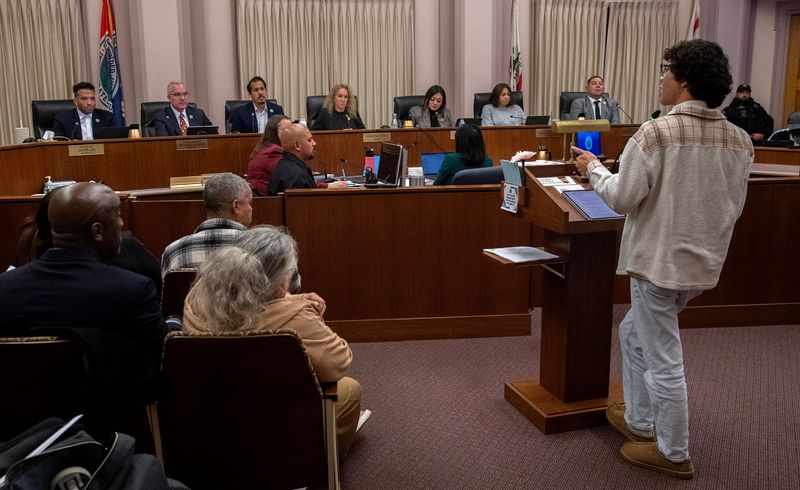
In a contentious decision, the Stockton City Council voted to override staff recommendations and redirect millions of dollars in loans to a different set of affordable housing developments, raising questions about the future of the city’s competitive funding process.
The April 14 vote came after hours of debate over how to allocate roughly $9.18 million in remaining housing funds from federal, state and local sources. Those sources include HOME, HOME-ARP, the Neighborhood Stabilization Program and Community Development Block Grant funds, as well as the state Homeless Housing, Assistance and Prevention and Permanent Local Housing Allocation programs and local housing funds.

City staff had presented a ranked list of proposals based on a formal scoring system evaluating financial readiness, developer experience and community impact. That analysis, later reinforced by an independent artificial intelligence review, identified a different set of top projects than those ultimately funded.
The recommendation was for The Don Shalvey Apartments by Visionary Home Builders to receive a $5 million loan to develop 108 affordable housing units and for the Danny Drive project by Delta Community Developers Corporation to receive a $4.18 million loan to develop 66 affordable housing units.
Despite that, a majority of councilmembers supported two alternative developments: The Brix at 242 N. Sutter St. by Community Revitalization and Development Corporation, which would provide 39 affordable housing units, and Alicia’s Place at 1625 French Camp Road by RH Community Builders, which would add 76 units. The council also approved funding for the Danny Drive project at 6303 Danny Drive, though for less than originally recommended. The project would deliver 66 units.
The decision marked a clear departure from the city’s established Notice of Funding Availability (NOFA) process, which was designed and approved by the council to ensure fairness and transparency in awarding public dollars.
To begin discussion on the item, several councilmembers disclosed meetings with some of the developers involved in the proposals.
Mayor Christina Fugazi said she met in March 2025 with Carol Ornelas and Valentino Silva of Visionary Home Builders, in summer 2025 with Robert Abbasi of RTI Properties and in November 2025 with Harry Joel. She said she did not receive campaign contributions from any of them.
District 1 Councilmember Michele Padilla said she met with Silva a week before the vote and said she did not receive any campaign contributions from him or Visionary Home Builders. District 5 Councilmember Brando Villapudua also said he met with Silva and “did not receive any checks,” though he did not specify when the meeting occurred.
Before staff and applicants presented the proposals to the council, Vice Mayor Jason Lee called a point of order, raising concerns about potential conflicts tied to The Brix. He said the project had been referred to outside agencies, including the state attorney general, the district attorney’s political corruption unit and the civil grand jury, and that it is currently under review.
“I do think that it’s appropriate that the mayor recuse herself from this discussion if we’re going to vote and potentially fund this project,” Lee said.
While making his case, Lee cited a January report from Hanson Bridgett LLP, the law firm that conducted an independent investigation that cleared him of wrongdoing in connection with his involvement in a “Wild ‘N Out” live show. The report focused in part on recusal and said public officials who are the subject of an investigation should recuse themselves from related discussions and decisions to avoid the appearance of a conflict of interest and uphold ethical standards.
The vice mayor argued that voting on funding tied to a project under investigation, which staff also recommended not receive funding, could undermine public trust and create “extreme optics of potential corruption.”
City Attorney Marci Arredondo said the prior report recommended broad recusal as a best practice in decisions involving investigations. She said the recommendation was recusal, but noted the mayor did not believe she had a conflict and did not want to recuse herself.
“I have not been contacted by the attorney general, the grand jury or the district attorney regarding any of this,” Fugazi said. “Whether it was passed on to them or not, whether they found merit in it or not, they have not reached out to me. There is no conflict on my end with this project.”
Lee said individuals associated with The Brix were pressuring the city’s economic development department to manipulate the value of properties in support of the project to position it for a NOFA. He also said one of the individuals donated to the mayor’s campaign.
Fugazi called a point of order and asked whether the council could hear the proposals for the projects. Lee said the council should but first made a motion for the mayor to recuse herself. It was seconded by District 3 Councilmember Michael Blower but ultimately failed 3-3. Blower, Lee and District 4 Councilmember Mario Enríquez voted in favor, while Fugazi, Villapudua and District 2 Councilmember Mariela Ponce voted against. Padilla was absent from the vote.
Following the failed recusal motion, the council proceeded to hear presentations from staff and applicants.
Throughout the meeting, multiple councilmembers emphasized the importance of adhering to the NOFA framework the council itself had approved. They pointed to the structured scoring criteria and the additional AI validation as evidence that staff’s recommendations were objective and consistent.
“I am very comfortable with the staff recommendation because we strengthened the NOFA process,” Enríquez said, urging councilmembers who disagreed to give a clear explanation why. “We presented the data. We have the criteria. They scored it and yet it’s still not good enough.”
Others echoed similar concerns, warning that deviating from the established framework after applications had been scored could create uncertainty for future funding rounds and erode confidence among developers competing for public funds.
“We need to be very mindful of how we’re coming up with these decisions to create appeal processes, to have forums like these, where we spend hours debating projects that staff [has] gone through the process that we approved to evaluate, because then what happens is people in the community think that we are biased toward your projects,” Lee said.
However, a majority of the council ultimately focused on different considerations, particularly whether projects were shovel-ready or close to construction and likely to be delivered in the near term.
“We’re not rubber stampers,” Fugazi said. “We were elected to do what our constituents ask us to do. Is it responsible to commit millions of dollars to a project that’s many years into the future? My answer is no to that. Taxpayers are tired of delays and they’re tired of wasteful spending.”
Supporters of the funded projects repeatedly highlighted that some developments recommended by staff relied heavily on competitive state tax credits and extended timelines, which could delay construction for years or require additional funding to close financing gaps.
With total funding requests exceeding $28 million, far outpacing the available resources, councilmembers acknowledged that any decision would leave some projects unfunded.
“It really is a difficult choice where you have to take the limited resources you have and figure out how to best use them,” Blower said.
He added that he had been on the council for a long time and that the NOFA process typically involved considering staff scores.
“That’s the criteria by which we should make these choices,” Blower said. “I feel like to kind of throw that off, because, you know, it’s great a lot of people came and spoke in favor of different projects, but again we have a process, so I feel comfortable with what the staff recommended.”
After rejecting a motion by Enríquez to adopt staff’s recommendations, the council approved an alternative allocation of $9.18 million in housing funds introduced by Villapudua. The final vote directed approximately $4.4 million to The Brix, $3.1 million to Alicia’s Place and the remaining funds to the Danny Drive project.
The vote was 4-3, with Fugazi, Padilla, Ponce and Villapudua in favor and Lee, Blower and Enríquez opposed. As part of the approval, the council also added a requirement that funded projects demonstrate progress by breaking ground within two years or risk having funds returned for reallocation.
Record reporter Hannah Workman covers news in Stockton and San Joaquin County. She can be reached at hworkman@recordnet.com or on Twitter @byhannahworkman. Support local news, subscribe to The Stockton Record at https://www.recordnet.com/subscribenow.
This article originally appeared on The Record: Stockton council approves millions in housing loans over staff recommendations
Reporting by Hannah Workman, The Stockton Record / The Record
USA TODAY Network via Reuters Connect