(This story was updated to add new information.)
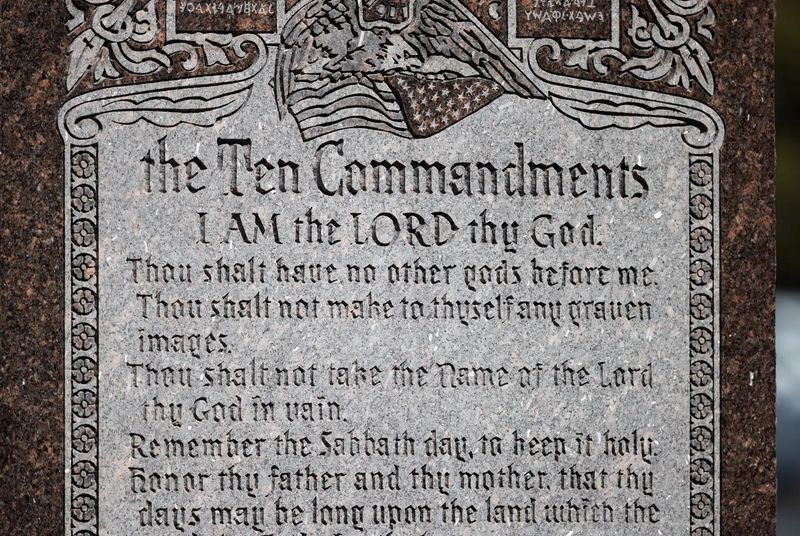
A federal appeals court upheld a contentious Texas law requiring public school districts display the Ten Commandments in classrooms, setting the stage for a potential Supreme Court fight.

The U.S. Court of Appeals for the 5th Circuit ruled April 21 found that the law, known as Senate Bill 10, does not establish an official state religion. Groups challenging the legislation made that argument, alleging it violates the right to religious freedom guaranteed by the First Amendment.
“S.B. 10 looks nothing like a historical religious establishment,” read the court’s opinion. “It does not tell churches or synagogues or mosques what to believe or how to worship or whom to employ as priests, rabbis, or imams. It punishes no one who rejects the Ten Commandments, no matter the reason.”
The opinion also states that SB 10 does not coerce people to practice Christianity, and it just “puts a poster on a classroom wall.”
“Yes, Plaintiffs have sincere religious disagreements with its content,” read the opinion. “But that does not transform the poster into a summons to prayer.”
The case, Rabbi Nathan v. Alamo Heights Independent School District, was argued in January before all 17 judges of the court, along with a similar Ten Commandments in public schools requirement from Louisiana.
Groups including Americans United for Separation of Church and State, the American Civil Liberties Union and the Freedom From Religion Foundation are representing the plaintiffs, a group of both religious and nonreligious families who sought to block the law.
The court ruled in favor of Louisiana in February. It said that because the displays had not yet been implemented, there was not enough information about their content and prominence in classrooms to preemptively deem them unconstitutional.
Corpus Christi school district involved in separate case
However, this isn’t the only pending case challenging the Texas law. In Corpus Christi, a Flour Bluff Independent School District parent joined a separate case, Cribbs Ringer v. Comal Independent School District.
In November, a federal judge ordered Flour Bluff ISD and the other school districts involved with the case to remove the Ten Commandment displays, citing previous cases.
It’s unclear how the recent decision on Rabbi Nathan v. Alamo Heights Independent School District, as well as the possibility of review by the U.S. Supreme Court, could impact the other pending Texas case involving Flour Bluff ISD.
Groups ‘anticipate’ asking Supreme Court to review
Judge Irma Carrillo Ramirez, joined by a handful of other judges, dissented from the Texas decision. She wrote that a law requiring Ten Commandments displays “with no ‘educational function’” violated the First Amendment.
The groups representing the plaintiffs said in a joint statement that they’re “extremely disappointed in today’s decision.”
“The First Amendment safeguards the separation of church and state and the freedom of families to choose how, when and if to provide their children with religious instruction,” the statement said. “This decision tramples those rights.”
The groups in the statement vowed to ask “the Supreme Court to reverse this decision and uphold the religious freedom rights of children and parents.”
Both the Lackland Independent School District and North East Independent School District, which are among the defendants in the case, told USA TODAY they would comply with the court’s decision.
USA TODAY reached out to the other school districts involved in the case for comment.
Texas leaders celebrate ruling on Ten Commandment Bill
Texas Attorney General Ken Paxton argued before the court on behalf of the state and celebrated the ruling as soon as it was announced.
“This is a major victory for Texas and our moral values,” Paxton said in a statement. “My office was proud to defend SB 10 and successfully ensure that the Ten Commandments will be displayed in classrooms across Texas. The Ten Commandments have had a profound impact on our nation, and it’s important that students learn from them every single day.
Texas House Speaker Dustin Burrows called the ruling a “big win” for the Texas Constitution, families, students and the rule of law on social media.
“This decision affirms what we’ve said all along: this law is consistent with our nation’s history and constitutional principles,” read Burrow’s social media post. “Texas has always led the way in defending religious liberty and the values that helped shape our country.”
Both Texas leaders were joined in their celebration by Texas Lt. Gov. Dan Patrick on social media, who had placed the bill among the Texas Senate’s top priorities.
“As chair of President Trump’s Religious Liberty Commission, I will never stop fighting for Texans’ and Americans’ religious liberty rights,” read Patrick’s social media post.
What does the Texas Ten Commandments law require?
SB 10 was passed during the 89th Texas Legislature in 2025, was signed by Gov. Greg Abbott and went into effect Sept. 1, 2025.
The law requires the following:
The law also stipulates that the school can not purchase the posters with district funds.
Mateo Rosiles is the Texas Connect reporter for USA TODAY and its regional papers in Texas. Got a news tip for him? Email him: mrosiles@usatodayco.com.
This article originally appeared on Corpus Christi Caller Times: Texas can require schools to display Ten Commandments, court rules
Reporting by Mateo Rosiles, Olivia Garrett and BrieAnna J. Frank, USA TODAY NETWORK / Corpus Christi Caller Times
USA TODAY Network via Reuters Connect