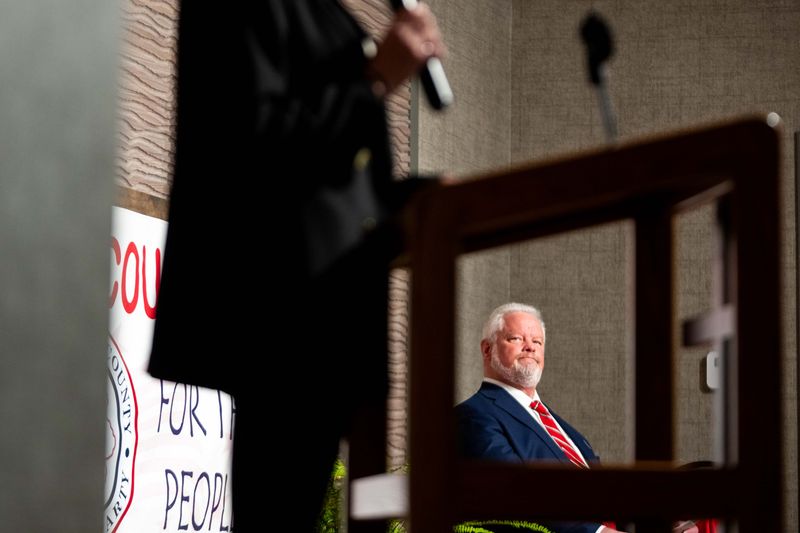
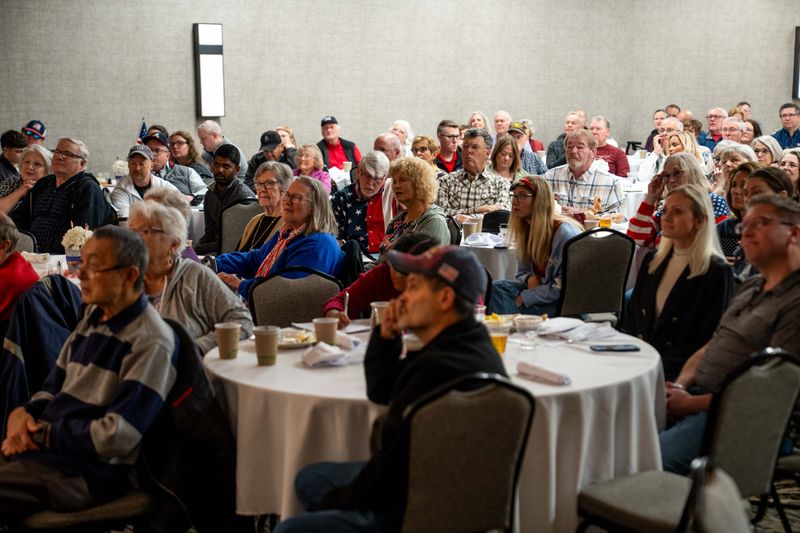
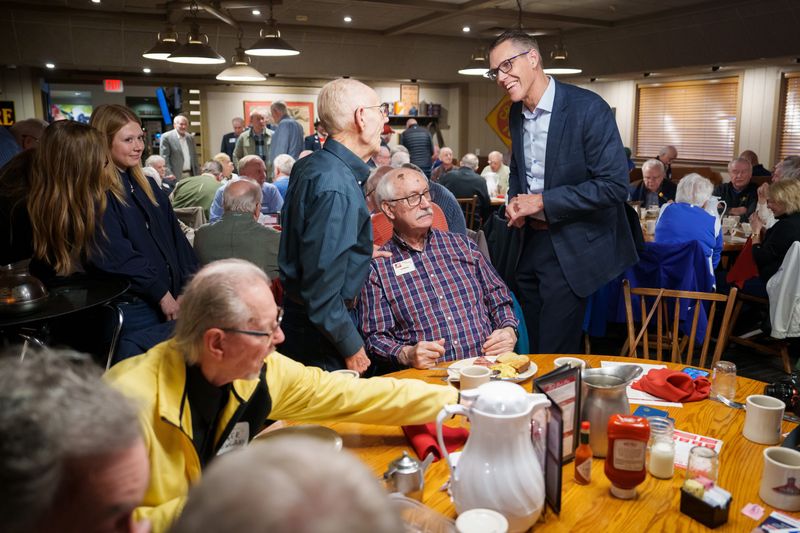
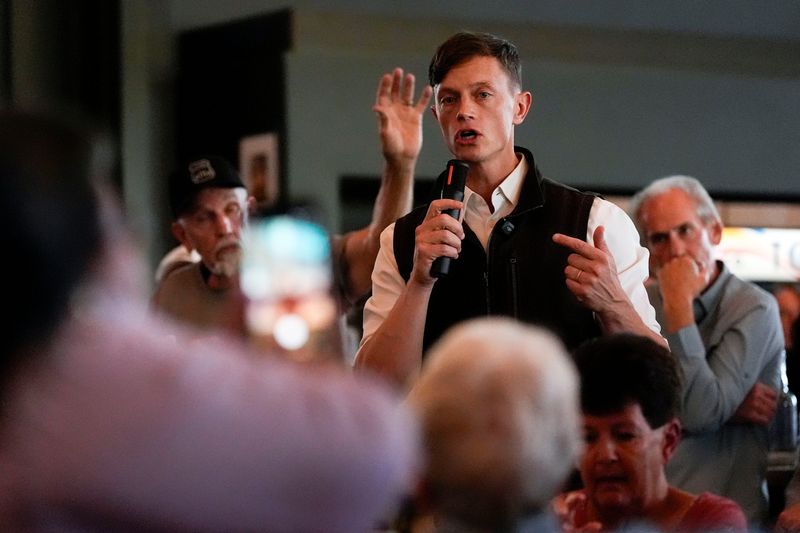
CLEAR LAKE — At a recent candidate forum filled with excited chatter, the aroma of pancakes and the kind of Republicans who love to knock doors and vote in primaries, it was hard to find voters excited about Iowa’s leading GOP gubernatorial candidate.
Attendees needed little prompting to share their unvarnished feelings about U.S. Rep. Randy Feenstra:

“I could never support him.”
“No chance in the world.”
“Absolutely not.”
The sentiment was pervasive at the April 11 Pancakes & Patriots event. It is widespread at MAGA Nation meetings of grassroots activists in West Des Moines. It has dominated the comment sections of the right-wing Iowa Standard blog.
Feenstra’s difficulty connecting with factions of the GOP base has become a concern among Republicans across the political spectrum who fret — some openly, many privately — that it could damage the party’s efforts to drive turnout in November’s general election.
“There’s no excitement for people to get out there and really rally behind him because he’s not rallied behind us,” said Jenn Turner, who is the Polk County chapter chair of Moms for Liberty, although she spoke to the Des Moines Register in an individual capacity. “He’s not shown that he cares.”
Billy Fuerst, a spokesperson for Feenstra’s campaign said the idea that Feenstra doesn’t have grassroots support is “a narrative being pushed by failing campaigns mired in the single digits and not gaining any traction.”
He said Feenstra has made nearly 100 appearances on his statewide tour to meet directly with thousands of Iowans.
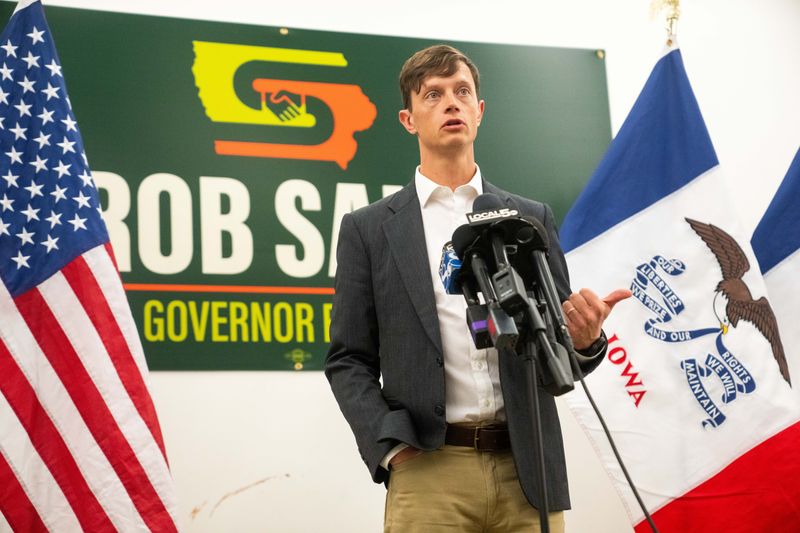
“Our campaign is built to win the primary and the general,” Fuerst said. “We have the resources, the message and the team to secure a strong victory in the primary and win the general to stop extreme liberal Rob Sand from turning Iowa into California, Illinois or Minnesota.”
Feenstra remains the favorite to win the June 2 primary election, but Republicans are becoming increasingly anxious about their chances in a general election against Sand, the state auditor and the only Democrat running for governor.
A March poll by Democratic pollster GBAO showed Feenstra trailing Sand by 8 percentage points in a head-to-head matchup.
The same poll found Iowa’s Republican U.S. Senate candidate Ashely Hinson leading each of her Democratic challengers by 3 and 4 percentage points, underscoring the challenges unique to Feenstra and the governor’s race.
Nonpartisan elections analysts at the Cook Political Report also have recently reclassified Iowa’s gubernatorial election as a “toss-up,” in part because of Feenstra’s apparent weakness with the Republican base.
“What made President Trump’s margins in the state so large was that he had really strong support from the base,” said Matthew Klein, the Cook analyst who authored the report. “And if Feenstra heads into a general election and he’s not able to replicate that, if he’s not able to match the enthusiasm that Trump had among Republicans, then it’s a huge problem for him.”
Feenstra expected to win GOP nomination for governor, even with some grassroots opposition
Feenstra, however, does have powerful support.
He boasts statewide political connections and millions of dollars in fundraising. He’s got endorsements from former Iowa Gov. Terry Branstad, U.S. Sen. Joni Ernst, U.S. Rep. Mariannette Miller-Meeks, numerous current and former legislators and backing coalitions of dozens of farmers and retirees.
His competitors — state Rep. Eddie Andrews, businessman Zach Lahn, former state Rep. Brad Sherman and former state administrator Adam Steen — are all relatively unknown and have not shown an obvious surge in momentum as the primary season wanes.
Steen has been the most aggressive in going after Feenstra directly, but he recently became mired in a fight with Andrews over a failed ballot access challenge that may have hurt his credibility with some voters.
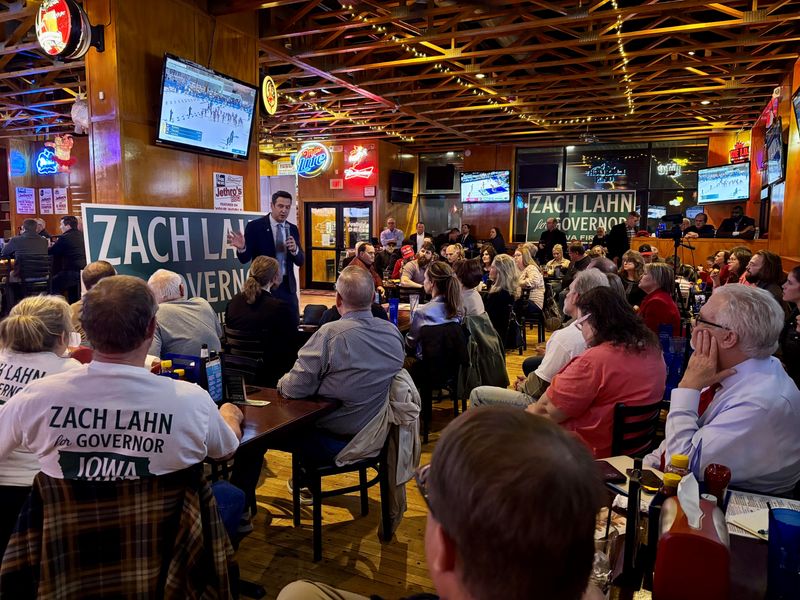
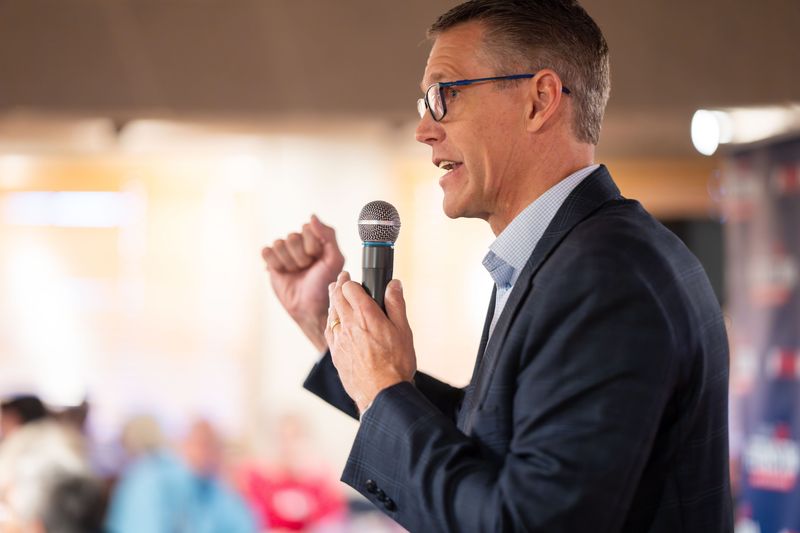
And Lahn, who gave $2 million to his own campaign, announced a six-figure television advertising buy on April 7. On April 21 he announced he would funnel $1 million into a second advertising round. As the only other Republican on TV, that could bolster his name recognition, but it comes relatively late in the primary season.
Absent a strong alternative, there’s little current indication Feenstra will have trouble locking up the nomination on primary night. He needs at least 35% of the vote to prevent the nomination from being decided by grassroots delegates at a statewide convention.
A poll of the primary field conducted April 14-15 by Victory Enterprises, an Iowa-based Republican consulting firm associated with Feenstra’s campaign, found that Feenstra led the GOP field with 41% of the vote.
Steen followed with about 9% and Lahn earned 8%. Sherman and Andrews both sat at about 5%, while undecided voters made up 31% of respondents.
The margin of error was plus or minus 4.4 percentage points.
But that hasn’t stopped Feenstra’s competitors from trying to push the nomination to a convention.
Internal polling conducted in March and commissioned by The Family Leader, which has endorsed Steen, showed Feenstra with 34.5% of the primary vote.
Undecided voters made up the largest share of respondents with 45.5%, and no other challenger topped Steen, who was at 10%.
‘He avoids everything’: A primary versus general election strategy
Earlier this year, Feenstra skipped a high-profile candidate debate hosted by Moms for Liberty that featured the four other Republican governor candidates. Instead, Feenstra attended a rally in Clive with Trump and flew in and out of Des Moines on Air Force One. The proximity to the president did little to quell activists’ outrage that he skirted the debate.
The perception that Feenstra is uninterested in engaging with corners of the party’s grassroots has since become a persistent theme of the primary race.
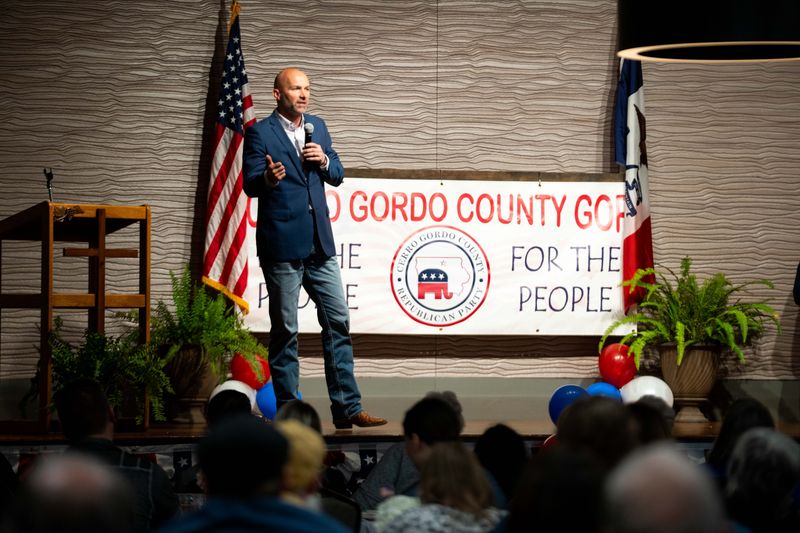
Cerro Gordo County GOP Chair John Rosenfeld, who helped organize the Clear Lake pancake breakfast, said he was not surprised that Feenstra did not attend.
“People are just kind of like, ‘Yep, that’s the Randy we know,’” Rosenfeld said.
Feenstra represented Clear Lake and Cerro Gordo County as part of the 4th Congressional District for one term before redistricting took effect in the 2022 election cycle.
“He certainly hasn’t spent a lot of time with the people,” Rosenfeld said. “He’s spent a lot of time with specialized functions, not including, you know, the folks we have here today, the voters, the actual, real, true grassroots of the party.”
Feenstra avoids most multi-candidate forums, he’s not agreed to any primary debates, and he does not widely publicize information about his campaign events.
As the primary’s perceived frontrunner, Feenstra might not need to participate in those types of events to win. But it irritates activists and voters who expect to hear directly from their candidates in a state known for its retail-style politics.
“He avoids everything,” said Brian Scott, a 70-year-old Johnston resident who attended a recent event for Lahn as he scouts the primary field.
Scott, who considers himself to be an “average Republican,” recently attended events for Lahn and Steen and said he likes both. But he wishes Feenstra would engage more in the primary process.
“I haven’t seen him in Iowa,” he said. “And I know he’s got a job in Washington and that sort of thing, which I haven’t seen him do anything with either. So, my overall opinion right now of Randy is not real good.”
Iowa Republican David Oman, a former state party chair and a former chief of staff to Iowa Republican governors Robert Ray and Terry Branstad, said he’s seen numerous gubernatorial races up close and encouraged candidates to be accessible.
“In Iowa, if you’re going to run for governor, then run for governor and be out there and introduce yourself to people and and let them ask you questions,” he said.
Drew Klein, a regional vice president at Americans for Prosperity, noted that the Republican base in Iowa “isn’t a monolith.”
“It represents a diverse set of policy priorities, political allegiances, walks of life and temperaments in general,” he said. “To do well with these voters, you have to meet them where they are and be authentic. Randy needs to focus on that.”
Luke Martz, a Republican political consultant, defended Feenstra, saying the congressman is rightly running a campaign focused more heavily on the general election.
“Randy’s background as a fiscal and social conservative representing the reddest congressional district in the state is not going to be what wins the general,” he said. “It’s going to be the policies and priorities that he talks about that resonate with Republican and independent voters that wins the day in November. And from what I’m seeing, that’s what he’s doing.”
‘What game is he playing?’ Republican voters vent frustrations with Feenstra
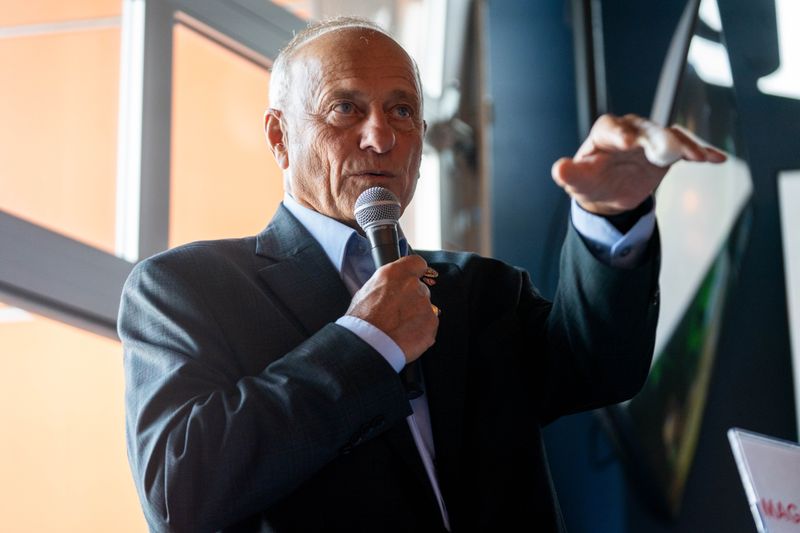
Some northwest Iowa Republicans are still bitter about the 2020 primary race Feenstra ran to oust Republican U.S. Rep. Steve King in the 4th Congressional District.
At the time, King was consumed in controversy and had become a political problem for other Republican candidates and elected officials. But he remains popular with many MAGA Republicans, some of whom blame Feenstra for forcing him out of office.
“What he did to Steve King — I was a friend of Steve King, so that’s just a non-starter,” said John Wacker, a Garner Republican who attended the pancake breakfast in Clear Lake.
Wacker, who described Feenstra as “too establishment,” prefers Sherman for governor.
Others interviewed by the Register pointed to Feenstra’s work in Congress and metrics such as the Liberty Score and the Heritage Action Scorecard, which rank members of Congress based on their group’s priority issues.
Feenstra has a C rating on the Liberty Score and an 81% lifetime score with Heritage Action.
Melissa Collins, a 46-year-old Republican from Johnston, said at an April 2 campaign event for Lahn that she likes all the candidates running for governor — “except for Randy Feenstra.”
“Anyone but Randy,” she said. “Whoever can beat Randy is my guy.”
“I pay attention to the Liberty score and how he votes in D.C., so I already was not fond of him,” she said. “But then it compounded when he doesn’t show up for anything.”
Feenstra doesn’t typically vote much differently than the rest of Iowa’s Republican congressional delegation, and he has the highest Liberty Score of the group.
But Turner, of Moms for Liberty, said the grassroots holds him to a higher standard because his district is such a safe seat for Republicans.
“He should be able to vote so strongly conservative and he doesn’t,” she said, speaking in a personal capacity. “So what game is he playing? He’s not there to represent us as conservatives. He’s there to represent himself and get further in the political realm.”
Some see Feenstra as soft on issues such as opposing eminent domain for the use of carbon capture pipelines, although he has become more forceful in his denunciation of eminent domain for private projects.
The right-wing Iowa Standard blog has taken shots at him for insufficiently opposing the Affordable Care Act in his 2022 PhD dissertation in business and health care administration from Northcentral University, as well as immigrant outreach work he did as Hull City Administrator.
And some Republican members of the Iowa Legislature have been critical after Feenstra suggested private schools getting public funding through Education Savings Accounts should not be able to exclude students.
None of those are disqualifying positions in a general election, but they don’t always land well with Iowa’s ruby-red primary electorate.
“He’s part of the Deep State, and I don’t want anything to do with the Deep State,” said Juli Kvale, a Republican who attended the Clear Lake event. “They are what are hurting our nation dramatically. So we’ve got to have government for the people, by the people. And Washington hasn’t listened to the people in the manner that they should have.”
Kvale, who is backing Sherman and thinks Steen is a good candidate, said she would do “everything I can to make sure (Feenstra’s) not the nominee.”
Rosemary Yokoi, a Mason City Republican who attended the Clear Lake event, said she has a “somewhat negative” opinion about Feenstra.
“You know what, I can’t even remember (why),” she said. “And that’s kind of awful, but I can’t remember why I have a less positive view of him.”
She said she has an open mind and would welcome hearing more from Feenstra to potentially change her opinion.
But Feenstra, though invited, hadn’t attended the forum.
“I wish he would be here today,” Yokoi said. “I was really hoping he would come.”
Feenstra calls himself a ‘Trump conservative,’ but he doesn’t have Trump’s endorsement
Feenstra appears to be trying to counteract negative perceptions by emphasizing his connections to Trump.
In his latest television ad, Feenstra identifies himself as a “Trump conservative,” and his previous ads both noted he stands with Trump and feature prominent images of the president.
But Trump has not weighed in on the race, even though Feenstra said he has asked for his endorsement. It’s been viewed as a snub.
Klein, of the Cook Political Report, said Trump’s reluctance to endorse is notable, given the fact that Trump traveled to Iowa and has backed a candidate in every congressional race in the state this year.
“I wouldn’t be surprised if it comes at some point,” he said. “But I think the fact that it’s taken this long is more a reflection of the fact that, yes, Feenstra has some work to do with the base.”
Does it matter in a general election?
Feenstra may not be the top pick of some grassroots activists, but his backers expect that he will have a broader appeal that will serve him well in a general election.
“If we want to beat Rob Sand, we need Randy Feenstra to win this primary,” said Republican West Des Moines Mayor Russ Trimble, who is supporting Feenstra. “I think Randy is the only one that can do it.”
Trimble touted Feenstra’s plan to focus on making the state more friendly to business and agriculture interests, and he called him “a great policy mind.”
He said he knows Feenstra has caught flak for missing the Moms for Liberty debate but defended his choice.
“He is an active, sitting congressman that’s got a job to do, and I respect him for doing that job,” Trimble said. “And even in spite of having a full-time job representing us in Washington, D.C., he has been here multiple times, meeting with voters, talking to voters, hearing what they care about. That’s the kind of guy that he is.”
He said he believes Republicans will rally around Feenstra after the primary.
Most Republican voters interviewed — even those who had the harshest criticism for Feenstra — said they likely would vote for him in a general election if he wins the nomination.
“I’d probably swallow my pride and vote for him,” Wacker said.
“I mean, that’s one of those things where I would press an ‘R’ and hold my nose,” said Kvale.
Even though Republicans have a massive voter registration advantage in Iowa, party leaders have said one of their biggest concerns for the midterms is ensuring that Trump voters turn out to the polls without him on the ballot.
“If our Trump voters are complacent, yes, we have to guard some of these races,” Republican Party of Iowa Chair Jeff Kaufmann previously told the Register in a broader conversation about the midterm election dynamics.
“(Democrats) are not going to sweep us,” he said. “But yeah, we could be vulnerable in some of those.”
Beyond turnout, a lack of grassroots enthusiasm could also present challenges mobilizing volunteers.
Kvale said she has been active in grassroots organizing for more than four decades. But if Feenstra is the nominee, “I would not help,” she said.
Turner also said she would not go beyond casting a ballot for Feenstra.
“You know, we all have to get on board, and we’ll all have to vote come November at the grassroots level,” she said. “I’m not throwing on a Randy Feenstra shirt and knocking doors, though.”
She worries that Feenstra will cost Republicans the election.
“I think Rob Sand makes himself out to be such a moderate that there are some very moderate conservatives that would swing that way,” she said. “Because personality-wise, he might come across better than Randy Feenstra.”
Sand has also taken some positions that have alienated members the Democratic Party, including his stance opposing transgender Iowans competing in girls’ sports.
But for a candidate trying to signal to independents and moderate Republicans that he’s a different kind of Democrat, creating distance from the party base could be to his benefit.
“I think Democrats in Iowa have been so badly burned by the last decade of politics that they are willing to get behind somebody, anybody, who looks like they have a realistic shot at winning, even if they may not align with them 100% of the time,” Klein, of the Cook Political Report, said.
“… Whereas Republicans are so used to winning that they feel they have the luxury of being able to squabble over small differences in policy or style in a way that could end up causing them more harm at the end of the day.”
At a March 12 Republican Party of Iowa event in Cedar Rapids, Kaufmann urged Republicans to take a more holistic view of their candidates.
“You remember what Ronald Reagan said,” he told the group. “Let’s live it, let’s not just quote Reagan. Let’s live it after the primary. He said if we agree 80% of the time, it doesn’t make us 20% enemies. It makes us political allies. That’s how we’re going to be victorious in 2026.”
Brianne Pfannenstiel is the chief politics reporter for the Des Moines Register. She writes about campaigns, elections and the Iowa Caucuses. Reach her at bpfann@dmreg.com or 515-284-8244. Follow her on X at @brianneDMR.
This article originally appeared on Des Moines Register: Does Randy Feenstra have a grassroots problem in Iowa’s governor race?
Reporting by Brianne Pfannenstiel, Des Moines Register / Des Moines Register
USA TODAY Network via Reuters Connect