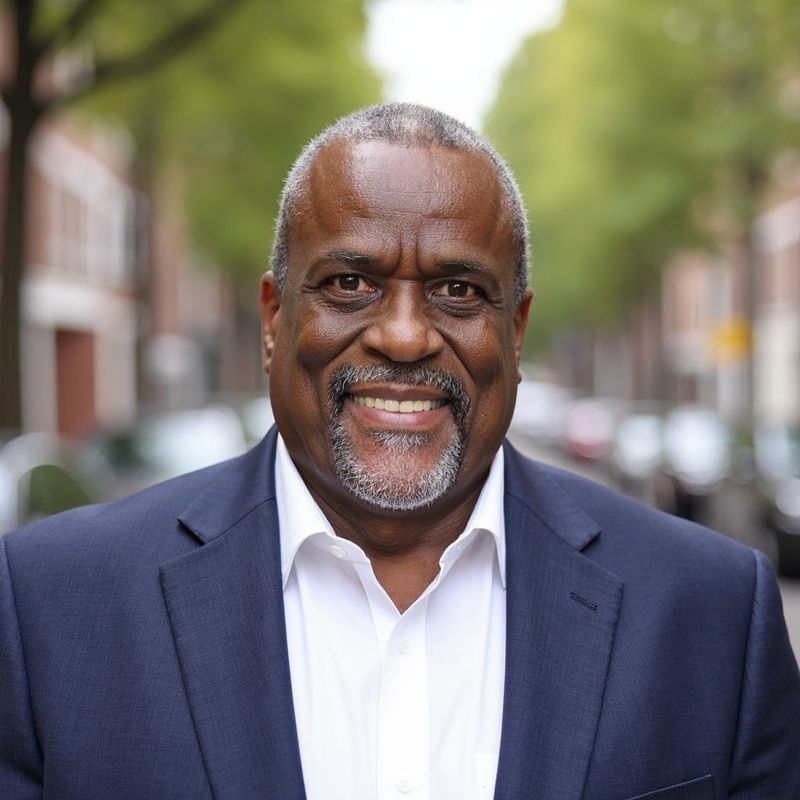
SOUTH BEND — As a child, Robert Naylor wrote for his elementary school newspaper published on mimeographed pages. That was just the beginning.

His journalism career would span 34 years, including 30 years at the Associated Press and several awards, including a Lifetime Achievement Award from the New York Association of Black Journalists as well as the Louis E. Inglehart Freedom of Expression Award from the Society of Collegiate Journalists.
On Tuesday, April 21, he will give the same talk, “Mandates and Movements: Building Communities from the Top Down and the Bottom Up,” twice at the Equity in the Arts Gallery in the Raclin Murphy Encore Center.
Then, on Wednesday, April 22, Naylor will lead a community discussion at the Martin Luther King Jr. Dream Center as part of its Lunch and Learn series on the topic “Telling our Own Stories … The Role of the Black Journalist.”
“I wanted to become a journalist … because I wanted to be able to tell the story of the people who really didn’t have a voice,” he said in a telephone interview. “The stories that are told about any group of people, about any community, becomes it’s legacy. We need to take charge of the shaping of our own legacy as opposed to letting other people do it.”
Changes and challenges for the media
Over the course of his career, the media landscape has changed drastically, with many local newspapers being swallowed up by larger conglomerates.
“I began my career working for my hometown newspaper,” Naylor said. “The guy who owned the newspaper was at the newspaper every day. He knew the people in the community. He was a member of organizations there. He went to church there. They had to really care about the community in a way that absentee people do not.”
This comes as many local newspapers are shrinking their staffs, billionaires continue to buy up legacy media outlets, with the proposed Paramount-Warner Brothers merger bringing even more news channels under fewer owners.
“News has to be about more than making a profit. It has to be about contributing back to that community and it requires a kind of stewardship for that community,” Naylor said. “It requires accountability to that community”
The potential Warner Bros. and Paramount-Skydance merger would bring more news channels — Paramount-Skydance already owns CBS, and the merger would add CNN to its portfolio — under fewer companies.
“The stories you tell about that community are things that really matter to them and that effect them,” Naylor said about the importance of local journalism. “It’s difficult to do when you don’t really know the people, don’t really know the community and perhaps if you’ve never even set foot in the community.”
Trust in legacy media also is currently at an almost all-time low, according to a poll by Gallup in October.
“Over the past decade, legacy news organizations have been operating in an unusually difficult environment,” Naylor wrote in a follow up email. “Journalists are trying to report facts, provide context, and help the public make sense of events that are often unprecedented in tone and behavior. At the same time, most newsrooms are working hard not to become part of the story themselves. No journalist wants that.”
In the past few months, journalism has come under fire from the Trump administration, from the Pentagon issuing new restrictions on reporters to journalists being arrested while filming ICE agents.
“Public trust has clearly been affected by the broader political climate. Repeated claims of ‘fake news,’ reductions in press access and the White House assuming control of the press pool,” Naylor wrote, “which was historically managed by the White House Correspondents Association, have all contributed to an environment where journalists must fight for both access and credibility.”
Trump announced March 2 that he would attend the White House Correspondents’ Dinner on April 25 for the first time as president even as his administration continues to threaten journalists.
The Trump administration’s FCC chair, Brendan Carr, for example, seemingly threatened ABC, Disney and Jimmy Kimmel in September over the late-night host’s comments following the killing of Turning Point USA co-founder Charlie Kirk and, more recently, threatened broadcasters’ licenses over the content of their coverage of the war in Iran that Carr described as “hoaxes and news distortions.”
“The framers of the Constitution understood the importance of a free press, which is why journalism is the only profession explicitly protected in the Constitution,” Naylor wrote. “That protection exists so journalists can act as watchdogs, hold those in power accountable, and ensure the public has the information it needs for democratic self‑governance. When access is restricted or when journalists face retaliation or regulatory threats, it becomes harder to fulfill that responsibility.”
A counter-intuitive approach to movements
After 34 years in journalism, Naylor pivoted to professional development for various member associations, nonprofits and academic institutions focusing on team building, strategic communications, career development, stakeholder engagement and diversity programs.
He recently published his first book, “The Soul of a Leader: Reflections and Meditations on Leadership.”
“In most societies, we believe [these movements] bubble up from the ground up.” Naylor said about the topic of his “Mandates and Movements: Building Communities from the Top Down and the Bottom Up” lectures at the Raclin Murphy Encore Center.
The purpose of the talk is to try to synthesize top-down leadership with grassroots movements.
“Even when that happens, we believe that leadership itself comes from the top down,” Naylor said by telephone. “That we dictate what our society, what our communities, what our involvements look like. What I believe is that it requires both of those things constantly to really affect the communities. …
“You must have effective leadership that really sets the pace, the tone, and creates an overarching idea or thought process about what your community is going to look like, how it’s going to function, how people are going to interact.”
Bringing grassroots movements and building things from the top-down together might seem counter-intuitive, Naylor said.
“The people in the leadership roles, if you will — and I use that term deliberately, in leadership roles, not people in charge — people in leadership roles have to constantly be mindful of what is going on at that grassroots level,” Naylor said. “What are people thinking? What are they talking about as our community grows and develops and broadens? What are they saying about who is included? Who is not included? Who has the power, who has the voice?”
Onstage
• What: Robert Naylor: “Mandates and Movements: Building Communities from the Top Down and the Bottom Up”
• Where: Equity in the Arts Gallery in the Raclin Murphy Encore Center, 211 N. Michigan St., South Bend
• When: noon and 6 p.m. Tuesday, April 21
• Cost: free
• For more information: Call 574-235-9190 or visit morriscenter.org/raclin-murphy-encore-center.
Onstage
• What: Robert Naylor: “Telling our Own Stories … The Role of the Black Journalist”
• Where: Martin Luther King Jr. Dream Center, 1522 Linden Ave., South Bend
• When: noon Wednesday, April 22
• Cost: free
• For more information: Visit mlkdreamcenter.com.
Email Tribune staff writer Marguerite Marley at mmarley@usatodayco.com.
This article originally appeared on South Bend Tribune: Award-winning journalist makes three appearances in South Bend
Reporting by Marguerite C.J Marley, South Bend Tribune / South Bend Tribune
USA TODAY Network via Reuters Connect