By Alex Lefkowitz and Edward McAllister
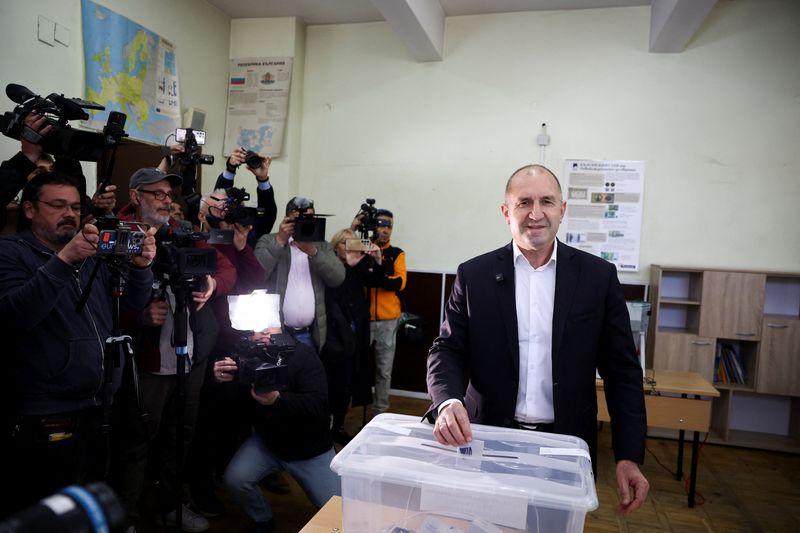
SOFIA, April 19 (Reuters) – Pro-Russian former President Rumen Radev is set for a runaway victory in Bulgaria’s election, exit polls showed on Sunday, after promising to end a spiral of weak, short-lived governments, although he will need coalition partners to form a majority in parliament.

Radev, a eurosceptic and former fighter pilot who opposes military support for Ukraine’s war effort against Moscow, stepped down from the presidency in January to run in the parliamentary election, which comes after mass protests forced out the previous government in December.
He rode a wave of frustration with political instability in the Balkan country of 6.5 million people, which has seen eight elections in five years and where voters are sick of corruption and veteran parties that have dominated politics for decades.
The final exit poll conducted by Sofia-based Alpha Research showed Radev’s Progressive Bulgaria with 38.1%, more than double the second-place GERB party, led by former Prime Minister Boyko Borissov, which got 15.9%. The exact percentages of other exit polls varied, but still showed a strong Radev win.
If confirmed, the outcome would mark one of the strongest results by a single party in years.
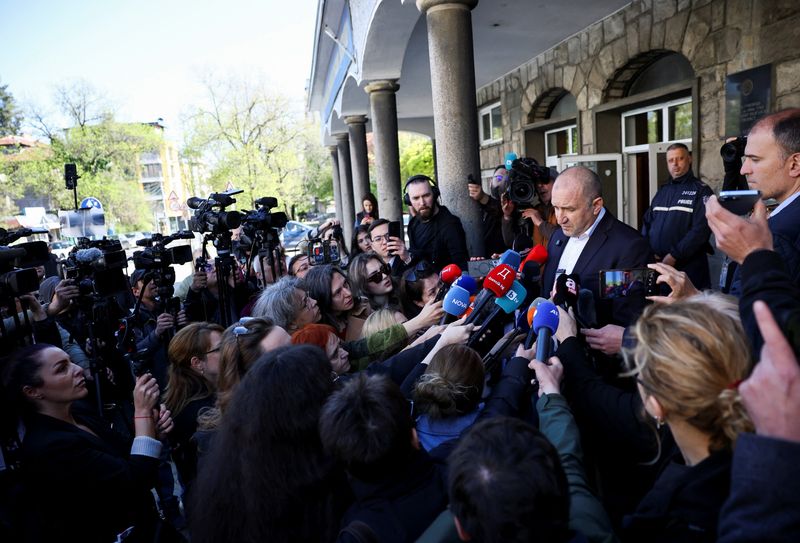
“We will do everything possible not to allow us to go (to elections) again. It is ruinous for Bulgaria,” Radev told reporters in brief comments after the exit polls were released.
He said that he would be willing to work with the pro-European reformist We Continue the Change-Democratic Bulgaria (PP-DB) coalition, which came third in the Alpha Research exit polls with 14.1%, on judicial reform, but said that a minority government was also an option in the 240-seat parliament.
“We are ready to consider different options so that Bulgaria can have a regular and stable government,” he said.
Final election results are expected on Monday.
RADEV MAY HAVE TO COMPROMISE
In his campaign, Radev talked about improving relations with Moscow and resuming the free flow of Russian oil and gas into Europe.
It is not clear how much that will impact the foreign policy of Bulgaria, a NATO and the European Union member which joined the euro zone in January — a move Radev has criticised.
Either way, a polished social media campaign, deep coffers and a pledge of stability boosted support for Radev, and his participation increased voter interest. Alpha Research put turnout at 47% with one hour of voting to go, up from the 39% total in the last election in October 2024.
Borissov appeared to concede in a post on Facebook, but added a note of caution: “To win the elections is one thing; to govern is quite another. Elections decide who comes first, but negotiations will decide who governs.”
WINNER WILL HAVE WORK TO DO
Bulgaria has developed rapidly since the fall of communism in 1989 and joined the European Union in 2007. Life expectancy has risen sharply, unemployment is the lowest in the EU, and the economy has greater safeguards since joining the euro zone in January.
But it lags behind other EU countries in many metrics, and graft remains endemic, including in elections, where vote-buying is rife.
The cost of living has become a particular issue since Bulgaria adopted the euro. The previous government fell amid protests against a new budget proposing tax increases and higher social security contributions.
Some voiced optimism after the vote.
“There is now an opportunity for the things people have been hoping to see change to actually become visible,” said Evelina Koleva, a manager at digital marketing company. “Now, in the near future, with this choice.”
(Writing by Edward McAllister; Additional reporting by Ivana Sekularac; Editing by Mark Potter, Jacqueline Wong, Christina Fincher and Ethan Smith)