Whiteford Township — Lexi Shepherd was in the shower when her well went dry.
The pressure had been low for a month. One day in December, the water was gone. For the next three months, Shepherd and her husband bought jugs of water for drinking and cooking, took laundry to relatives’ homes and could do only a handful of dishes at a time before the tap gave out for the rest of the day.

“The pipes will just make a really loud screeching noise, and then there’s no water,” said Shepherd, who lives in Bedford Township near its border with Whiteford Township. “You turn the faucets, and nothing comes out after that.”
Shepherd and her husband are among at least 60 homeowners whose wells have recently gone dry in Whiteford Township and neighboring communities in southern Monroe County, an area prone to sinkholes and groundwater contamination because it sits on a unique underground geologic formation called karst.
Dozens of homeowners in the area have had to drill their wells deeper or drill new wells altogether. Some, including Shepherd, have shelled out thousands of dollars to connect to a municipal water system. David Kubiske, an engineer and founder of the Dundee firm David Arthur Consultants, said Monroe County well drillers are a month behind schedule because of the glut of dry wells.
Whiteford Township leaders hired David Arthur Consultants to investigate what is causing wells to go dry. There are a few possibilities, Kubiske said, such as dry weather, demand from household wells, high-capacity pumps irrigating farms and golf courses, or pumping done to remove water from area stone quarries or to serve the township’s municipal water customers.
Whiteford Township gave Kubiske a list of nearly 60 Whiteford residences where homeowners said they have had to deepen their wells or drill new ones in recent years. Kubiske said there are additional reports of dry wells in Ida and Summerfield townships that aren’t included on the list. This is the heaviest wave of dry wells Kubiske has seen in his career.
“It’s our hope this study will give us a better picture of what’s going on with our wells,” Whiteford Township Supervisor Jeff Thomas said. “Is there a cause for it? Are there a series of causes for it? What can we as a township do to help address that situation?”
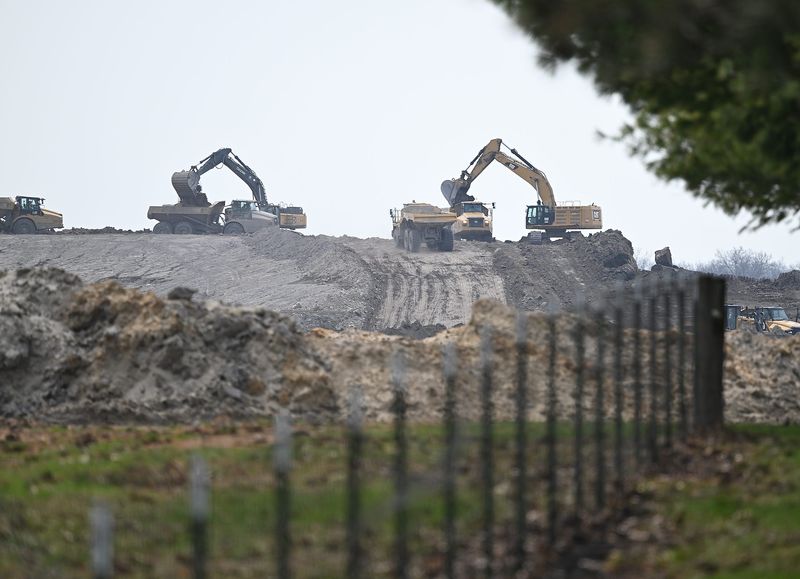
Many residents said they believe a nearby limestone quarry is to blame. But because of a carve-out in Michigan’s groundwater dispute resolution rules, they have few options for fighting back against the industry.
“When (people) drive by the gravel pit, they see these strong pumps pumping all this water into the ditch,” said John Chandler, a former Summerfield Township supervisor whose well went dry in early December. “They think to themselves: ‘Wow, that’s my water going to the lake.’
“My question is, who’s going to pay for this?”
To understand what’s causing wells to go dry, Kubiske and engineers are reviewing the information provided to the state of Michigan when homeowners first drilled their wells. Well drillers have to report the location of wells and the depth of the water table, and Kubiske said he can source records back to the 1970s.
By comparing those historic water levels with current levels in the same wells, the engineers can see where the water level has changed. They plan to continue checking those levels over time for as long as the township wants to continue the study, Kubiske said. They will also measure the water levels at homeowners’ wells when the Stoneco quarry, golf courses and farms turn on their big pumps to determine whether the pumping impacts homeowners’ well water levels.
“We want to see the whole picture,” Thomas said. “That will help us take care of the immediate issues right now as we can, and also try to help so we don’t have these issues in the future, or at least decrease them as much as we can.”
Whiteford Township’s history of water problems
Whiteford Township’s water woes date back decades, former township Supervisor Walter Ruhl said. Some homes have relatively shallow wells at depths as low as 60 feet, he said. Shallow wells are likely to run dry, while the area’s deeper caches of water can contain hydrogen sulfide that requires extensive filtration. Ruhl spends $300 each month on filters and salts to make his well water usable.
“Anybody that says we’ve got good water in Whiteford Township is basically uneducated,” he said.
The karst geology below this portion of Monroe County makes the water’s underground movements unpredictable. Unlike much of the state, where communities sit on deep layers of sand or clay soils, a strip of Monroe County is essentially sitting on bedrock made of limestone.
That limestone looks like Swiss cheese. Water moves through it easily and fast. That’s bad for water quality. Pollutants from farm runoff, a gasoline spill or a leaking septic system are likely to move into a nearby well.
The township built a municipal water system in 2015 and serves a portion of the township near the unincorporated community of Ottawa Lake. The wells for that system are 300 feet below ground, but the Michigan Department of Environment, Great Lakes and Energy still considers it “under the influence of surface water,” Ruhl said, meaning the township has to treat its water as if it came straight from Lake Erie.
The township is in a region surrounding Toledo, Ohio, that was once the Great Black Swamp. Farmers and developers drained the wetland with tiles, funneling water into a series of drains and rivers to move water into Lake Erie.
Ruhl suspects tile drainage, population growth, years of dry weather and intensive farming practices that require more irrigation are behind the recent spate of dry wells. That’s what the township’s report will find, he predicted.
“When you increase population, and more people are sucking on the straw, that’s taking the water out of the ground,” Ruhl said. “You’re going to run out of water at some levels. And in this area, the deeper you go, the worse water you get generally.”
Stoneco quarry says a variety of factors cause dry wells
Rodney Baker lives in Whiteford Township, about 1.5 miles from Stoneco’s Ottawa Lake quarry. His well went dry in November when the water level dropped beneath his well pump.
Baker called Stoneco, since the company had paid to drill new wells for some of his neighbors on Whiteford Road who live closer to the quarry. They sent a contractor to check on his well, he said, and later told him they wouldn’t replace it.
Stoneco told Baker his problem was caused by drought, Baker said. He spent $6,600 drilling his well to 162 feet deep and moving his pump down from 77 to 95 feet.
“With people across the street from me, you determine the cause for their wells to go dry is what Stoneco has been doing,” Baker said. “You walk across the street, and the reason my well went dry was because of drought.”
Stoneco spokesman Scott Bolthouse emailed a statement in response to an interview request from The Detroit News. In it, he said Stoneco continuously monitors groundwater conditions at the quarry and investigates residents’ concerns when they report well water problems to the company.
“If our operations are found to impact a well, our policy is to provide the homeowner with a replacement well or an alternative water source,” Bolthouse said. “While water levels can be impacted by a variety of factors, in 2025, Stoneco assisted over 60 residents experiencing well issues.”
Bolthouse did not answer questions about how Stoneco determines whose wells it will replace.
Whatever calculus Stoneco uses to decide which residents to help is a sticking point for many of the people whose requests were rejected, said Lindsay Daschner, owner of fresh-cut flower farm Forget Me Not Farms in Whiteford Township.
“As you can imagine, water is the cornerstone to the foundational success of any crop,” Daschner said. “We ran out of water in one of our wells. It was a really scary, unnerving experience.”
The water level in the farm’s well dropped more than 20 feet between May 2025 and February. Daschner had the pump moved lower and will have to drill her well deeper if the water level drops again. The well driller she hired to move the pump blamed Stoneco for her water troubles, Daschner said.
Stoneco initially told Daschner her business was outside of the company’s groundwater zone of influence. After she was interviewed by the Toledo Blade, a Stoneco official returned and said the firm would help her if she had future water issues.
“They’re picking and choosing who they’re helping,” Daschner said. “This is a community-wide crisis, and it’s wrong. They need to make people whole and realistically assess the impact they’re having.”
Grassroots coalition forms to fight quarry firm
Daschner, Chandler, Shepherd and others have formed a grassroots group called the Karst Aquifer Coalition of Monroe County. They aim to protect the area’s groundwater resources and are surveying residents to learn more about the problems they are experiencing with their wells.
The coalition members have Stoneco’s Ottawa Lake quarry in their sights.
“One of the biggest things I hear from people is ‘how come they have millions of gallons of water they can pump, and I don’t have any?'” said Chandler, whose 80-feet-deep well went dry in December.
He lives about eight miles from the quarry and said Stoneco denied responsibility for his water loss. He is on a waiting list to get his well drilled 40 feet deeper.
Stoneco has applied for a permit to expand its Ottawa Lake mining operations to mine another 23,901 cubic yards of material. It is seeking a permit from EGLE that would allow the company to remove 7.41 acres of wetland for the expansion. It would replace some of the wetlands at a different site and buy some wetland credits in exchange.
“If Stoneco is awarded this full permit to expand their operations even closer to my farm…, the threat is even going to be more critical,” Daschner said.
Jerry Massey, who lives across the street from the quarry, said he’s more concerned about contamination than water quantity. He suspects the quarry’s high-capacity pumps draw water toward his home well, which is good for water levels but could be bad if it draws pollutants toward his home.
The mine’s expansion would involve razing existing wetlands and replacing them elsewhere. That could mean water runs into the ground, including contaminated water, even faster, Massey said.
After more than 31,000 gallons of diesel spilled from a gas station along U.S. 23 in Whiteford Township in April 2024, Massey was ordered not to drink or bathe in his home’s water for two weeks as health officials searched for the extent of the pollution’s spread in the sinkhole-prone area.
“I would hate to see how everyone would scramble if that were to happen again,” he said.
Property owners left with limited options
Any private well that draws more than 100,000 gallons per day must register with the Michigan Department of Environment, Great Lakes and Energy. Since it was developed in 2008, new applicants must use a computer program to show their proposed water withdrawal isn’t likely to affect surface water or neighbors’ wells.
Some mines, including Stoneco’s Ottawa Lake quarry, predate that program and are allowed to continue using the amount of water they were permitted to use at their start. The quarry is allowed to pump a maximum of 8.8 billion gallons of water per year, confirmed Jim Milne, supervisor of EGLE’s Water Use Assessment Unit.
The quarry hasn’t approached its maximum pumping capacity since at least 2011, according to a review of EGLE data. Its annual water use has ranged from 955,437,000 gallons in 2012 to 1.86 billion gallons in 2024, according to the facility’s water use reports from 2011-25.
Mines use dewatering wells to dry the underground pits where they want to extract something like limestone or copper, said Lena Pappas, who manages EGLE’s Groundwater and Geological Services Section.
Mines’ dewatering wells are exempt from the state law that sets up a dispute resolution process for groundwater wells, Part 317 of the Natural Resources and Environmental Protection Act. If someone suspects a farm’s irrigation well is causing their home’s well to go dry, EGLE is able to evaluate and help resolve the problem, Pappas said.
“That’s pretty much off the table for those wells that are dewatering (for mining),” she said.
People instead can file a civil lawsuit, Pappas said.
Other Michigan communities have turned to the courts. Ann Arbor Charter Township sued Mid-Michigan Materials LLC in Washtenaw County Circuit Court in 2023 after residents’ wells went dry near the company’s Vella Pit. The parties are negotiating a settlement agreement.
ckthompson@detroitnews.com
This article originally appeared on The Detroit News: Wells are going dry in southern Monroe County. But why?
Reporting by Carol Thompson, The Detroit News / The Detroit News
USA TODAY Network via Reuters Connect