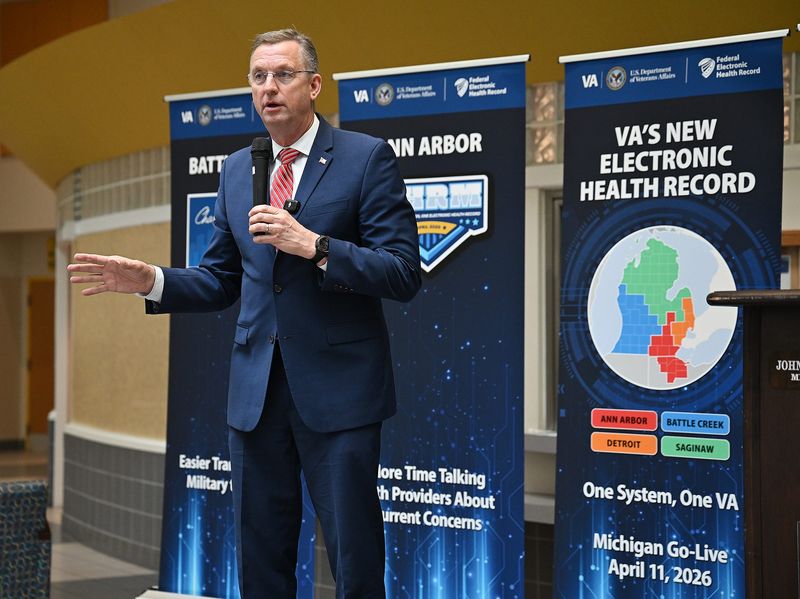
Detroit — About three years after pausing rollouts of its troubled new electronic health record system, the Department of Veterans Affairs is going live with it Saturday at four Michigan sites: Ann Arbor, Detroit, Battle Creek and Saginaw.
VA Secretary Doug Collins led a ceremony celebrating the new rollout Friday at the John D. Dingell VA Medical Center in Detroit, marking the transition to what promises to be a possibly risky change for VA medical centers.

The goal is to create a single electronic record shared by the VA and the Pentagon, with the plan of having the system running at all 170 VA hospitals by the end of 2031. VA Deputy Secretary Paul Lawrence said during a news conference Friday that the agency plans to roll out the system at 13 sites in 2026 and 26 next year, anticipating a pace of about 28 to 30 sites each year after that.
“But already, folks in the VA system are knowing how well this is going to go. They’re asking to be moved up,” Lawrence said.
Collins said the department has traditionally been too risk-averse and resistant to change at the expense of veterans’ care, and the inefficiencies of the old system cost the VA hundreds of millions of dollars each year.
“I don’t care what part of this hospital you’re in, or any part of our VA system,” he said. “If you don’t have a veteran taking advantage of the benefits they’ve earned when they raise their right hand, we don’t have a job.”
Collins and other agency officials have touted improvements to the system, updated contracts to better hold the vendor, Oracle Health, accountable, as well as putting in place a better process to address problems with the software. The VA has said the electronic health records system is “more reliable than ever.”
“Both (Rep.) Tom Barrett and I have been part of meetings, asking questions and staying close to staff. It shows you how important this is to the VA that the secretary is coming in himself and his deputy,” said Rep. Debbie Dingell, an Ann Arbor Democrat whose district includes the Ann Arbor VA hospital.
“And we’re all going to stay close to ensure that this is a smooth transition. This needs to be a win for the VA patients.”
As recently as December, lawmakers of both parties said they were worried about the new rollouts on an accelerated schedule in 2026, given the system has been blamed for patient safety risks, productivity loss, usability challenges, delays in care and issues with medication management at the half dozen sites where it was introduced before the department nearly three years ago paused further rollouts to address dangerous problems.
They pointed to findings last year by two government watchdogs, the Government Accountability Office and the VA’s Office of the Inspector General. The latter found the new records system caused a patient scheduling issue that played a role in the 2022 death of a veteran after the VA hospital in Columbus, Ohio, failed to follow up with the veteran to reschedule a missed appointment.
The GAO, in a March 2025 report, said 58% of the system’s users believed it increased patient safety risks, and only 13% believed it made the VA as efficient as possible.
Collins said Friday that the inspector general will continue to monitor how the electronic records system is functioning, as before.
“Our IG office is a wonderful group that helps us do better in what we do,” he said.
An investigation published by The Spokesman-Review and Washington Post in December found that the electronic health record system remains plagued by problems that interfere with patient care at the facilities where it’s in use in Washington, Idaho, Oregon, Montana and Ohio.
That report found the system had a role in more than 4,600 cases of patient harm, including six deaths, at those facilities as of Aug. 1, according to VA data obtained through a records request.
Back in early 2023, the VA delayed planned rollouts at several Michigan VA hospitals including a July 2023 transition at the Ann Arbor Healthcare System, in part over considerations for how it would interact with Ann Arbor’s medical research mission.
Lawrence acknowledged that launch delays have impacted patients’ trust in the system.
“Experiences like that do not disappear. They stay with people. They shape expectations and they create skepticism, not the kind you can talk your way out of, and that’s understandable and earned,” he said.
In April of 2023, then-VA Secretary Denis McDonough paused all deployments of the new system nationally as part of a larger program “reset.” At the time, all trainings and activity related to the electronic health record system developed by Oracle Cerner were halted in Michigan.
The overhaul of the health records system was launched by President Donald Trump during his first term in 2017. It was supposed to take 10 years and cost about $16 billion to implement, according to the Military Times.
Barrett, a freshman Congressman from Charlotte, Michigan who serves on the Veterans Affairs Committee, said the state is an ideal market for unveiling the new system because its hospitals cover many kinds of practice groups the VA does, such as intensive research and multi-trauma.
“They each have a little specialty, but they all work hand in glove together with one another,” he said.
Barrett said he discovered VA hospitals haven’t necessarily been able to exchange records with each other easily when his father-in-law, who lives in Tulsa, Oklahoma, sought a new insulin sensor from the center in Battle Creek when he visited Barrett in Michigan for Christmas.
“Having a modern system, having the ability to cross-collaborate, will allow veterans to get the care that they deserve … and the care that will put them front and center, while allowing us to be seamlessly in the background,” he said.
mburke@detroitnews.com
Are you impacted by the VA’s new electronic medical record system? Please contact reporter Melissa Burke at mburke@detroitnews.com or leave a message at (202) 657-7644.
This article originally appeared on The Detroit News: VA to roll out long-delayed electronic health records system in Michigan
Reporting by Melissa Nann Burke and Julia Cardi, The Detroit News / The Detroit News
USA TODAY Network via Reuters Connect