Leisa and Kent Walker sped home as soon as they got the call.
They pulled up to their new Ottumwa home right as the fire department came careening down the drive, sirens wailing.

Standing outside was their 11-year-old son, Sam, and his caregiver — blackened from head to toe in soot.
First, it was relief that washed over Leisa and Kent. Then fear.
“You’re just shaking because you realize how close a call it was,” Leisa said.
Sam, who has severe autism, is also deaf and legally blind. He had stolen away from his room after bedtime and slipped into the basement kitchenette, where he accidentally started a fire by twisting knobs on the stove, not knowing the heat could ignite with the unpacked moving box sitting on the counter.
Sam’s caregiver heard the newly installed fire alarms and found smoke billowing up the basement steps.
She ran downstairs to find him sitting apart from the flames, watching gleefully as the bright, twisting tongues of fire danced across the room.
“She literally had to pull him up that staircase while he was kicking and scratching and hitting her,” Leisa said. “He wanted to stay and watch.”
Sam’s caregiver would later earn an award from the fire department for pulling him to safety.
It’s just one of many instances over Sam’s now-35 years that he’s posed a danger to himself or others. And at 11 years old, the Walkers were still discovering all the ways things could go wrong and the degree to which they must remain vigilant over his actions.
As a child, Sam would run away from home and from school, evading his caregivers. As an adult, he hits and lashes out at those who upset him.
He does not speak and uses basic sign language to communicate. He requires 24-7 supervision.
Over the years, the Walkers have found a fragile equilibrium through a combination of their own personal dedication and help from Medicaid services to keep Sam safe and healthy.
Despite all the challenges they face, the Walkers have created what they believe is a good life for Sam.
Today, Sam lives with his parents in his own basement apartment, secured with extra alarms and cameras to keep him safe. He has a steady caregiver who has worked with him for more than two decades and knows his triggers.
With the help of a caregiver, Sam volunteers at Goodwill daily and at the Iowa Food Bank twice a week. He goes to McDonald’s on Mondays, Subway on Wednesdays and Culver’s on Fridays. He lives for French fries and Diet Dr. Pepper. He takes walks through local parks and the recreation center where neighbors wave to him as they cross paths.
Any deviation to Sam’s schedule is triggering, so the structure and the routine soothe him.
It’s what the Walkers once heard described as “an enviable life” for someone like Sam — one that, at the time, felt heartbreakingly unobtainable.
And yet, here they were. Finally at a place of stability and relative peace.
But that all changed just before last Thanksgiving when the Walkers got word that Iowa Total Care, the private company managing Sam’s Medicaid services, was cutting nearly in half the amount it previously covered — a move that risks upending the fragile ecosystem they worked so hard to build.
“I was just absolutely devastated,” Leisa said. “I couldn’t think. I couldn’t formulate words to my case manager when she called me, because I knew what this meant. I knew what this meant for our son. I knew what this meant for our family.”
If the Walkers can’t get the company’s decision reversed, they’re looking at putting Sam into a residential facility — an outcome they’ve long avoided and one they say would cost the state more than twice as much as his in-home care of around $8,000 a month.
But they’re not alone. The Walkers say they’re among numerous Iowa families fighting to retain critical services for their loved ones on Medicaid.
Medicaid, which provides medical care for low-income and disabled Americans, is jointly financed by state and federal governments. In many states, the program is run by the state government. But in Iowa, former Republican Gov. Terry Branstad privatized the system beginning in 2016, contracting with for-profit companies like Iowa Total Care to manage portions of the program in an effort to both reduce quickly rising costs and improve quality of care.
Now, 10 years later, Iowa’s Medicaid program continues to face budget pressures that are only expected to intensify as surges in pandemic-era funding wane and provisions of President Donald Trump’s “One Big Beautiful Bill” begin taking effect.
That law is expected to reduce federal Medicaid spending by about $911 billion over the next decade, according to KFF, an independent source for health policy research, polling and journalism. According to a KFF analysis, Iowa could see between $7 billion and $12 billion in reduced federal Medicaid funding during that time.
It’s not clear to the Walkers whether the decision to cut their son’s services is related to that broader financial outlook. But they believe it will be families like theirs — people like Sam — who ultimately bear the brunt of a system that advocates say lacks adequate resources.
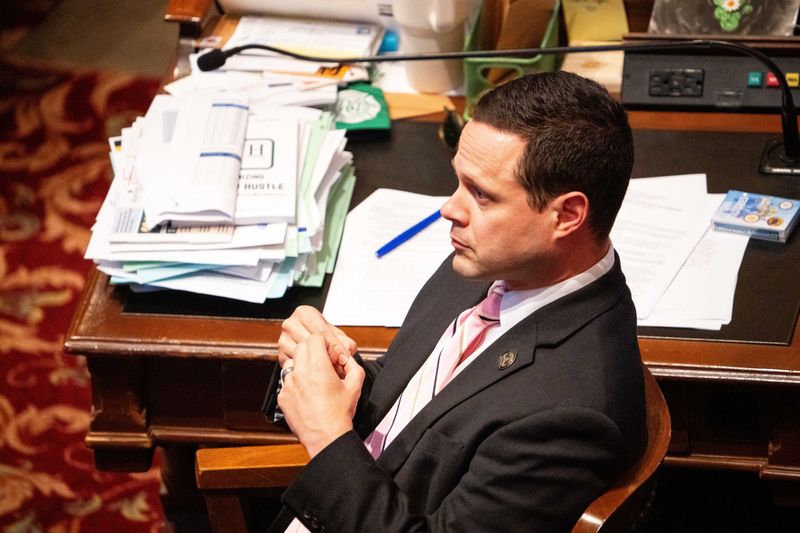
Democratic state Sen. Matt Blake, an attorney representing the Walkers as they appeal the company’s decision to cut their services, said Iowans are already struggling to navigate a strained system.
He and others worry about what’s on the horizon for families like the Walkers who rely on costly long-term care as state budget pressures intensify and as policymakers look for ways to cover the shortfalls.
“They are a fraction of the population, but they are an incredibly large part of the budget because of the intensive, often 24‑hour level of services they need,” Blake said. “And if Medicaid budgets continue to strain, both from federal funding and from state funding, these are the vulnerable populations that are going to be some of the first that are likely turned to because of the high cost.”
Representatives from Iowa’s Health and Human Services Department did not return the Des Moines Register’s multiple requests for comment. Iowa Total Care also did not respond to a request for comment.
In February, however, an HHS policy specialist said on a Zoom town hall with families that there has been “a lot of fearmongering” and “misinformation” about cuts in care.
‘Skill building’ versus ‘supervision’
Leisa Walker and other Iowa families who regularly navigate the state’s managed care program have, by necessity, become well-versed in the language and terminology of Medicaid.
Exception-to-policy. Community Choices Option. Supported Community Living. Unit-based versus day-rate reimbursement options. Iowa Administrative Code section 441-78.41 (249A).
It’s a tangled web of jargon and bureaucracy, programs and administrative codes.
But at the heart of it all lies the wellbeing of some of Iowa’s most vulnerable citizens. And the interpretation of a single line of state code can determine whether those loved ones can remain in their homes.
In the Walkers’ case, the debate is over whether the Supported Community Living services he receives through Medicaid are intended to pay for his supervision.
Iowa Total Care says they are not.
In its denial, the company wrote that Sam’s care should only include “limited supervision” and should primarily be focused on addressing his goals — things his family has helped identify, such as accessing his community, maintaining his health and reducing emotional outbursts by using coping skills.
It cited time spent “providing supervision to prevent behaviors,” visiting relatives and watching videos as examples of supervision that violated the rules.
The Walkers, their attorney, an administrative law judge and written guidance from the state issued in 2018 say supervision is a component of the care Sam receives and should be covered.
The Walkers say the line between skill-building and supervision is blurred for Medicaid recipients as disabled as Sam.
The family argued those points when they asked for an internal review of the initial denial and in a Feb. 2 hearing before an administrative law judge through the “state fair hearing” appeals process.
The judge who heard the case took particular issue with Iowa Total Care representatives’ testimony that it justified its decision to scale back the Walkers’ care, at least in part, on a “conversation” it had with unnamed officials at Iowa Health and Human Services. According to the judge’s decision, those representatives argued that the alleged conversation has the effect of law and could be used to help justify reducing Sam’s care.
The judge noted that any such conversation would contradict a 2018 clarification of policy document the department issued stating that supervision should be covered.
“Having Iowa Total Care under oath telling us that the reason they’re denying a certain level of care and a certain reimbursement level is because somebody in state government told them to — instead of having any publication or anything where public scrutiny or the Legislature or different groups have the ability to weigh in on it — is a massive overstep of authority by HHS,” Blake said.
That judge decided in the Walkers’ favor in a written Feb. 5 decision, but Iowa HHS has the authority to accept or reject the result. The Walkers have been waiting weeks to hear what HHS will do.
If it’s rejected, they could take the issue to district court.
While they wait, the Walkers are left in limbo.
They opted to continue receiving the full services they believe they’re entitled to while they appeal. If they’re unsuccessful, they’ll be required to reimburse Medicaid for those services. But if they don’t use the full number of service hours they’re requesting, they worry the company will use it as evidence that the care is not actually necessary.
“My assumption is that most people don’t do that, because that’s a big risk to take,” Leisa said. “And so I think they’re also banking on that a lot. And I was just mad and said, ‘No. Don’t take this away from me, and I’m going to prove to you that he needs these services.'”
‘A lot of what we’re seeing is the high-needs people being cut’
But the Walkers say they’re not the only ones facing service cuts based on this rationale.
The Walkers monitor a social media page for families navigating the state’s managed-care system, and they say they’ve seen numerous posts in recent months from Iowans dealing with the same issue they now face.
That’s one of the reasons they hired Blake, their lawyer, to help contest the cuts.
“We’d already heard the rumblings of what was going on,” Leisa said. “And we just felt like this was a bigger deal than just what our family was experiencing.”
They hope that, if they are successful, they can pave the way for other families who don’t have the time, the energy or the means to push back on their own. Kent is a dermatologist, and Leisa, who has not been able to work outside the home since Sam was born, has dedicated significant time to the family’s appeal.
Stacy Ring got a similar notice in January that Iowa Total Care was cutting back what it covers for her son, Alex Neal.
Alex is 20 years old, has autism and is nonverbal. He lives at home, where his mother quit her job in community based behavioral health services to serve as his primary caregiver. Stacy and her husband live in Council Bluffs and have four kids.
In its notice, Iowa Total Care said it was concerned that the family’s team of caregivers was spending too much time supervising him instead of practicing skill-building.
Ring said it said it planned to cut nearly in half the number of care hours it would cover for Alex, reducing his monthly budget from about $6,300 to about $3,000.
“He can’t respond to safety threats,” Ring said. “So, if there was a tornado warning, he wouldn’t automatically evacuate. If there was a fire, he probably wouldn’t automatically leave. He would probably actually try to put it out, which would be dangerous to him.”
“They’re calling that supervision,” Ring said. “We’re calling it safety monitoring.”
Ring appealed the decision to Iowa Total Care and was prepared to elevate the issue to a state fair hearing if she was denied. But she said she got a call from her son’s case manager in late March.
“Are you sitting down?” he asked her, before sharing the news that Iowa Total Care reversed its decision and would continue covering his full care. She said she believes it’s unusual to see a reversal like that.
But Ring said she’s not letting her guard down.
“I am under absolutely no deluded belief that this is over,” she said. “It may be over, possibly for this year for us, but it will probably come back again. … We’ll take the win for right now, but it’s probably just a battle and not the war.”
She, too, is involved in support networks for Iowa families in similar situations and said the denials for families like hers feel “more pervasive and more aggressive” in recent months.
Leah Price, an independent support broker who helps clients understand and manage their budgets through Medicaid, said she has seen members facing increased scrutiny and cuts to services over the last year.
Price, who works with about 220 Iowa families, said that during her first 16 years in the job, she only attended two appeals hearings, called “state fair hearings,” where families had elevated complaints about service cuts to an administrative law judge.
She has been to three during the last year alone.
“A lot of what we’re seeing is the high-needs people being cut,” she said.
And although she said some of the rational for cuts is changing, “the cuts are not stopping,” she said.
Price said she experienced her first panic attack last year as she takes on more and more clients who need help. She can’t walk away, she said, even though she suspects she could make better money at the Casey’s down the street.
“There’s so much red tape,” she said. “My focus is no longer on the members’ care. It’s on the rules, the laws and the policies and how we’re going to get around this so that they can get their care. There’s no talk about the care they need. There’s no talk about, ‘How are we going to meet their needs?’ There’s talk about, ‘What are we cutting?’”
Iowa HHS officials addressed the issue during a February town hall meeting over Zoom as more families raised concerns they were experiencing the same cuts as the Walkers and Ring.
“There’s been a lot of fearmongering out there about HHS reducing services, about saying that supervision is not a component of SCL, which is not the case … ,” LeAnn Moskowitz, a policy specialist with HHS, said on the call. “I just think people are doing the whole community a disservice by spreading this fear and misinformation.”
Those services should include supervision and support, she said, but “supervision and support cannot be the entirety of the service.”
But several people on the call pushed back.
“We are seeing cuts. Like, drastically, because of that,” one person said.
‘There’s already so much strain in the system’: Iowa Medicaid budget faces $90 million shortfall
The Walkers’ and other families’ claims come against the backdrop of a state grappling with major budget shortfalls in its Medicaid program.
State officials who make up Iowa’s Medicaid Forecasting Group estimated on March 12 that Iowa will have a $90.6 million Medicaid deficit in the current fiscal year ending June 30.
To cover the deficit, lawmakers passed a bill raising a one-time tax on health insurance providers, issuing a $89 million supplemental payment through the state’s general fund and tapping reserves through the Taxpayer Relief Fund. Gov. Kim Reynolds signed the tax hike into law March 26.
But officials expect those budget problems to persist, projecting that the deficit will rise to $167.6 million in fiscal year 2027.
Rep. Gary Mohr, R-Bettendorf, who chairs the House Appropriations Committee, said over the next five to seven years, he projects the state’s Medicaid deficit will reach about $600 million.
Republican House Speaker Pat Grassley, R-New Hartford, told reporters he expects the state will continue to face shortfalls, but Republican leaders will address them to prevent service cuts.
“We recognize we’re going to have these continued shortfalls,” he said. “We’ll have to make the decisions one year at a time to make sure we can fully fund them. All I can just say is our priority is making sure we are fully funding them, so we’re not having a reduction in service.”
Many factors are at play as Medicaid programs in Iowa and across the country adjust to a unique moment of transition, said Alice Burns, Associate Director of KFF’s Program on Medicaid and the Uninsured.
As COVID-19 pandemic-era surges in federal funding are phasing out, provisions of Trump’s signature “One Big Beautiful Bill” will begin phasing in.
That legislation authorized about $900 billion in spending reductions through the Medicaid program and will put additional financial pressure on state budgets.
“If you take a step back and think about the reconciliation law, it means a historic reduction in federal support for health care,” Burns said.
Historically, when states have needed to shore up their Medicaid budgets, they could levy provider taxes on groups such as hospitals.
But Congress didn’t just authorize cuts through the “One Big Beautiful Bill.” It also limited states’ abilities to raise taxes on health care providers to make up the difference.
That’s why Iowa lawmakers rushed to approve a retroactive tax on health insurance providers in the state before the “One Big Beautiful Bill” makes that type of tax increase impossible going forward.
“Basically, that tool is just not available right now to states,” Burns said.
She said other states have begun looking at alternative means of balancing the books.
“Some states have talked about establishing new sales taxes,” she said. “We’ve heard about a state or two talking about whether they could create a new fee on employers that have a lot of employees enrolled in Medicaid. ”
The flip side of raising revenue, she said, is making spending cuts.
Burns said it’s probably too early for states to already be feeling the direct financial impact of the “One Big Beautiful Bill” on their Medicaid budgets. She said it’s “premature” to say whether the service cuts families like the Walkers are seeing are a result of the mounting financial pressures facing Medicaid.
But she said it’s worth thinking about families like the Walkers and the future of Medicaid for vulnerable Americans.
“I think one of the things we’ve been thinking a lot about is, there are these major pressures coming from new cuts to Medicaid,” she said. “And how are those going to be layered on a situation where there’s already so much strain in the system?”
Faced with a burdensome appeals process, families don’t always have options
Ring, 55, worries about what could happen to Alex if she’s someday unable to be there, and that fear drives some of her advocacy.
“My point in fighting for all of these services is not that as his mother, I can’t do these things, or I will ever let his needs go unmet,” Ring said. “But if I die today, his needs are the same.”
The Walkers, in their 60s, don’t know how much more they can give to Sam’s care.
“It doesn’t feel like we can,” Leisa said.
They’ve already signed a release to allow Sam’s case manager to start looking at options for residential placement, which will cost the state much more. They don’t feel they have any other options.
“We want that sense of community for him, and he’s entitled to that,” Leisa said. “And that’s part of what the waiver programs were established for, to keep individuals like Sam in their communities and out of institutional-type residential places. But when they start taking away what already works, what else do we do?”
Sam’s total monthly budget, which is set by Iowa Total Care and paid by Medicaid, is about $8,400. The residential facilities his family has looked at cost around $20,000 a month and would also be paid by Medicaid.
“I think they’re just banking on, ‘we’ll just take the services away and you won’t do it,’” Leisa said. “You know, you won’t go ahead and look for residential replacement. Because that’s the thing that makes no sense to us.”
They’re not sure any facility in Iowa would take Sam. And even if they do, they don’t expect Sam would last long there. He often hits people, and residential facilities can expel residents for violent behavior.
“It’s just a horrible situation to be put in,” Leisa said. “When you had something that was working — not only was it working for us, but it was working for Sam. He’s safe, he’s well cared for, he has a sense of community. We have people who know him and love him, who help take care of him. He’s got the structure and support that is essential for him to keep his behaviors under control.
“I mean, I can’t even wrap my head around the fact how we would transition him to some other setting. But then I also can’t wrap my head around kind of being stuck as a prisoner in our home either. So it’s just a situation we don’t want to have to be put in, but we are.”
She thinks back to that night of the fire 24 years ago with emergency sirens wailing and Sam covered in soot.
For her, it’s emblematic of just how much care and attention Sam needs — will always need — to remain safe.
“He hasn’t changed,” she said. “He could easily do it again.”
But it’s also representative of how much they’ve learned and how far they’ve come. With the right support, it is possible for Sam to remain in his home and be a recognized member of his community. It’s possible for him to live an enviable life.
It’s a dignity, Leisa says, that he deserves.
Brianne Pfannenstiel is the chief politics reporter for the Des Moines Register. She writes about public policy, campaigns, elections and the Iowa Caucuses. Reach her at bpfann@dmreg.com or 515-284-8244. Follow her on X at @brianneDMR.
This article originally appeared on Des Moines Register: Families worry their fragile peace could be at risk with Medicaid cuts
Reporting by Brianne Pfannenstiel, Des Moines Register / Des Moines Register
USA TODAY Network via Reuters Connect