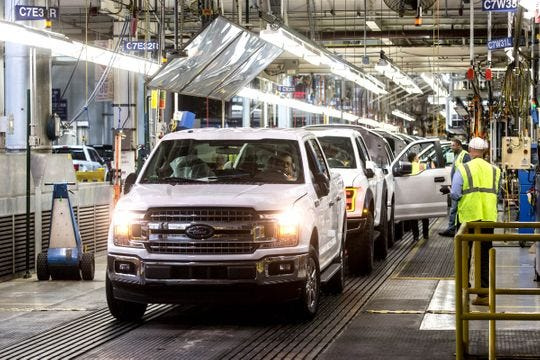
Ford Motor’s most popular selling vehicle, the F-150 pickup, is in short supply despite the automaker adding a shift at its Dearborn Truck Plant to make up for last fall’s lost production after a fire at a key aluminum supplier created a shortage of the metal used in the body of the truck.
The tight inventory could mean car buyers might pay more for an new F-150.

That’s because the Dearborn-based automaker is using what aluminum it can obtain to build more of the profitable high-end trims of the F-150, which have an average list price of about $87,000, said David Greene, principal of Marketplace and Industry Analytics at www.cars.com. Ford is building fewer entry-level F-150s, which have an average list price on Cars.com of about $52,000, Greene said.
Greene said making more of the pricier trims rather than base models is a strategy automakers deployed in 2021 when the COVID-19 pandemic disrupted the supply chain, causing a shortage of semiconductor chips, which carmakers use in vehicle electronics.
“That’s definitely going back to chip shortage strategies, and it’s also probably helping offset, if they’re absorbing tariff costs, on that aluminum,” Greene said, referring to the 50% tariff President Donald Trump put on imported aluminum last year.
To offset higher costs, Ford also is increasing the delivery fees on the vehicles, Greene said, even as it lowered the manufacturer’s suggested retail price on some 2026 F-150s. The delivery fee is a nonnegotiable charge set by the car company that covers the manufacturer’s cost to transport the vehicle from the factory to the dealership.
Ford spokesman Said Deep said of the delivery fees: “These charges … are reviewed and adjusted as necessary to keep consistent with the industry. We average the charge so no matter where a customer lives in America, the destination and delivery is the same.”
Meanwhile, the war in Iran is not helping automakers because it’s disrupting the global supply of aluminum, causing price volatility and making it more competitive to get. But Ford’s leadership said it is working with its aluminum supplier Novelis to get it back online — though it could be later this year before F-150 inventory stabilizes.
Ford’s ‘big problem’
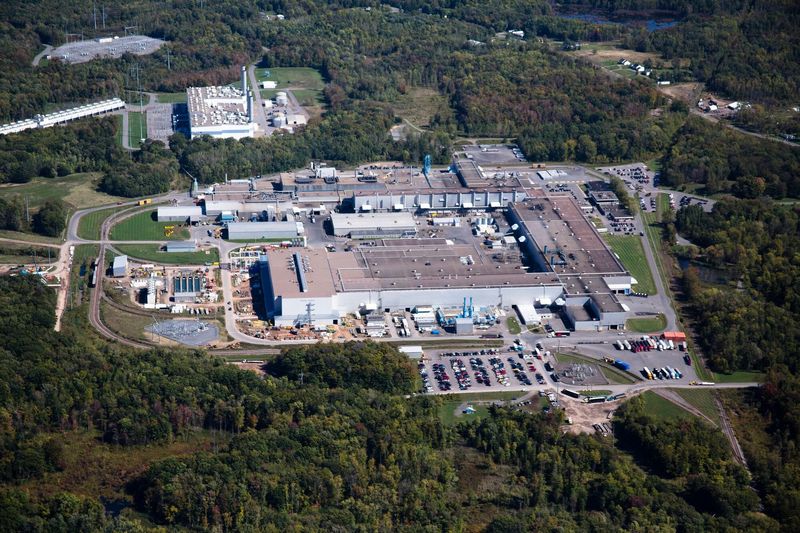
In October, after the first of two fires at the Novelis aluminum factory in Oswego, New York, took much of the factory down, Ford was forced to halt production of the all-electric F-150 Lightning pickup, which was made at the Rouge Electric Vehicle Center in Dearborn. It also had to pause production of Ford Expedition and Lincoln Navigator large SUVs made at the Kentucky Truck plant in Louisville.
Novelis was Ford’s main supplier of aluminum, which Ford uses in the bodies of its pickups and SUVs. Soon, the shortage of aluminum caused the automaker to see disrupted production to its profitable F-150 gasoline pickups, built at its Dearborn Truck Plant and Kansas City Assembly Plant in Claycomo, Missouri.
Ford leaders reassured Wall Street at the time that it would make up the lost F-150 production early this year by adding a third shift at Dearborn Truck Plant to build an extra 50,000 trucks in 2026.
Novelis spokesperson Julie Groover told the Free Press on March 24 that the aluminum maker expects to have the factory operational again by the end of June, though Ford’s chief operating officer indicated full inventory recovery might occur further into the second half.
In the meantime, according to Cars.com data, F-150 supply at dealerships was down 34% in February compared with the year-ago period.
“That’s a big problem for Ford, especially since, my understanding is, there’s, give or take, 700 pounds of aluminum on every F-150,” Greene said. “They’ve got to get it from somewhere, and, if their primary supplier can’t supply them, where’s it going to come from?”
Ford’s costly solution
Ford leaders have said they started working with alternative aluminum suppliers last fall as they also worked with Novelis on getting the factory operational again.
Ford COO Kumar Galhotra said on March 18, during an interview with Bank of America’s autos analyst, that since the hot mill at Novelis is not functioning, but its cold mill is working, Ford has to procure “hot band material” to help with the aluminum production. Hot band is the coiled product made through a hot-rolling process that is then sent to cold mill for final production, making it harder.
“So literally when you see the rolls on 18-wheelers on the highway, that steel or aluminum, that’s the way the material is transported. We’re trying to get those hot band material from other Novelis sources and non-Novelis sources to the cold mill operation so that we can continue to keep running our plants,” Galhotra said. “There’s a lot of inefficient, high-premium freight cost happening to keep our factories running.”
Galhotra said those costs will go down when Novelis’ hot mill is operational later this year. Also, Ford is importing hot band and having to pay tariffs on the incoming aluminum — costs that should also be reduced later when Novelis is running again.
In its third-quarter earnings report in October, Ford said the shortage in aluminum and production disruptions from that first fire on Sept. 16 will cost Ford $1.5 billion to $2 billion over the next few months into 2026. Ford expected to mitigate at least $1 billion of that, putting the ultimate hit to its adjusted earnings before interest and taxes at about $1 billion or less.
Ford spokesman Deep told the Free Press on March 25, “Ford F-Series has been the bestselling truck in America for 49 years and through February remains the No. 1 truck. We have good inventory of F-150 and Super Duty for customers to choose from and we’re making up production as part of our Novelis recovery plan with more volume coming in the back half of the year.”
Production woes hurt loyalty
Since October, inventories of the entire F-Series line slid by 29%, and currently sit at the lowest level in two years, said Sam Fiorani, vice president of Global Vehicle Forecasting at AutoForecast Solutions. F-Series inventory at the start of March was 172,400 units, down from 241,300 in October, he said.
The war on Iran is not helping Ford, or any automakers for that matter, in their quest for aluminum.
“Inventory levels are still slipping, but at a very slow pace,” Fiorani said. “Interruption in the global supply of aluminum due to the war in the Middle East is disturbing the price of aluminum and causing manufacturers to search for alternative sources, increasing the strain on the market.”
Ivan Drury, director of Insights at Edmunds.com said, Ford’s lack of F-150 selection is prompting the historically loyal set of Blue Oval owners to start buying rival’s vehicles.
“Year-to-date 2026 loyalty (F-150 traded-in, F-150 bought) has dropped to 32.8% versus the previous 10 year average of 42.2%, with virtually all competitors benefiting from F-150’s production woes,” Drury told the Detroit Free Press.
The production issues are also driving a slow model-year sell-down, Drury said. As of March 23, 21% of F-150s for sale were 2025 model year, whereas all direct competitors are below 5% for their 2025 model year trucks.
“The lengthy sell-down times are especially problematic because more incentives are required to sell aging inventory and put the model up against its newer self for a comparison,” Drury said. “Since trucks are highly configurable, the last ones on the lot will most likely be the most obscure configurations and thus the most difficult to sell.”
Ford changes up pricing
According to Greene, who cites Cars.com’s data — which defines a car as being built when it lands at a dealership — for January and February this year, Ford has added 25% more of the fully loaded, highest trim F-150s to inventory and decreased production of base models by 19% compared with the year-ago period. Greene estimates Ford has built about 40,000 F-150s in the first two months.
The data also shows some other interesting Ford changes for 2026 model year. Greene said Ford cut the manufacturer’s suggested retail price on the highest trim levels by $2,300 to $5,280 depending on the model.
But because Ford upped its build of the higher trims it put into the overall inventory mix, the average advertised price on Cars.com, across the F-150 trims, increased 4.2% or $2,625 to $65,620 in February compared with the year earlier, he said.
Greene said Ford also increased its 2026 destination fee on all F-150s and Expeditions by $200 to $2,795. The heavy-duty F-250 and F-350 saw a $700 increase in destination fees to $2,795.
Ford leaders update aluminum recovery
Ford leaders are vague on the time frame for when the automaker will make up the 50,000 in F-150 production. On March 18, Galhotra pointed to the task of rebuilding an entire building, the equipment in it and a hot mill, all while bringing in aluminum from other locations to keep the system running as a “lumpy” process that makes it difficult to predict when Ford will be at the 50,000-unit mark.
“But the second half, once the mill comes online, we’ll be a lot more stable and we will have room to make up a vast majority of the lost units,” Galhotra said. “But it remains to be seen how fast. It’s not when the mill starts running; it’ll be how fast the mill can ramp up because there’s a ramp-up component to it.”
Ford builds more of other big sellers
Greene said Ford has started producing more of some other vehicles in its offering to offset the F-150 shortage.
“In particular, we were seeing 3.2% more Explorer inventory, they’ve also boosted inventory of the Maverick, the Mustang, the Bronco Sport and, based on their reported sales, it looks like they are selling more of all of those, as well as the Bronco,” Greene said. “It really looks like those are probably the vehicles that they’re pushing as an alternative.”
In February, Ford reported sales of the Bronco Sport jumped 12.4% to 11,273 sold compared with February 2025. Similarly, sales of the Bronco soared 28% to 12,553 sold, sales of the Explorer shot up 33.4% to 20,100, sales of the Maverick inched up 1.1% to 10,387 and sales of the Mustang rose 54,5% to 4,313 units sold.
While Edmunds data showed a ding to F-150 loyalty, Greene and Fiorani believe that many truck buyers would likely wait for Ford to build the pickup they want rather than shop a rival brand.
“Full-sized pickup buyers are among the most brand loyal, making it very difficult for Chevrolet or Ram to lure potential customers away from a Ford dealership,” Fiorani said. “It is more likely that buyers will purchase a vehicle from stock that isn’t exactly what they were looking for, electing to forego particular options, colors, or engine choices, and pay a little more than they planned.”
Still, Ford has at least a few more months of dealing with the fallout from the fire, Drury said, “but as we’ve seen in past years, Ford has always managed to sort out the issues and right the ship.”
Jamie L. LaReau is the senior autos writer for USA TODAY Co. who covers Ford Motor Co. for the Detroit Free Press. Contact Jamie at jlareau@freepress.com. Follow her on Twitter @jlareauan. To sign up for our autos newsletter. Become a subscriber.
This article originally appeared on Detroit Free Press: Ford’s top-selling F-150 is in short supply, driving up costs
Reporting by Jamie L. LaReau, Detroit Free Press / Detroit Free Press
USA TODAY Network via Reuters Connect