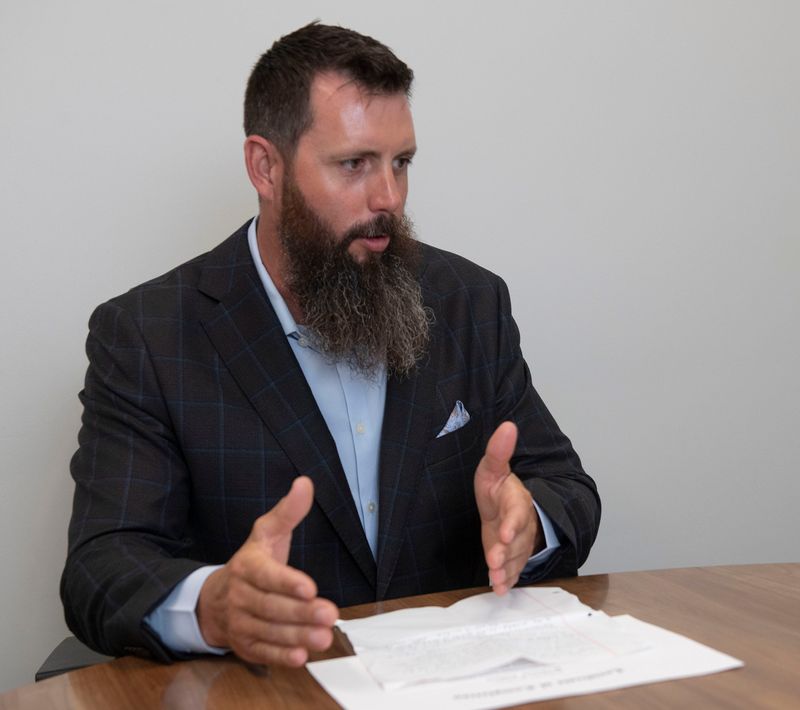
Robert Allen left his Cantonment home in 2005, at the age of 17, to join the Marine Corps.
His eight years of service included two tours in Afghanistan, where he served first as an ordinance technician and later as a machine gunner. He also worked as a water survival instructor and trained fellow soldiers in martial arts.

When he returned home, Allen’s wife left him and took the daughter he adored with her, refusing to allow him to see her.
“I thought I had everything figured out, that I knew what I wanted to do, then I went through a rough divorce,” he said. “The whole reason I got out of the military was my daughter and being in her life.”
Allen, who also found himself battling the legal system due to what he claims were trumped up domestic violence charges that were eventually dropped, turned to alcohol.
“I didn’t drink for long periods of time, but when I did drink I would over do it,” he said. “It was not the right thing to do, but when you feel like the courts are against you … .”
He would later be diagnosed with post traumatic stress disorder.
On a winter’s night in early 2025, Allen was pulled over in Milton and arrested for driving under the influence. It was a night that would forever change his life.
Three months after his arrest Allen entered the Veterans Treatment Court program in Santa Rosa County, and less than a full year later, on March 25, he and four other enrollees were honored with a brief graduation ceremony.
Leaving the Santa Rosa County Courthouse where the graduation was held, Allen said he felt as though he’d had a weight lifted from him.
“Life is so great now, and this program has really helped,” he said.
He said prior to his arrest “Alcoholics Anonymous was never on my radar.”
Veterans taking advantage of the treatment court get a heavy dose of AA. They are required to attend 90 meetings in 90 days during the first stage of the program and continue attending four days a week during its later stages.
Program enrollees are also required to work full time, put in 50 hours of community service, pay off mandatory court costs and receive counseling for things like substance abuse or anger management. Each veteran’s course through the program is tailored to offer the most benefit, Allen said. He was instructed to attend counseling and substance abuse courses once a month.
Graduates like Allen who successfully navigate the voluntary program can leave behind further entanglements with the legal system and avoid lengthy probations or even jail time. The DUI charge against Allen was dropped March 25 upon his graduation.
“In my opinion, it helps make a better, safer, stronger community,” he said of the program. “Going to (Mothers Against Drunk Driving meetings and seeing first hand what people have gone through, it’s education rather than punishment. You’re educating the offender, not just punishing them and they come away as a productive member of society. You’re not just punished for your mistake, you’re taught to deal with the underlying problems that led to your mistakes.”
It’s also not for everyone, he said.
“It’s longer and harder than taking probation, you’ve got to go through random drug testing and if you fail you stand to lose everything,” he said. “It might be easier for some people just to take the probation and go on with their life.”
He said for him failing was not an option. When he received his DUI he lost his job as a truck driver, but not the CDL license that allowed him to drive the big rigs. Getting through the course assured he would retain the CDL license.
Ironically, Allen learned of the Veterans Treatment Court Program when he called an attorney for advice on keeping his CDL license. No one associated with the jail, the Clerk of Court’s Office or the public defender assigned his case had let him know.
He credited a man named Raymond Mitchell with the Veterans Justice Outreach Program with showing him the many resources available to him as a veteran. He said Carmen Reynolds, a retired lieutenant colonel who was instrumental in setting up the Veterans Treatment Court in Santa Rosa, helped guide him through the program itself.
Reynolds and Allen worked together to ensure that information about the Veteran’s Treatment Court appears on the “release sheet” filled out as an arrestee is being processed out of jail.
While enrolled in the Veterans Treatment Court program Allen was able, again with Reynold’s help, to secure a good paying truck driver’s job on Whiting Field. He’s found a church family that he has grown to love and, perhaps best of all, he has been reunited with both of his daughters, who now live with him full time.
It would have been not long after his entering the treatment program that Allen would have learned that Gov. Ron DeSantis, in what most believe was a politically motivated swipe at state Rep. Alex Andrade, vetoed $150,000 set aside to fund the Santa Rosa County Veterans Treatment Court for a second year.
“It’s hard to believe they would let a political dispute get in the way of this program,” he said.
A group called Friends of Veterans Treatment Court, headed by Reynolds, helped raise enough funds through the year to keep the program, which currently has about 25 enrollees, afloat.
In the meantime, a bill introduced during this year’s session would insulate future Santa Rosa Veterans Treatment Court funding by placing it within the overarching State Court budget, through which most specialty courts receive an annual appropriation. It is awaiting DeSantis’ signature to become law.
Allen said as a graduate he intends to stay involved with the Santa Rosa County Veterans Treatment Court, possibly as a mentor to others going through the program.
“The program has been so beneficial to me,” he said.
This article originally appeared on Pensacola News Journal: Santa Rosa Veterans Court graduates grateful for a new lease on life
Reporting by Tom McLaughlin, Pensacola News Journal / Pensacola News Journal
USA TODAY Network via Reuters Connect