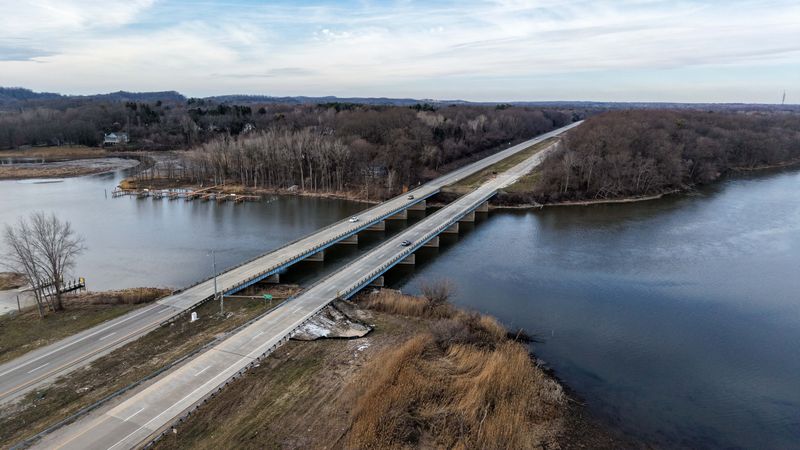
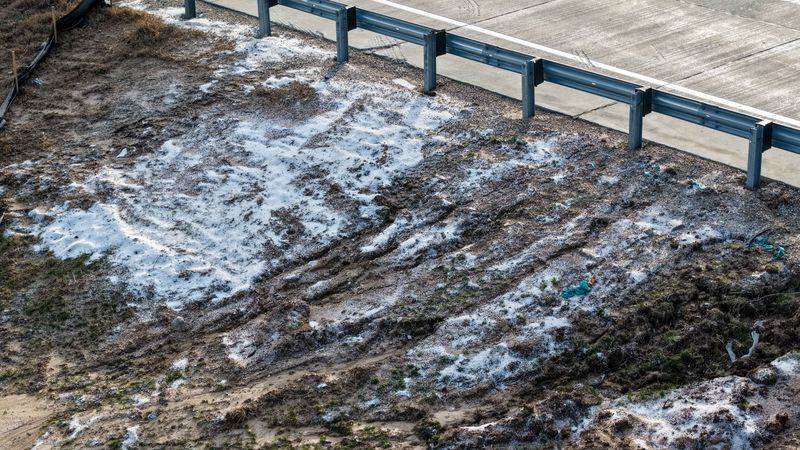
More than a month after they poured from a semi-trailer on a west Michigan highway, little bits of white plastic appeared to be everywhere — strewn along at least 11 miles of highway, embedded in soil, sunk to the bottom of the Kalamazoo River, cascading down an overpass like snow.
An estimated 26,000 pounds of plastic pellets, or nurdles, spilled from the truck after it crashed during a Jan. 27 snowstorm on an Interstate 196 overpass near the west Michigan beach town of Saugatuck. Quest Liner, the Dubuque, Iowa-based trucking company, said even more spilled when a wrecker hauled the truck to a tow lot in Holland without properly securing the cargo.

Even Eddie Kostelnik, a state official who has spent a year investigating microplastic pollution in Michigan, was surprised at the extent of the spill.
“The first time I was able to see the pile, I was like ‘Wow, there’s a lot of pellets here,'” said Kostelnik, a Michigan Department of Environment, Great Lakes and Energy environmental quality analyst. “I went out on a second site visit, and we went on the shoulder down the road all the way to Exit 49, 11 miles from the crash site. We continued to see them all over the roadside. …
“Then we saw some in the tributaries, roadside ditches and, of course, in the Kalamazoo River.”
The spill highlights an enduring environmental problem in Michigan. Plastic pollution is ubiquitous in the environment, particularly in the Great Lakes, but because the material is not considered toxic, there are few regulations governing how it is handled or monitored. Once they get into the environment, plastic particles are difficult to remove.
Scientists are warning that the particles threaten the environment as well as wildlife and human health. Wayne State University researchers have found plastic particles spur algae growth, which can exacerbate harmful algae blooms and trick fish into eating plastic disguised as food. Another team of Wayne State researchers is investigating how microplastics move through the fish and animals that rely on southeast Michigan streams.
What exactly are nurdles?
Nurdles are small pieces of plastic, about the size of a pencil eraser or smaller, used as raw ingredients to make plastic goods. Nurdles are considered microplastics. Microplastics are also created when larger items, such as grocery bags, to-go cups or car tires, break into little bits.
Microplastics are considered a “contaminant of emerging concern,” a category of substances that typically aren’t regulated but have been found in the environment and could pose risks to wildlife or human health. They aren’t regulated like hazardous materials.
Most microplastic spills aren’t reported, creating ‘a huge issue’ for environment
There are examples of huge nurdle spills across the world, said Yoorae Noh, a Michigan State University assistant packaging professor. Almost 1,700 tons of nurdles spilled onto the coast of Sri Lanka in 2021, and a shipping container full of nurdles spilled into the Port of New Orleans in 2020.
The big spills get reported, Noh said, but the small ones do not. Small nurdle spills can happen “continuously” through the life of the small plastic pellets — after they are produced, loaded into containers for shipping, moved across the world, unloaded and then turned into products, she said.
“Those are absolutely not reported in the system,” Noh said. “That is a huge issue.”
Noh said regulators should closely monitor nurdles as they move through the supply chain to ensure none are lost along the way. She recommended that regulators require handlers to weigh shipments of nurdles at the beginning of their journey and the end to measure the amount that spilled along the way.
EGLE does not regulate the shipping of nurdles. Neither does the Michigan Department of Transportation, nor the federal environment or transportation agencies.
In a statement emailed by a company representative, Quest Liner said spills of nurdles onto roadways are rare.
“Quest Liner utilizes a range of operational safeguards — including specialized equipment, purposeful hardware, and comprehensive driver training — to minimize the risk of spills and ensure any that do occur are quickly contained,” the statement read.
Industrial facilities that use plastic pellets must develop stormwater pollution prevention plans, EGLE spokesman Josef Stephens said. Those facilities must store pellets properly and provide controls that prevent them from leaking into the environment.
Michigan EGLE studies microplastic pollution
EGLE is starting to investigate the extent of plastic pollution in the state. The department received $2 million from state lawmakers last year to survey the state for microplastics pollution, fund microplastics research, measure microplastics in drinking water and develop a statewide strategy for mitigating microplastic pollution.
“They’re everywhere, and we don’t know much about their effects,” said Kostelnik, who works in the EGLE water resources division’s emerging pollutants section. “I think there’s a concern about that lack of knowledge, so as we increase our knowledge base and figure it out, we might get a more clear picture of where to go on the microplastics issues.”
Kostelnik said the team started sampling rivers and streams to look for plastic pollution in 2025, an effort the team will continue through 2028. He said they hope to eventually find trends about the amounts of plastic in rivers that go through urban, agricultural or forested areas.
Part of the challenge facing EGLE’s microplastics team is the lack of scientific standards for measuring microplastic pollution and the lack of state or federal guidelines about the amount of pollution considered safe in water, air or soil.
“What we’re seeing in the current set of research is that these microplastics can potentially have effects on organisms in the environment and that humans have microplastics in our bodies, but more research needs to be done to figure out how that affects organism health and our health,” Kostelnik said.
Bills advancing in the Michigan Legislature aim to curb microplastic pollution in the state and extend EGLE’s microplastics work.
The three bills, proposed by Democratic Sens. Jeff Irwin, of Ann Arbor, Dayna Polehanki of Livonia and Sue Shink of Northfield Township, together would prohibit the sale, manufacture and distribution of products containing microbeads; require EGLE to develop a microplastics program that sets a standard for what’s allowed in municipal water supplies; and require EGLE to develop a plan to survey the state for microplastics and recommend strategies to reduce microplastic pollution.
“We have to take steps to protect our environment and overall public health from the multiple harms of microplastics,” Shink said in a press release. “As we find out more about microplastics and the science and research surrounding them advances, we have to adjust policy accordingly.”
The bills were passed by the Senate Natural Resources and Agriculture Committee on March 10, advancing the Democratic-led Senate floor for a possible vote.
During an earlier hearing on the bills in the same committee in September, Teri Quimby, president and CEO of the Michigan Chemistry Council, said chemical manufacturers are committed to protecting public health and the environment and asked for lawmakers to seek input from the industry. The Michigan Chemistry Council opposes the bills, according to a card the organization submitted this month.
“Chemistry is one of Michigan’s largest manufacturing sectors and directly impacts almost all manufactured goods,” Quimby said in September. “It makes modern living possible. It is ever present in our daily lives.”
If approved in the Senate, the legislation would face an uncertain future in the Republican-led House. Michigan’s political leaders approved a record low number of new laws in 2025 — 74 new public acts.
Why it’s hard to remove microplastic nurdles
Noh, from MSU’s School of Packaging, called up the safety data sheet for the nurdles that spilled from the Quest Liner truck. Safety data sheets are made by manufacturers to help first responders handle releases of materials.
It’s important to know the chemical composition of nurdles in order to know how to clean them and to understand their health impacts, Noh said.
The pellets that spilled into the Kalamazoo River are polystyrene plastic. That poses a complicated cleanup challenge, Noh said. The material is denser than water, which means it will sink into the river sediment. Cleanup crews can’t simply scoop them from the top of the water.
“We cannot ruin the ecosystem with scooping all the sediment,” Noh said. “It is not a simple cleanup. We have to rethink how we (clean) up the plastic spill into the river, into the wetland, into the freeway.”
Quest Liner said cleanup efforts “continue to advance with strong momentum” as the company works with MDOT and EGLE to respond to the spill.
“Quest Liner remains deeply committed to protecting the communities we serve and the natural resources we enjoy,” a company representative said in a statement.
Cleanup crews have been working at the I-196 spill site for weeks, EGLE’s Kostelnik said. A dive team was out in early March to assess the extent of pellets stuck in the bottom of the Kalamazoo River.
The Kalamazoo River is a Superfund site, so it’s dangerous for people to touch the sediment. EGLE had to warn volunteers to stay away from the site.
EGLE issued a violation notice to the trucking company Quest Liner on Feb. 26. Quest Liner contracted with two firms to coordinate its nurdle cleanup, according to EGLE documents.
One of the firms, Young’s Environmental Cleanup, Inc., based in Flint, has cleaned piles of pellets from the crash site, documents show. In a work plan, the company said it had vacuumed some nurdles from the embankments and would collect the remaining nurdles with coconut fiber logs placed along the highway. It will also mobilize a dredging crew to remove the nurdles from the river.
In response to the company’s plan, EGLE staff said Young’s would have to extend its cleanup into Kalamazoo River tributaries and onto M-40, as well as be careful of wetlands and other sensitive areas that were affected.
The staff acknowledged that a total cleanup was not likely.
“Nurdles/pellets were observed consistently throughout this path on the shoulder, drainage areas, drainage ditches, and within the tributaries,” EGLE staff wrote in response to the company’s cleanup plan. “YECI’s plan should include recovery of nurdles/pellets to the maximum extent practicable throughout the entire affected area.”
ckthompson@detroitnews.com
This article originally appeared on The Detroit News: It’s not snow. Michigan has a nurdle problem after microplastic spill
Reporting by Carol Thompson, The Detroit News / The Detroit News
USA TODAY Network via Reuters Connect