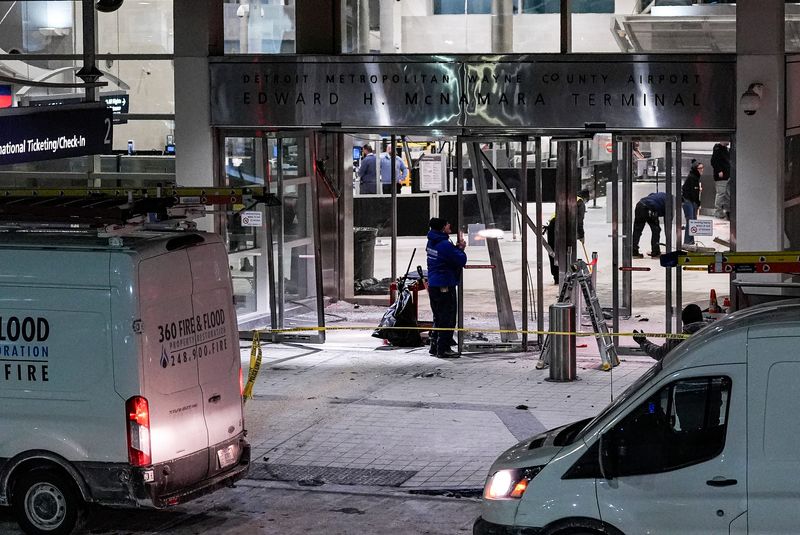
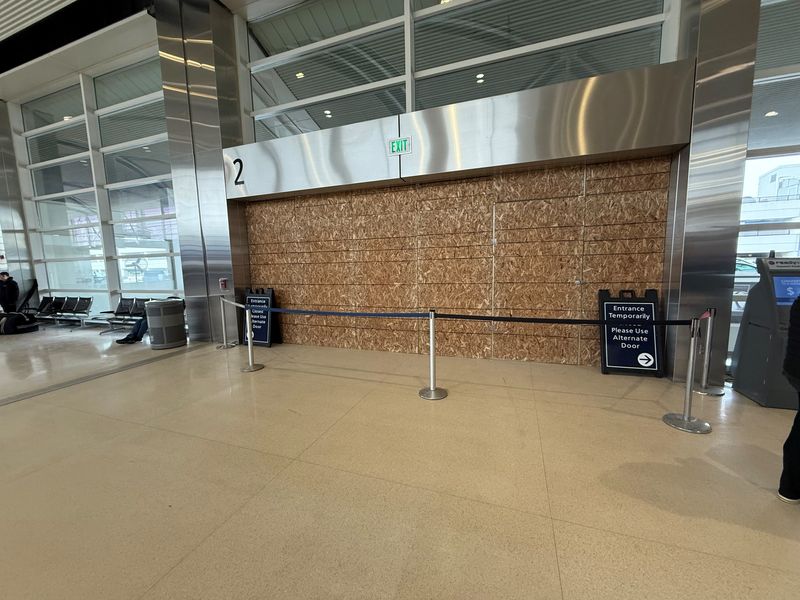
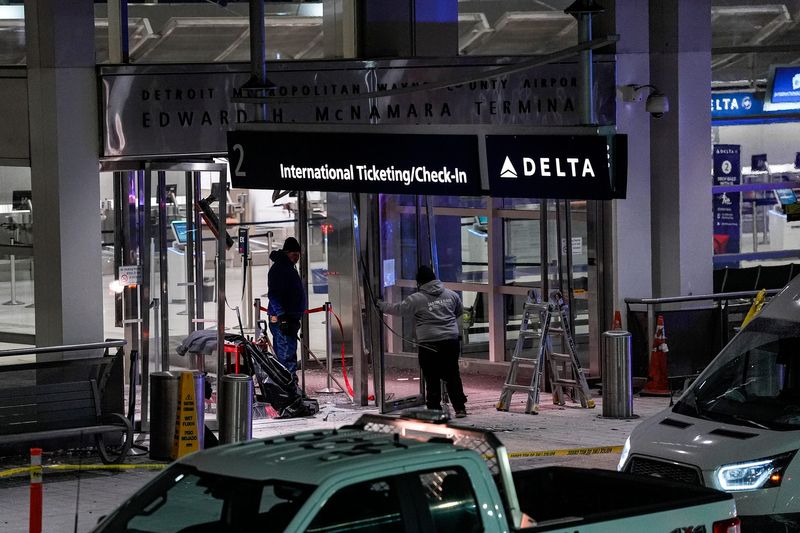
One week after a man rammed his Mercedes through door No. 2 of the McNamara Terminal, Metro Airport officials are tight-lipped about what they are doing to prevent a recurrence.
“As a result of this incident, the Wayne County Airport Authority is reviewing its safety and security measures and will make any improvements or adjustments necessary,” spokesman Matt Morawski told the Free Press in an email.

Morawski wouldn’t say what those improvements might include.
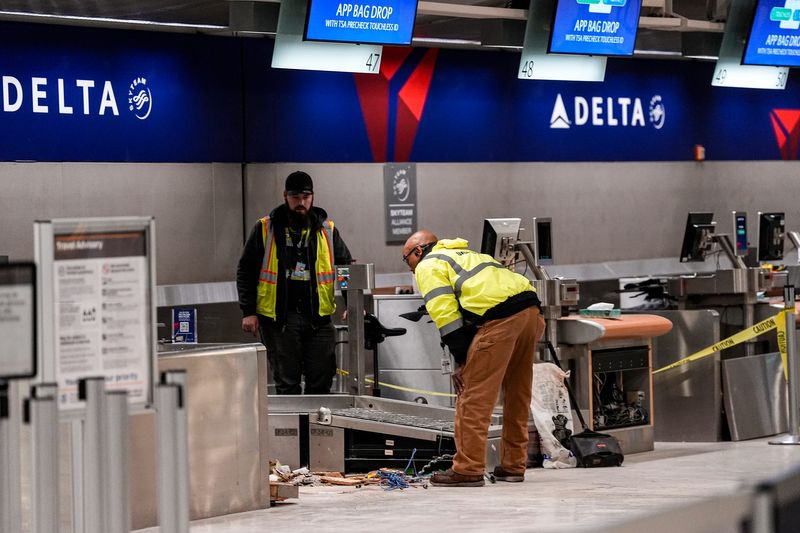
The crash happened about 7:30 p.m. Jan. 23. A man driving a Mercedes sedan hopped the curb and crashed through the door that travelers use to enter the terminal from the sidewalk out front. The car mangled the steel door frames and sent glass flying. It didn’t stop until it struck a ticket counter inside the terminal.
Six people suffered minor injuries. No one was killed. Airport police arrested the driver, though as of Friday afternoon, they still had not requested charges from the Wayne County Prosecutor’s Office.
The man’s motive for the crash is not yet clear, though there’s been no indication yet that it was done as a form of terrorist attack.
Airport CEO Chad Newton declined an interview request. Airport Authority Board Chairman Dennis Archer Jr. referred questions to airport media relations. Morawski said in an email that “we are not doing interviews at this time,” though he eventually provided short written responses to Free Press questions.
So should travelers feel safe?
“Yes,” Morawski wrote. “Operations have returned to normal. At Detroit Metropolitan Airport, our top priority is the safety of our customers, employees and tenants.”
One traveler who was in the terminal at the time, Michelle Wheaton, 54, of Pontiac, told the Free Press she was saddened by the crash.
“It’s so sad that you can’t travel, that you can’t go to the movies or your churches or your grocery stores,” she said.
Asked whether the airport planned to install bollards outside the terminal, Morawski said the terminal already has them out front.
News of the crash was noticed at other airports as well.
“It is shocking any time you hear something like this, just because the efforts that airports go to make it such a secure situation,” said Kasey Posa, a spokeswoman for Flint Bishop International Airport.
Bishop hasn’t had a vehicular crash like the one at Metro but it did face what was later classified as a terrorist attack. In June 2017, a man drove from Montreal to Flint and used a survival knife to attack airport police Lt. Jeff Neville.
Neville wrestled with the man until other officers could subdue him. Neville was hospitalized after the attack but recovered. The attacker was convicted and sentenced to life in prison.
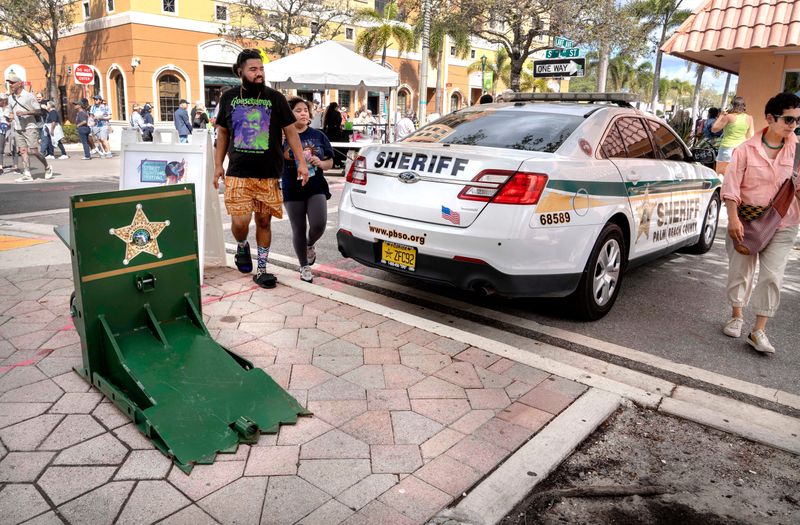
Posa said vehicular threats have been on the radar of airports, including Bishop. The airport has speed bumps out front to slow down traffic. It has physical barriers in front of the building. It often parks police vehicles out front and it uses surveillance to monitor traffic.
“We’ve gone through our assessments and with our speed bumps, our barricades, our physical barriers, we believe that we would not have that same outcome,” she said.
Airports around the world plan constantly for ways to defend against all manner of terrorist attacks including those involving vehicles, said Lee Kair, a former Transportation Security Administration executive who now works for The Chertoff Group, a security consulting firm.
In June 2007, a man loaded a Jeep Cherokee with propane tanks and gasoline cans. He raced it at the doors of the airport in Glasgow, Scotland, on a busy summer travel day in the United Kingdom. Investigators credited a concrete pillar near the door with preventing the planned fireball from getting inside the terminal where thousands of travelers were awaiting flights.
“It’s called public area security,” Kair said. “So all of the area in front of the checkpoint is a so-called public area and that has been a focus globally in aviation for a very long time.”
Preventing such attacks can be tricky, Kair said. Many airports, included Detroit Metro, have several lanes of traffic just outside the terminal door.
To stop a speeding vehicle before it breaches the actual building usually requires some type of physical barrier like bollards or concrete walls known as Jersey barriers, which are often seen on freeway construction sites.
“The challenge is that sometimes some of those things are not visually appealing if you will,” Kair said. “A Jersey barrier or something like that doesn’t look as aesthetically nice as big metal poles that are shiny and you know go down 6 feet.”
Kair said that bollards and Jersey barriers typically have to be sunk 6 feet into the ground for optimal stopping performance, which is fine on a lower level but not so easy on an upper level.
“You’d have to put a big hole in the floor to put the Jersey barrier in, but that’s actually the ceiling of the level below,” Kair said. “It might affect the structural integrity by putting in a security measure, so all of that stuff has to be taken into account.”
Kair said technology is evolving along with the threats that airports face. Many airport have glass facades to bring in natural light. Synthetic films now exist that can be applied to the glass to reduce shattering in the event of an explosion out front.
Airports already have surveillance cameras but new artificial intelligence technology can now monitor them in real time looking for red flags like vehicles that are speeding or parked in one place for extended periods.
Kair said not all security measures are obvious. For example, airport employees who shoo cars away from the entrance once they’ve dropped someone off or picked someone up prevent vehicles from lingering in a high traffic area.
Terrorists are known to case their targets before their attacks and having police vehicles parked out front can serve as a deterrent.
Even airport architects are part of the security posture, designing buildings that would be harder to breach.
“You would certainly build them differently if it was brand new construction, to put security in place,” Kair said. “But that doesn’t mean you can’t mitigate those kinds of concerns so there’s a wide range of things you can do.”
Travelers have a role to play, too, Kair said.
“Travelers should always have vigilance in public areas,” he said. “If you see something out of the ordinary, report it to airport authorities.”
Free Press staff writer Darcie Moran contributed to this report.
Contact John Wisely: jwisely@freepress.com. On X: @jwisely
This article originally appeared on Detroit Free Press: Airport officials mum after car crashes into terminal
Reporting by John Wisely, Detroit Free Press / Detroit Free Press
USA TODAY Network via Reuters Connect