I’ve got a good feeling about 2026. Not with regards to like, the world at large or anything; I’m just talking about the massive potential for me, personally, to eat some really good stew.
Over the last several months Indianapolis has welcomed new restaurants serving cuisines from places like the Balkans, West Africa and the Maghreb, all of them heavy hitters in the world of brothy, slow-cooked comestibles. But for this week’s INdulge, I consulted the Caribbean to up my stew game with:

The next dish you should try in Indy
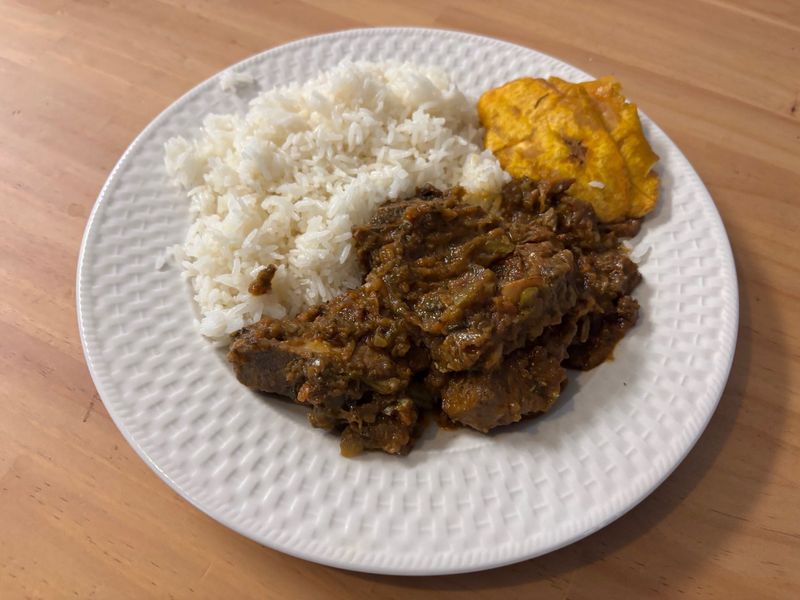
Though I enjoy pretty much any assembly of ingredients in a thick, heavily flavored liquid, I am especially partial to the beef-plus-vegetable school of stew. And to me, there are few better versions of this tried-and-true formula than Haitian legume, which you can find at a handful of Indy-area Haitian restaurants, including Sunrise Kitchen in Lawrence ($22).
Unlike in English, in which the word “legume” specifically refers to the fruit and seeds of plants in the Fabaceae family (beans, lentils, peanuts, you know the drill), in the largely French-derived Haitian Creole language, the word refers to all vegetables. The vegetables in legume typically include eggplant, carrots, leafy greens, cabbage and a mild potato-like Mesoamerican squash called chayote. All of these are piled in a massive stockpot alongside some type of meat (beef, or vyann bef, at Sunrise Kitchen), cooked until tender and then ground into a dense, fibrous mash akin to a particularly thick curry.
In a traditional Haitian kitchen, the cook cleans the stew meat of choice with a combination of salt, water and acid, usually in the form of lime juice. This practice originated in a pre-Meat Inspection Act world where eating meat was more of an “at your risk” operation. Though most Western government agencies these days don’t endorse this method, it’s still a common practice in several cultures around the world and can absolutely be done hygienically. Speaking purely for myself, I try not to tell anyone what to do in their own kitchen, especially when they’re feeding me.
Once cleaned, the bone-in stew meat is marinated with various herbs and spices like thyme, garlic, onion powder and cloves. But the most important component is epis (derived from the French épices, for “spices”), a loosely defined blend that typically includes mashed bell peppers, garlic, citrus and parsley.
The distinctly green flavor base provides the foundation for several Haitian dishes, and it is said each cook’s epis is a smidge different. Where some lean into the Scotch bonnet peppers first cultivated by the native Taíno people of Caribbean, others might incorporate more of the thyme that originated in North Africa and Eurasia. In 2022 a Bon Appétit described epis as the primary provider of “oomph” in Haitian cuisine, and I couldn’t agree more.
In fact, to me the joy of legume is that it’s pretty much all oomph. The leafy greens and eggplant produce a sort of hard-to-place, earthy flavor. Carrots bring an extra hit of sweetness, while the assorted herbs and spices of the epis add a subtly celery-like kick. The hunks of faintly pink stewed beef are excellent, but equally crucial are their rendered fat and juice that give the legume its heft. Everything coalesces in a tremendously satisfying mush, which is really all I look for in a good stew.
Sunrise Kitchen serves its legume with white rice, fried plantains called bannan peze, which skew starchier and more robust than sweet, and sos pwa, a glossy purée of black beans that I could happily eat by the spoonful.
The whole meal is a fascinating mosaic of Haiti’s culinary influences, from the leafy greens and eggplant that have been grown in West Africa for centuries to the black beans and chayote squash that originated in the Americas. Like with any traditional dish, there is debate over what ingredients constitute the ideal legume, but I don’t think that should stop you from trying the commendable version at Sunrise Kitchen or any other Caribbean eatery. After all, I’d argue that as long as you find a stew delicious, what goes on in the pot is none of your business.
What: Legim ak vyann bef, $22
Where: Sunrise Kitchen, 4333 N. Frankin Road, Lawrence, (317) 830-9472
In case that’s not your thing: Sunrise’s menu is small but offers a crash course in Haitian cuisine, with staple items like griot (citrus-marinated and fried pork, considered Haiti’s national dish by many, $18.50), stewed goat ($24) and tasso kodenn (fried turkey, $21), plus sides including rice and beans ($6), diri djondjon (black rice with mushrooms, $6) and okra ($6).
Contact dining reporter Bradley Hohulin at bhohulin@indystar.com. You can follow him on Twitter/X @BradleyHohulin and stay up to date with Indy dining news by signing up for the Indylicious newsletter.
This article originally appeared on Indianapolis Star: INdulge: Comforting Haitian stew is next dish you should try in Indy
Reporting by Bradley Hohulin, Indianapolis Star / Indianapolis Star
USA TODAY Network via Reuters Connect