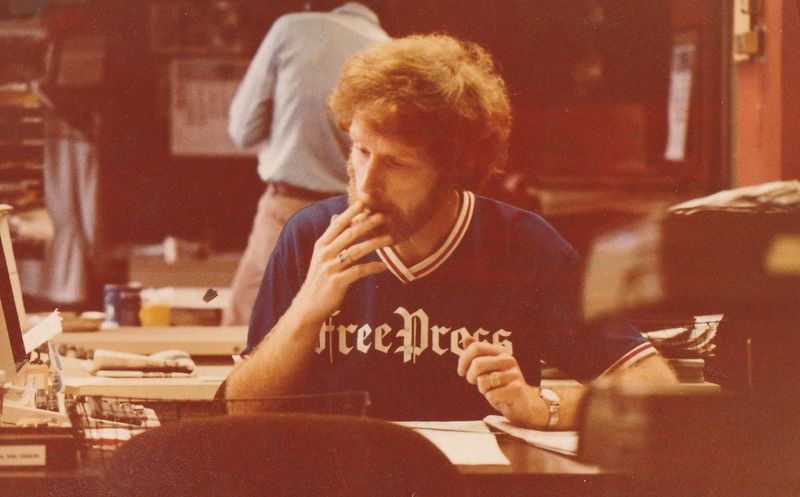
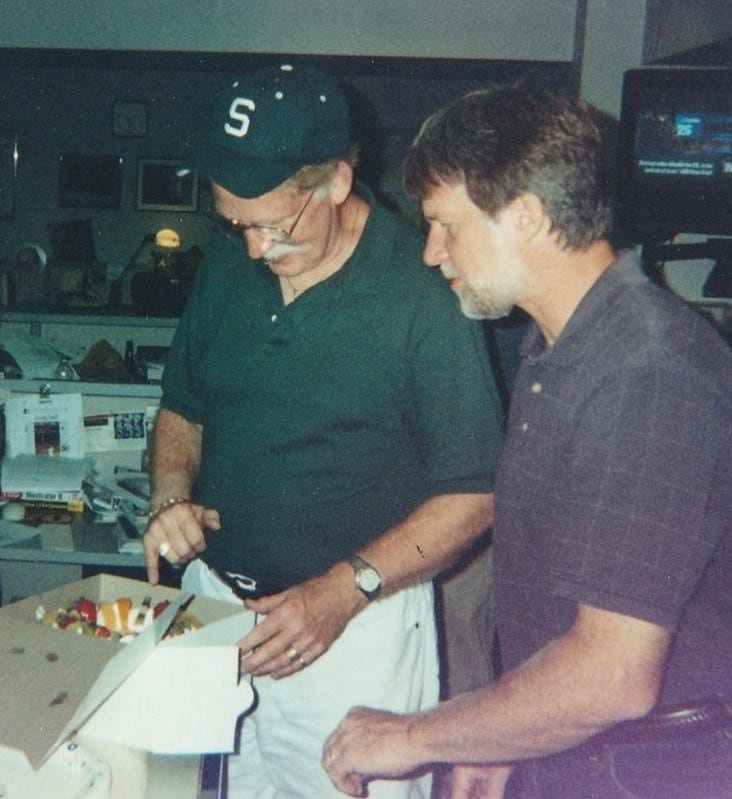
For Detroit Free Press readers of a certain age, Ken Kraemer was an unknown but critical cog in delivering their daily sports fix.
To his co-workers, spanning the middle 1950s to the early 2000s, Kraemer was “an old-school, big-hearted, hard-assed classic,” “a pro’s pro” and “one of a kind” with “high standards with a low tolerance for BS,” according to numerous social media tributes.

Kenneth Lee Kraemer, born in 1936 and raised on Detroit’s east side, worked for the Free Press for more than four decades. Nearly all his career was spent in the sports department, though he started as a copy boy running errands while in college, reviewed a Beatles concert and worked for a spell in what were then called the women’s pages, as the only male on that staff.
Kraemer died Nov. 7 at age 89 after a series of health struggles, surrounded by his family in his Warren home. In lieu of immediate services, a celebration of life will be held in January.
Kraemer’s name rarely appeared in print — some years only in a listing of the sports staff that accompanied Dick Mayer’s annual Christmas drawing, which was crafted by artistically arranging the names of prominent sports figures in the shape of Santa Claus or Rudolph or something festive. But for three-plus decades, Kraemer was a linchpin in guaranteeing that the Free Press arrived each morning on a doorstep, at a convenience store or in a street-side box and in later years instantaneously at freep.com.
He held various titles over the years — often assistant sports editor — but whatever his title, on each of his shifts, always working nights and weekends, he carried much of the burden to ensure Free Press readers received the best possible sports section. He was there for all the big events and roughly 8,000 routine nights that nonetheless were high-stress, four-deadline races against time.
During it all, Kraemer could find things that brought out his infectious laugh, mixed with a short fuse that seemed to make his red hair glow brighter, and an extensive vocabulary for words that could be printed in a family newspaper and those that could not.
“I’ll always remember Ken as deadline approached,” recalled Dave Robinson, sports editor from 1985-93. “He could be a bit tense and surly — but I soon realized he was just hyper-focused on getting everything right for Detroit sports fans. Just before deadline he would push the button, breathe a sigh of relief and then came a smile. Another job well done.”
The first half of his career, Kraemer usually served as “the slot,” the person who oversaw the production of that day’s sports section, laying out pages, talking with sportswriters and shepherding the finished product. The second half of his career, Kraemer served as copy chief, overseeing a crew of editors and ensuring quality writing and accurate stories and headlines despite the heat of deadlines.
“I never thought he was destined for a long life with the nightly pressure he put up with,” said Bill McGraw, who was elected to the Michigan Journalism Hall of Fame after a lengthy Free Press career as an editor, a metro reporter, a columnist and a sportswriter who covered the Red Wings for years and the 1984 Tigers. “Ken was a legend, a weirdo, a talent and a good boss.”
Kraemer’s eyes were often the last to read a story before it went into print. And he knew this: Every story could contain mistakes, and it was the copy desk’s job to find and correct them. A name might be misspelled. A statistic might be wrong. Deadlines must be met every day, and sometimes reporters had little time to file a report.
Kraemer attempted to verify everything — he carried a briefcase filled with media guides from teams — and he passed that passion on to the younger copy editors who followed his leadership.
He had an advantage this way, too: He was a Detroiter who graduated from old Eastern High and Wayne State University and spent his whole life in the area except for a stint in the U.S. Army after college, and he knew the lay of the land for Detroit sports teams.
Kraemer was a young man when the Lions and Red Wings won multiple championships in the 1950s. He worked for the Free Press when the Tigers won the 1968 World Series, and he was still at the paper when the Pistons won back-to-back NBA titles in 1989-90 and the Wings won back-to-back Stanley Cups in 1997-98.
Kraemer recognized the stars who helped make this happen — Gordie Howe, Bobby Layne, Al Kaline, Isiah Thomas, Steve Yzerman — and the lesser-known contributors.
Before smoking was banned in the Free Press offices in the mid-1980s, Kraemer worked at a breakneck pace with a cigarette and ashtray close by — picture old newsrooms in black-and-white movies — and there were times when he could be volatile amid the noisy chaos. As the workday moved into nighttime, games blared from a TV and radio, phones rang incessantly and prep scores were yelled across the office.
“Before we got computers, we had to use typewriters,” recalled Mick McCabe, a longtime prep reporter inducted into the Michigan Sports Hall of Fame and the Michigan Journalism Hall of Fame. “Ken typed with such intensity it was like he was angry at the typewriter, being sure to punish the keys. He was that way with computer keyboards, too. Of course, he was nicknamed the Big Red Ape by Hal (Swami) Schram.”
The Rock often resided in Kraemer’s cubicle before he retired in 2001. It was presented by acclamation as punishment whenever a sports staffer made an inappropriate comment or a joke in poor taste. The same shift, Kraemer could crack up his crew with a well-timed deadpan line:
“You’re a good editor, (insert name), but you look at the clock too much.”
“It comes as no surprise to this veteran observer …”
“What’s worse than track? Field.”
“Ask if my house is on fire — if not, tell her I’m on deadline.”
“Some people are born logged off.”
As he grew older, Kraemer mellowed, and he would lament some of his old outbursts. He also could laugh at the fact he had a car stolen eight times in downtown Detroit.
“Kraemer was the heart and soul of the Free Press sports department,” said Tim Marcinkoski, a longtime copy editor. “He loved his job … and hated ice storms.”
To the bone, Kraemer was a good man beloved by his co-workers for making them laugh, for inspiring them to do their best work and for doing his job above and beyond for decades. And as a man who loved his wife of 65 years, Bernie. The vanity plate on their car proclaimed their decades of affection: 2UVAKND (two of a kind).
In addition to Bernie, Kraemer is survived by sons Daniel Kraemer, of Livonia; Scott Kraemer, of Fenton, and Brian Kraemer, of Denver, and grandson Juda Kraemer, of Denver.
Special writer Owen Davis contributed to this report.
Contact Gene Myers at gmyers@usatodayco.com. He started working with Ken Kraemer at the Free Press right out of college in 1983. Ten years later, Myers became the sports editor, and Kraemer served as his assistant sports editor in charge of the copy desk until retirement. Myers retired from the helm in 2015 only to unretire in 2024 to coordinate books and page prints across the USA TODAY Network. Recent books and page prints to check out from the USA TODAY Network include a book on the Tigers’ 125th anniversary and a page print from Tarik Skubal’s latest Cy Young Award.
This article originally appeared on Detroit Free Press: A behind-the-scenes superstar for Free Press Sports dies at 89
Reporting by Gene Myers, Free Press Special Writer / Detroit Free Press
USA TODAY Network via Reuters Connect