

Public hearing to be held before final adoption on Nov. 20
By Barb Pert Templeton

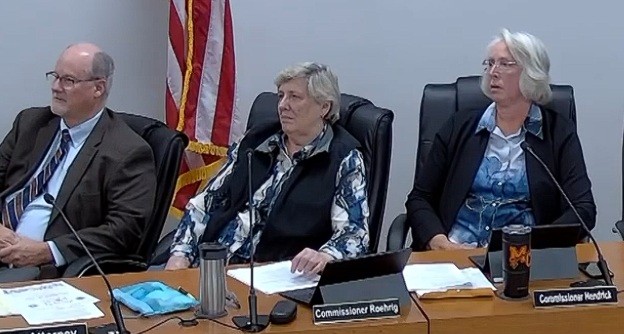
A first reading of Ordinance 25-004 – Water/Sewer Rates was approved by members of the Marine City Commission at a Nov. 6 meeting. Commissioner Jacob Bryson was absent from the recent meeting.
The new rates, which are expected to be adopted at the Nov. 20 commission meeting following a public hearing, won’t go into effect until Jan. 1. The increase is a 56.8% bump for users.

Mayor Pro Tem Lisa Hendrick passed out a document she created for the commission members to provide a little more detail about the increase in charges.
She said it will be a $75.13 per quarter increase, so, it’s $25 per month. The increase is for the ready-to-serve fees and the debt service. So, the price of your water really isn’t going up, Hendrick added.
A 56% increase to cover the antiquated water and sewer infrastructure for Marine City is expected to become a reality for users on January 1.
“Everybody’s going to get hit with the same amount, $75.13 (per quarter),” Hendrick said. “And I don’t want to pay it but it’s just an unfortunate thing that we all have to deal with; I come from the country so we didn’t have a lot of great water out there so we were conservative users so I’m a low water user but still…. it’s going to jack my bill up. The last one was $132 and it’s going to go up to $207 – so that’s a jump for everybody.”
At the start of the Nov. 6 meeting, Matt Lumbert, a wastewater technician with Michigan Rural Water Association, gave a water rate study presentation.
Lumbert said they’ve been working on the rate study for seven months and it was a fairly complicated structure so they tried to clean it up and simplify it so everyone could understand it.
“What you guys haven’t been doing is putting away for capitol improvement projects, the rate structure was just covering your day-to-day cost, it wasn’t putting anything away for the future; you guys were kind of just rolling along,” Lumbert said, noting he worked with the city engineers.
The waste water plant is going to require a lot of improvements and the water department is currently undergoing updates. He said they ended up settling on a simple base rate plus a commodities charge with the commodity charge based on how many gallons of water are used.
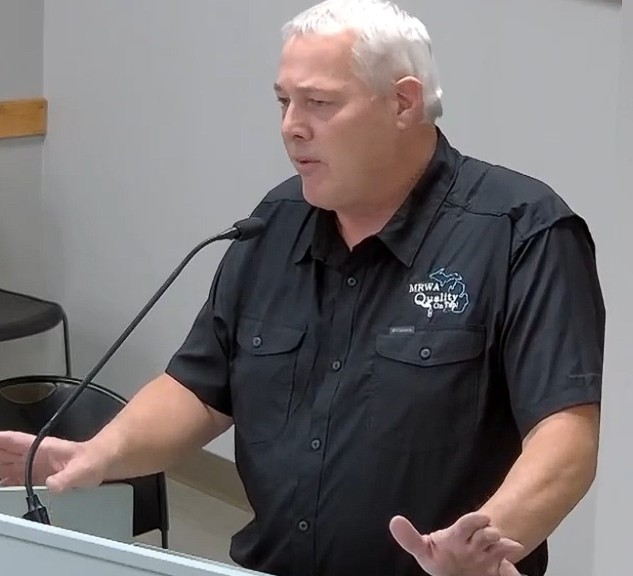
Matt Lumbert, a wastewater technician, with Michigan Rural Water Association, gave a presentation to the Marine City Commission on Nov. 6, 2025.
“It’s a pretty hefty increase, probably kind of hard to swallow but I think for years and years you’ve just been undercharging, just been slowly going backwards,” Lumbert said. “These are always tough to do but those are the numbers.”
A closer look at the increases
City Manager Michael Reaves asked Lumbert to explain what the ready-to-serve charge includes because it reflects the largest increase. He added that many people don’t realize the city has a water producing plant, a waste water plant and two pump stations, all part of the infrastructure that needs to be covered.
“Yes, the infrastructure is always still there and needs to be maintained and operated,” Lumbert explained. “The ready-to-serve charge is just what it says, it hooks up to your house, it’s ready for service, you make a phone call and you have water.”
City Attorney Robert Davis said so the commodity charge is the product and ready-to-serve is the instrumentation to deliver the product? So, you’re not just paying for the water you’re paying for all the structures to get it to you?
“Yes. and that’s the thing nobody sees and everybody forgets, all that’s involved,” Lumbert said. “There’s a lot nobody sees, the underground pumps, the hydrants and the pumps at the plants are extremely expensive.” Reaves asked when Lumbert looked at the city’s rates for ready-to-serve and commodity charges seven months ago where did the city fall when comparing rates across the state?
“Just seeing your rates, you were low, you were in the bottom for sure,” Lumbert said. “I see a lot of rate studies and when I came and started looking here and you gave me your rate structure, I knew you were going to need a fairly large increase.”
“I know people are going to struggle with this but we didn’t increase the rates for the water and sewer – it’s only on the infrastructure, basically,”
Marine City Mayor Pro Tem Lisa Hendrick
“Even with the rate increase, where are we at?” Hendrick asked.
Lumbert said he doesn’t like to compare because everyone’s different. Yet, for example, Marine City has an expensive treatment system because they use service water, lots of Michigan systems have ground water, which doesn’t need a whole lot of treatment they just pump it out of the ground and send it to customers.
“You guys have full treatment, so you’re treating the water out of the river so you have extra equipment for that, extra chemicals, extra manpower, it’s a full treatment system so you have more requirements from the State of Michigan to meet those standards,” Lumbert said, noting
that with the city’s new water rates they are middle of the road in comparison to other communities.
New rates will be a struggle
Lumbert said water and sewer gets forgotten about but people don’t seem to complain about paying $75 for a phone bill.
“Which we can live without but you can’t live without water and sewer,” he added.
“I know people are going to struggle with this but we didn’t increase the rates for the water and sewer it’s only on the infrastructure, basically,” Hendrick said.
“The ready-to-serve piece?” Reaves asked.
“Yes, that’s where all the increases went so even though they can still use a certain amount of water that’s not going up, it’s basically like a flat fee, unfortunately,” Hendrick replied.
Reaves said his understanding is that many things at the waste water treatment plant including the equipment. are near end of life.
“Yes, it’s almost like is this even worth sticking money at it, some of things down there are even beyond use, it’s very dated and it’s time,” Lumbert said.
Hendrick said she knows they are doing a pretty large increase this time out but what does the future look like, more increases?
“It’s a pretty hefty increase, probably kind of hard to swallow but I think for years and years you’ve just been undercharging, just been slowly going backwards. These are always tough to do but those are the numbers.”
Matt Lumbert, a wastewater technician, with Michigan Rural Water Association, noting he worked with city engineers.
Lumbert said on the water side they’ve got a good handle on things but on the waste water side they won’t know until the engineers come up with a price. He said it’s going to be in the millions of dollars and if they charge a small percentage rate each year, similar to cost of living, that would work.
Davis asked if the city has distributed anything to the public about how they can lower their water use and/or commodity use with water conservation ideas? He directed the question to Lumbert in the audience.
“What can I do at my house to use less water?” Davis asked.
Lumbert said there are suggestions on their website at the Michigan Rural Water Association and City Clerk Jason Bell said Marine City has information on their website too.
“You do have some control over your commodities charges,” Davis said.
“Don’t take 20 minutes showers, make it five minutes,” Hendrick added.
Reaves said there’s also instances where a toilet leaks or a spigot is dripping and people don’t think about that or running water while washing dishes or when brushing teeth. Those are small changes that can be made day to day to lower the charges.
The city commission will meet on Thursday, Nov. 20 at 7 p.m. at the city offices where a public hearing on the issue is expected to be followed by the commission’s formal adoption of the ordinance.
