Just one day before Ford Motor Co. is due to report its third-quarter earnings — which some analysts expect will warn of an up to $1 billion hit to fourth-quarter profits due to an aluminum shortage — the automaker announced a massive recall of nearly 1.5 million older model vehicles in the United States because the rearview camera might stop working.
The news is a blow to the Dearborn-based automaker, which has been struggling for the past five years with recalls that range from backup-camera failures, faulty low-pressure fuel pumps and issues with the seat belt system.

Ford has instituted new processes to fix its quality, as reported by the Detroit Free Press in July, but on Oct. 22, Ford’s stock price closed down 1.04% to $12.43.
Ford COO Kumar Galhotra explained the latest recall in a blog post Oct. 22, published on Ford’s website. In it, he said that, in addition to ways recalled vehicles can get fixed, Ford will offer a new 15-year extended warranty on rearview cameras for other Ford and Lincoln rearview camera-equipped vehicles that are not included in the recall.
“We at Ford aim to move past this specific problem with analog rearview cameras,” Galhotra wrote.
He also explained why Ford was adding the extended rear-camera warranty: “We are taking this additional action to provide extra reassurance to our customers.”
Still, the number of vehicles recalled is a staggering figure that is almost equal to the total number of new vehicles Ford has sold in the United States through the end of September — 1.7 million.
It also puts the automaker at a record-breaking 126 recalls filed with the National Highway Traffic Safety Administration. To put that in perspective, the next major automaker with the highest number of recalls this year is Chrysler, owned by Stellantis, at 40 recalls. That’s followed by Volkswagen Group at 33 and General Motors at 20.
Ford spokesman Mike Levine told the Free Press this latest recall and the extended warranty on rear cameras will not have a material impact on Ford’s third-quarter earnings.
This newest recall
In September, federal regulators and Ford agreed on a plan to address vehicles built between 2015 and 2025 with analog cameras. Some of the vehicles would be recalled and the rest would be covered by a program that includes a 15-year extended warranty on rearview cameras.
Levine did not immediately have a figure for how many vehicles are now covered by the extended warranty, but the list in Galhotra’s blog includes 28 vehicle models, some as current as the 2025 model year. It also includes the automaker’s bestsellers: the 2015-2020 F-150 and 2015, 2017-2022 Ford Super Duty pickups.
According to NHTSA’s safety recall report, regulators notified Ford in February of concerns that the rearview cameras may not function correctly. Ford investigated and in September told the government that it was “unable to identify a defect related to motor vehicle safety across all vehicle populations equipped with this analog camera.”
But Ford said it is aware of 12,487 warranty claims related to camera problems and there have been five accidents, but no injuries, related to it.
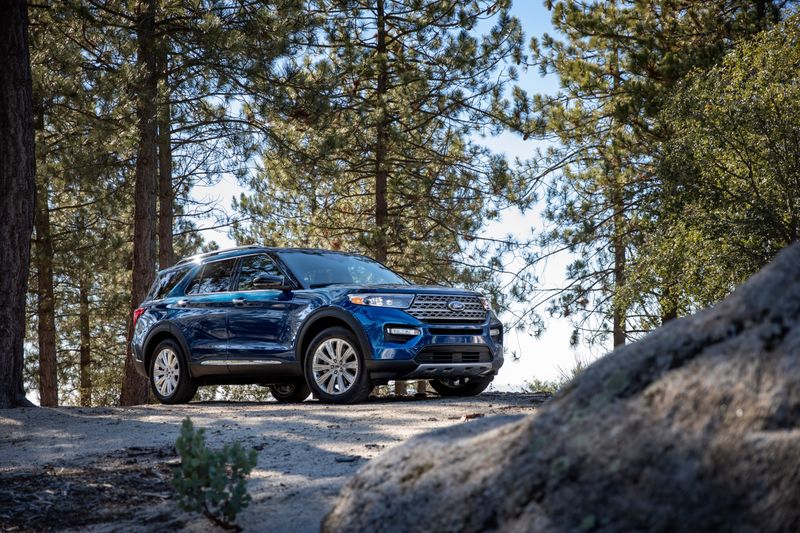
Ford is issuing the recall, which covers various 2015 through 2020 model-year Explorer, Escape, Mustang, Flex, Fiesta, C-Max, Taurus, Fusion and Lincoln MKT and MKZ vehicles.
NHTSA acknowledged the recall, writing in a letter to Ford dated Oct. 21: “A rearview camera that fails to properly display an image can reduce the driver’s view behind the vehicle, increasing the risk of a crash.”
Ford is mailing out notices over this month to people who own vehicles that fall under the recall and dealers will inspect and replace cameras as needed.
The origin of Ford’s recall problem
This latest recall is part of a string of recalls in the past few weeks. Last week, Ford recalled nearly 625,000 vehicles in the United States due to seat belt and rearview camera display problems. Last month, the automaker recalled 1.9 million vehicles worldwide because of a faulty rearview camera.
Ford’s recall problem, in part, stems from a November 2024 agreement with regulators in which the company agreed to a $165 million civil penalty after a NHTSA investigation found the automaker failed to recall vehicles with defective rearview cameras in a timely manner.
That order required Ford to look back at all of its vehicle recalls over the last three years to make sure Ford covered the right number of affected vehicles, and if not, expand the scope of recalls to include more vehicles. Some safety experts say that is partly driving the high number of recalls.
That’s because some of Ford’s recalls this year are what they call “re-recalls.” That means they are software recalls Ford performed going back to 2017, Doug Field, Ford’s chief EV, digital and design officer, told the Free Press earlier this year. He said by monitoring the vehicles in those recalls, Ford found a group of vehicles that did not receive the right software fix in the first recall and are being recalled again.
Ford’s endeavors to fix quality
Earlier this month, CEO Jim Farley sat down with the Free Press to talk about his five years as the company’s leader, much of which has been spent on fixing the quality problems. Farley said about half of Ford’s recalls today address software issues, something Alan Mulally’s team did not have to deal with when Mulally was CEO in 2007 and Farley worked under him.
“That team, being on it, never had to deal with a ton of software, backup camera systems that are not only a Ford issue, but an industry issue and I think we’re dealing with it before most others because we were the first to put modems in all of our vehicles,” Farley told the Detroit Free Press.
The balance of Ford’s recalls are on vehicles engineered before 2020, he said.
“I can’t do anything about that engineering. It’s in the field. All I can I do is deal with the problems quickly,” Farley said. “I can’t remake the vehicles that were made seven years ago.”
Farley said the quality improvement processes he has put in place are delivering the highest-quality cars coming off the line or with three months-in-service since 2007.
“Our durability of our powertrains that we’re testing are fully competitive, we believe, with the likes of Toyota,” Farley said. “Since I’ve been CEO, we’ve improved our quality of our launches. The Expedition and Navigator were our best launches in company history. As the vehicles mature in the field for six months now, we’ve had almost no recalls and very little issue with those vehicles. I would say we are making a lot of progress and it does take time.”
Galhotra wrote on Oct. 22 that over the past two years, Ford has “significantly expanded our team of safety and technical experts, more than doubling our resources.”
Ford also has increased its testing protocols on critical systems, Galhotra said, and is applying the insights gained from that testing to production models. He said Ford is seeing quality improvement across its newest vehicles.
“Our 2025 initial quality is on track to become among our best ever, and Ford was the most awarded brand in the J.D. Power 2025 U.S. Initial Quality Study, with four Ford vehicles topping their segments,” Galhotra said.
Jamie L. LaReau is the senior autos writer for Gannett who covers Ford Motor Co. for the Detroit Free Press. Contact Jamie at jlareau@freepress.com. Follow her on Twitter @jlareauan. To sign up for our autos newsletter. Become a subscriber.
This article originally appeared on Detroit Free Press: Ford recalls nearly 1.5 million vehicles in U.S. over rearview camera failures
Reporting by Jamie L. LaReau, Detroit Free Press / Detroit Free Press
USA TODAY Network via Reuters Connect