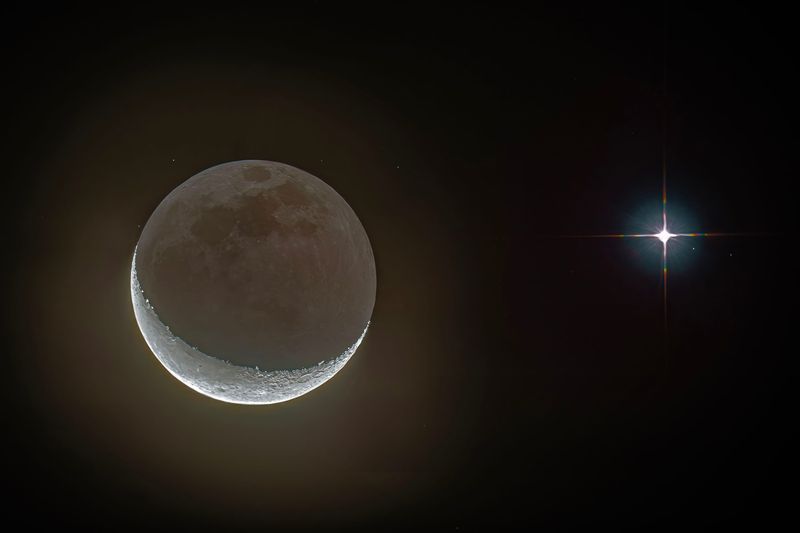
If you were up early enough on Friday, Sept. 19, you may have noticed the bright star shining next to the crescent moon in the morning sky.
Except it wasn’t a star, it was the planet Venus. And it was part of an occasional celestial meetup known as a conjunction. This one was between the moon, Venus and the star Regulus, NASA said in a monthly skywatching guide. A different conjunction between Venus and Jupiter prominently shared a section of the night sky for much of August.

If you missed the view on Sept. 19, will you get another chance to see the star next to the moon? Here’s what to know.
When is Venus, moon, Regulus conjunction?
The upcoming conjunction will be a party between the moon – Earth’s only natural satellite – as well as a star named Regulus in the constellation Leo and Venus. The second planet from the sun, Venus is often referred to as Earth’s twin since both bodies are rocky and share a similar orbit.
If you missed it on Sept. 19, the trio will still be shining on Sept. 20. However, according to EarthSky, they won’t be as close together. The moon will be closer to the horizon, with Venus and Regulus higher in the sky.
Where, how can I see celestial conjunction in September? Viewing tips
For those in the Northern Hemisphere, which includes the U.S., spotting the conjunction is as easy as locating the moon.
Look east in the early pre-dawn hours toward the waning crescent moon as it sets in the sky. The moon will be located near Venus and Regulus, Chelsea Gohd, a science communicator at NASA’s Jet Propulsion Laboratory in Southern California, explained in a video.
Seek out locations with unobstructed views of the horizon and check the weather forecast to ensure skies will be clear. DarkSky International is a U.S nonprofit that maintains a list of designated dark sky communities around the world, including 163 in the United States.
How to see the star near the moon, conjunction from Ohio. Dark sky locations
Of the 159 locations in the United States that are designated dark sky communities, two are in Ohio:
Other dark sky destinations around Ohio, according to Ohio Magazine, include:
Do you need a telescope to see Venus, moon, Regulus conjunction?
While telescopes certainly will enhance the view, spectators don’t necessarily need any equipment to spot Venus, the moon and Regulus in the pre-dawn sky from the Northern Hemisphere.
That’s because after the sun, Venus and the moon are the two brightest objects in our night sky. Furthermore, Regulus is regarded as one of the brightest stars visible to Earth.
What is a planetary conjunction?
A conjunction is an astronomical event in which at least two planets – or, in this case, other celestial bodies – appear to our vantage from Earth to be close together in the sky.
Even though the planets are in reality still tens of millions of miles apart, the events present a special opportunity for astronomers and casual stargazers to see multiple worlds in our solar system at one time.
So, what causes conjunctions to take place?
As planets in our solar system orbit the sun at varying speeds, sometimes their orbital paths bring them close together on the same side of the sun. The same can be said of the moon, which instead orbits Earth.
When this event lines up with our view from Earth, we get a conjunction, according to the nonprofit Planetary Society.
This article originally appeared on Akron Beacon Journal: Can you see the star next to the moon, planet conjunction tonight? What to know
Reporting by Chad Murphy and Eric Lagatta, Akron Beacon Journal / Akron Beacon Journal
USA TODAY Network via Reuters Connect