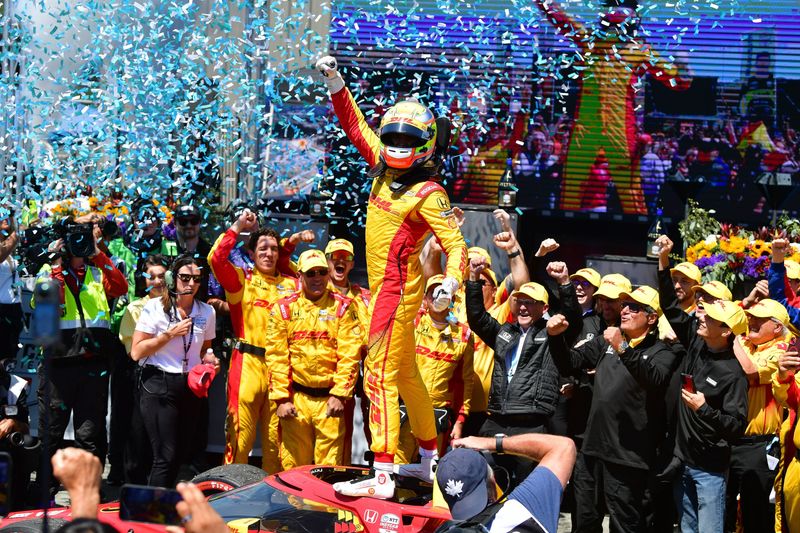
IndyCar and Penske Entertainment officials said they saw the prospect of elevating two races — Laguna Seca as its future season finale, and Nashville Superspeedway in the prime TV window immediately following an eight-figure FIFA World Cup final audience — as reason enough to make its seventh change to the final race of the year since 2019.
Therein lies the reason the third-most-watched race of 2025, with an average audience of 1.142 million viewers — trailing only the season opening St. Pete (1.420 million) and the Indy 500 (just over 7 million) in 2025 — will vacate its spot as the potential championship decider and slide into the one-time role with a monster lead-in audience, handing Laguna Seca, a race whose average audience has never topped in 750,000 in average audience since it rejoined the calendar in 2019.

The move was a major focal point of IndyCar’s 2026 schedule release Tuesday, one that featured previously announced new (or revamped) street races in Arlington, Texas, and Markham, Ontario, a return to Phoenix Raceway with new partners in NASCAR and a surprise doubleheader at the Milwaukee Mile — along with a noted lack of races in rumored locales Mexico City and Washington D.C.
Among the several moves on the calendar, the latest finale shakeup seemed to leave many in the paddock as confused and curious as any development — appearing in the outset as a change for change’s sake and a major step back in the quality and excitement for IndyCar’s finale. The move is believed to have been an end product of a series of shifts in the potential landscape of the series’ prospective 2026 calendar, but one that both Penske Entertainment president and CEO Mark Miles and IndyCar president Doug Boles were deeply enthused of during a Tuesday morning news conference.
“(Monterey, California) is a great community that loves racing, and it’s a great community for our fans to go to. It’s one of the most iconic U.S. tracks, and our drivers enjoy it,” Boles said. “I think it’s a great place to close the season out, and we’re really looking forward to doing that, as we’ve done in the past.
“It’s just a really fitting place for us to end the season in 2026.”
Why Nashville Superspeedway was the pick to follow FIFA World Cup final
As IndyStar reported two months ago, Laguna Seca was initially in position to run July 19 in that elevated role as the race TV product immediately following Fox’s broadcast of the men’s FIFA World Cup championship match at 3 p.m. Its fit was easy to spot; as a West Coast race, it could be held at mid-afternoon locally and still have plenty of daylight to use, despite that likely TV window starting at 6 p.m. on the east coast.
Additionally, compared to virtually all the sport’s Midwest offerings running in the heat of the afternoon would be no detriment, compared to a late-afternoon one at, say, Nashville Superspeedway, where temperatures could be hitting 90 degrees before factoring in humidity that time of year for such a race window. Back in July, the plans were for the IndyCar paddock to immediately head south to Mexico City for a prospective race the following weekend. Though a long trip from the central coast of California to the heart of Mexico, it would be no longer a trip than NASCAR transporters experienced when they did the same earlier this year, making for a logical semi-regional swing.
But when questions began to surface as to the ability for race organizers to hold a truly successful event at Autodromo Hermanos Rodriguez in 2026 — one that as planned would’ve run just a week or two after the completion of the World Cup and forced race promoters to try and break through the noise of the major summer event to both prospective fan attendees and sponsors alike — the entire back half of IndyCar’s 2026 schedule was thrown into a major rethink.
After exploring various possibilities that might work and thrive in that prime post-World Cup final TV window that included Laguna Seca, World Wide Technology Raceway and Nashville Superspeedway, ultimately series officials landed on the latter as one they believed could best put on a show for the throng of uber-casual fans who may have left their TVs on following the World Cup championship and may not know a thing about IndyCar.
Whereas Laguna Seca made tons of sense with Mexico City still in the picture, a one-off trip all the way out west for a race that historically has featured a runaway winner was no longer as proper a fit. Nashville Superspeedway, a race some in the paddock have astutely pointed out is one promoted by Penske Entertainment, allowing the series itself to reap in the direct benefits of said race landing a monster TV audience, came across moreso as one that with an added boost could really blossom into something major, rather than one in Laguna Seca that might reach truly respectable heights in TV viewership, but nothing more.
“As we look at the schedule, we’re looking at opportunities to put our events in places where it really elevates them, and it’s clear that moving Nashville, which was a fantastic event and one that our fans support, into that window is an opportunity to really elevate the sport with some of the greatest racing there is,” Boles said. “We’re going to double down on our promotion of that event, and we’re going to do everything we can to make it more successful.
“We just truly believe this is the spot for that race that’s truly going to highlight the IndyCar series with what’s turned out to be one of the more competitive events we’ve had this year.”
IndyCar believes Laguna Seca can thrive again as season finale
In taking one of IndyCar’s edge-of-your seat races and moving it from the finale spot for the foreseeable future — Miles said Penske Entertainment has a multi-year plan for Laguna Seca to remain the finale beyond 2026 — the series seems to be banking on the idea that its Nashville oval race ultimately has a better shot of being well watched anywhere on the calendar, whether it be as the finale, with historic World Cup finale lead-in buzz or on its own sometime in the back half of the season in 2027 and beyond.
Laguna Seca, on the other hand, one that comes with the prospect of receiving a sanctioning fee from a third-party promoter unlike the self-promoted Nashville race, is one seem by Penske Entertainment officials as one worthy of an elevated role as the championship host.
Though it’s a vision others in the paddock and many fans online disagree with, claiming an action-packed oval that comes with a nightlife mecca of Nashville 35 minutes away and a venue just four hours away from the home of the fan base in Indianapolis, Miles and Boles said they appreciate and see value in being able to wine and dine partners in the ritzy locale on the ocean — one that Scott Dixon not-so-affectionately called “sleepy” two years ago.
Back in 2023, several drivers in the series were split when the idea of moving the finale from Laguna Seca, the home of it in 2019, 2022 and 2023, to a downtown Nashville street race that ultimately flopped. Some like three-time defending champion Alex Palou — a three-time Laguna Seca race-winner saw running the finale on such an unpredictable venue that any street race would be as a detriment to the racing product in the way in which a driver’s fortunes can change so easily while racing in such tight quarters with walls on both sides.
Others, like Marcus Ericsson and Dixon, felt Laguna Seca was a bit tired for a series looking to project energy, youth and excitement, whereas a street race, as well as (in the right format and venue) and oval race may better fit the profile for.
“Laguna Seca is a beautiful track, but you always feel coming to Laguna for the finale that it’s not the energy you want,” Ericsson said.
Added Dixon: “You’ve got to finish the championship at a place that has energy, and right now, we’ve not been doing that. (Laguna Seca) is very sleepy. Nashville’s a lot of fun and has a lot of energy — both on TV and in-person.”
Graham Rahal agreed, too, noting the importance of finish right in the heart of where IndyCar’s fandom lives, rather than forcing that core audience to hop on a flight to watch or largely relying on the local audience to bring that boost for in-person atmosphere befitting of a championship race.
“Frankly, for us to finish in the Midwest, that’s probably where we should be,” he said. “That’s where the core of IndyCar racing is. And to have a great party with all our sponsors, there within the big scene of Nashville, that’s such a great spot.”
Miles, clearly, prioritized other aspects of the finale week in what ultimately proved to be the direction the series was steered, favoring a track that has undergone a notable leadership switch and one that experienced a notable uptick in attendance earlier this summer.
“There have been some changes (at Laguna Seca), and we think they’re terrific people with real vision and the ability to invest, and they’re going to be investing in that venue, so we’re looking forward to taking advantage of that,” Miles said. “Monterey is a place a lot of people want to be, and with the leadership of the management of the race now, and with Fox, we can make an incredible celebration.
“We think (the area) is iconic in and of itself, in addition to the importance of the track. We think we can take that event as the finale to a whole other level.”
Get IndyStar’s motor sports coverage sent directly to your inbox with our Motor Sports newsletter.
This article originally appeared on Indianapolis Star: A ‘sleepy’ season finale returns but IndyCar sees it as ‘really fitting place.’ Here’s why
Reporting by Nathan Brown, Indianapolis Star / Indianapolis Star
USA TODAY Network via Reuters Connect