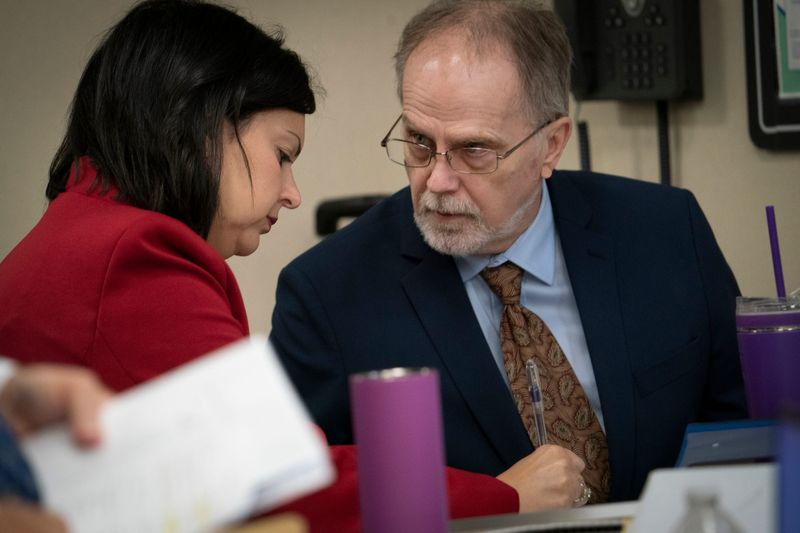
Video footage shows about 40 minutes into his hyperbaric oxygen treatment at Troy’s Oxford Center, 5-year-old Thomas Cooper moved around inside the chamber enough to pull the sheet off the mattress — and when the boy’s knee appeared to touch the bare mattress, it sparked the fire that killed him, according to a hyperbaric safety expert who testified on Tuesday, Sept. 16, in a court hearing for employees criminally charged in the boy’s death.
“A second later, the entire chamber was alight,” said Francois Burman, who reviewed video footage from the day of the fire on Jan. 31.

Burman is a mechanical engineer who has worked 32 years in the field of hyperbarics and serves on the National Fire Protection Association’s code committee and as a member of the Undersea and Hyperbaric Medical Society’s Safety Committee.
Assistant Attorney General Chris Kessel asked: “If there was a buildup of static energy … and a static discharge were to occur, would a grounding strap prevent that static discharge from occurring?”
Burman responded: “It would. … You don’t have to be an electrical engineer to answer that question. … It’s going to find the path of least resistance.”
Berman said he believes it was static electricity that caused the deadly fire based on his review of the evidence — after ruling out other potential explanations, he said the only reasonable one would point to static electricity.
Burman was the second witness called in Troy’s 52-4 District Court by the prosecution for a preliminary hearing in the criminal case against the center’s CEO and founder Tamela Peterson and three employees, all charged in Thomas’ death. Judge Maureen McGinnis must decide whether there’s enough evidence for them to proceed to trial.
Burman testified that he visited the Oxford Center’s Troy location on Feb. 5 and reviewed video footage from the day of the fire, and identified several violations of industry standards, including evidence that shows:
Burman testified that “once a fire starts in one of these chambers, it cannot be extinguished” in time to save a person’s life.
Burman said he has visited more than 200 facilities in his career, and testified that none have used the type of hyperbaric chambers that were used at the Oxford Center without grounding straps.
Defense attorneys were unsuccessful in their attempts to disqualify Burman from testifying, arguing he is not a fire marshal or fire investigator.
McGinnis ruled: “Fire cannot be separated out from hyperbaric safety,” and allowed his testimony.
According to the U.S. Food and Drug Administration, the air inside a hyperbaric chamber is made up of 100% pure oxygen in a pressurized environment. That increased air pressure helps a person’s lungs get more oxygen to tissues throughout the body, which can help it heal and fight certain infections. But it also creates a highly combustible environment that increases fire risk.
Michigan Attorney General Dana Nessel charged the Oxford Center’s Peterson, Gary Marken, its operations director, and Jeffrey Mosteller, its safety and training director, with second-degree murder and involuntary manslaughter in Thomas’ death.
And she charged Aleta Harward Moffitt — who was operating the hyperbaric oxygen chamber on the day Thomas died — with involuntary manslaughter and intentionally placing false information on a medical record.
Nessel said they all failed to follow lifesaving safety protocols that ultimately culminated in the spark from static electricity that caused the fire, killing Thomas.
The Oxford Center provided non-FDA approved treatments for a variety of conditions, including children with autism and ADHD. Nessel has described the business as a cash grab that preys on desperate families.
Defense attorneys for the Oxford Center employees questioned expert testimony and explored other ways a fire could have been caused and prevented.
For example, Todd Flood, an attorney for Marken, accused the prosecution of using “Jedi mind tricks” to lend credibility to evidence that is irrelevant in his case — like the life cycle indicator on the chamber Thomas was in that authorities allege was tampered with and dialed back by Marken.
Burman acknowledged that the life cycle counter appeared to have been tampered with, but also testified that the odometer-like device on the chamber had no relevance to the cause of the fire in this case.
“It had nothing to do with the condition of the chamber,” Burman said. “It was how it was used, not the chamber itself.”
Moffitt’s attorney Ellen Michaels emphasized that during testimony, Burman conceded a safety check may have occurred outside of what’s shown in the video, and that he also said the fire was not specifically caused by the operator’s inspection of Thomas’ pajamas.
And Mosteller’s attorney, Alona Sharon, asked questions focused on whether the operator failed to check that Thomas wore synthetic underwear combined with cotton pajamas.
She noted that the underwear Thomas was wearing contained synthetic fibers such as nylon, spandex and rayon. Those fibers, Burman said, also could pose a fire risk inside the chamber.
Defense attorneys also asked Burman about alternative means to ground a patient other than by having them wear a grounding strap and other potential causes of the fire.
Acknowledging that raising the level of humidity inside of a hyperbaric oxygen chamber reduces the risk of static buildup, Sharon also asked: “Should there be a regulation that there be a certain level of humidity in the chamber?”
Burman’s answer: “It makes sense that it should be a requirement. It would make it better, make it safer.”
Previous testimony from former employee
The first witness the prosecution called Sept. 15 was Tiffany Hosey, a former employee of the center who testified that she was fired in 2024 after she expressed safety concerns about the use of its hyperbaric chambers. Nine months later, Thomas was burned alive.
Hosey is a certified hyperbaric technologist and a hyperbaric wound specialist who worked at Detroit Receiving Hospital before taking a job at the Oxford Center in 2020. Using the type of hyperbaric oxygen chambers at the Oxford Center without the grounding straps, Hosey testified, “It means death.”
And despite several attempts to address these concerns with Peterson, Marken and Mosteller, the center’s founder instead said Hosey was “uneducated and ill-informed,” and Mosteller tried to prove the straps weren’t necessary by performing his own experiments, Hosey testified.
Industry experts, manufacturer safety manuals, and her own training suggested otherwise, Hosey said.
“I don’t have all the information about what happened to Thomas,” she said, noting that she worked primarily in the Brighton location. Thomas died in Troy.
But she does believe a grounding strap could have prevented the boy’s death, she testified.
The preliminary examination is expected to continue at a later date.
This article has been updated to include new information.
Andrea Sahouri covers criminal justice for the Detroit Free Press. Contact her at asahouri@freepress.com.
This article originally appeared on Detroit Free Press: Expert: Static electricity caused deadly hyperbaric fire at the Oxford Center
Reporting by Andrea May Sahouri and Kristen Jordan Shamus, Detroit Free Press / Detroit Free Press
USA TODAY Network via Reuters Connect