About 350,000 Michigan workers who filed for unemployment insurance benefits as far back as March 2020 must return up to $2.7 billion in benefits, Michigan’s Unemployment Insurance Agency said on Sept. 8.
Many of the affected claims were filed during the height of the covid pandemic, the agency said, but it wasn’t able to request repayments because of a court order in a class-action lawsuit against the agency.

That class-action settlement, which was filed by claimants who received unemployment insurance benefits during the pandemic and then were told they owed money back to the state and in certain cases, had their wages garnished or tax returns seized, was settled for $55 million in May.
As part of the order from the state judge approving the settlement, a preliminary injunction that prevented the UIA from engaging in collection efforts was dissolved. The pause in collections will be lifted on Sept. 12, the UIA said.
The first payments for affected workers are due two weeks later, on Sept. 29. The UIA said claimants who can’t afford the back payments can apply for a waiver.
“It’s an incredibly difficult position for these people to be in and it’s a difficult position for the UIA because we have a duty to collect this money by law,” Jason Palmer, the director of Michigan’s UIA, said in an interview with the Detroit Free Press on Sept. 8. “We could not collect for essentially five years worth of payments. So we are trying to balance that with empathy and giving people notice and giving them a chance to apply for these waivers and trying to communicate as best as we can.”
Why are so many claimants being told they were overpaid benefits?
During the pandemic, there was a massive influx of unemployment insurance claims as businesses closed their doors and workers stayed home.
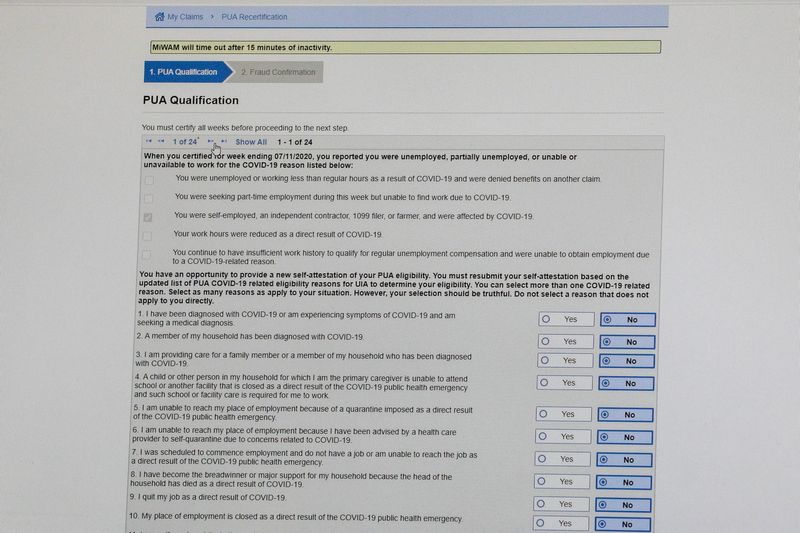
A new form of unemployment insurance was created in the early days of the pandemic when then-President Donald Trump signed the CARES Act into law. Called the Pandemic Unemployment Assistance (PUA) program, this new form of unemployment insurance extended benefits to workers not typically covered by traditional unemployment insurance, such as to freelancers, contract workers and self-employed workers.
The CARES Act also added an extra $600 to traditional claimants’ weekly benefit amount. In Michigan, the maximum benefit amount at that time was $362, so claimants could receive up to $962 until the benefits expired in July 2020. Federal money was reduced to $300 after that.
Nearly 2.5 million people applied for and received at least some of the jobless benefits they qualified for during the pandemic.
Many were denied. Others, as many as 1.83 million claimants, were approved for benefits and received them but were later told they weren’t eligible amid evolving guidance on eligibility from the federal government.
The UIA said those claimants had to pay the money back and in some cases, the agency clawed back money from those claimants. Collection activities were paused for these claimants, and for any claimant who filed for benefits on or after March 1, 2020, and were told they were overpaid benefits, as part of a court order in a class-action lawsuit against the agency in December 2022.
Who does the UIA say was overpaid benefits?
Now that the pause is being lifted, Palmer said the affected claims could have been filed at any time between March 2020 and July of this year, although the majority of the affected claims were filed in 2020 or 2021. Most of these claimants likely received money through the federal PUA program.
All of these claimants have all been told they were overpaid benefits in the pandemic, he said, but have not received any collection attempts, such as a monthly bill or having their wages garnished.
Overpayments can occur for many reasons, the agency said, including incorrect wage reporting, failure to meet work requirements or providing false or misleading information.
When asked if these 350,000 claimants committed fraud, Palmer described how the agency’s fraud manager considered fraud, as big “F” or little “F.” Big “F,” he said is people who steal someone’s identity and file an unemployment insurance claim or are part of crime rings, for example.
In Michigan, 165 individuals have been arrested or charged for unemployment fraud or identity theft, 125 people have pleaded guilty or have been convicted and 108 individuals have been sentenced, according to an unemployment insurance fraud landing page on the UIA’s website that was updated in mid-June. Several people charged with unemployment insurance fraud were UIA employees.
“Most people in this bucket are people who my fraud manager would call little ‘F,'” Palmer said. He gave examples such as claimants who misrepresented their attachment to the workforce, or claimants who, when certifying for benefits, said they didn’t work and didn’t have earnings. Once the agency received wage record data from employers, though, it found out that the person had earnings during that time frame.
Palmer acknowledged that some of the claimants who the agency said were overpaid benefits probably forgot or “assumed that we forgot. That’s why we’re trying to do all this proactive communication.”
Where will the money go?
“We are legally obligated under the Michigan Employment Security Act to seek repayment and we must fulfill our responsibility to ensure taxpayer money is returned to the Unemployment Insurance Trust Fund. …” Palmer said in a news release.
The U.S. Department of Labor requires Michigan and other states to recover overpayments, a Michigan UIA spokesperson said in an email. Palmer said the federal benefits collected will be returned to the federal government.
Palmer said the penalties in interest are being waived for most of the claims, except for fraud.
How do claimants know if the UIA said they were overpaid benefits?
Workers will receive a reminder by Sept. 9 in their online unemployment insurance benefits accounts (the Michigan Web Account Manager (MiWAM)) that they were overpaid benefits and that those benefits must be returned, the UIA said.
A follow-up collection notice known as Form 1088 will be sent as soon as Sept. 12 that includes the amount owed and information about applying for a financial hardship waiver, the agency said.
Questions concerning balances should be directed to the Benefit Overpayment Collections Unit at 866-500-0017, option No.1, then No. 4 and then No. 1, the UIA said.
What options do claimants who were told they were overpaid have?
Under the settlement agreement, UIA is prevented from collecting overpayments until protest or appeal rights have been exhausted and claimants are given a chance to request a waiver based on financial hardship, administrative or clerical error or a wage reporting error.
The UIA said workers have time to request a financial hardship waiver, and can do so by going to the “UI Claim” screen in their online unemployment insurance accounts under the “Claimant Services” tab.
Overpayments will not be waived on claims where there have been findings of fraud or intentional misrepresentation, the UIA said.
The UIA has answers to a list of frequently asked questions about the overpayments, which can be found near the top of the UIA’s website at Michigan.gov/UIA.
(This story has been updated with new directions to reach the UIA with questions.)
Contact Adrienne Roberts: amroberts@freepress.com
This story was updated to add a gallery.
This article originally appeared on Detroit Free Press: Michigan wants $2.7B from workers it says were overpaid COVID-19 unemployment benefits
Reporting by Adrienne Roberts, Detroit Free Press / Detroit Free Press
USA TODAY Network via Reuters Connect