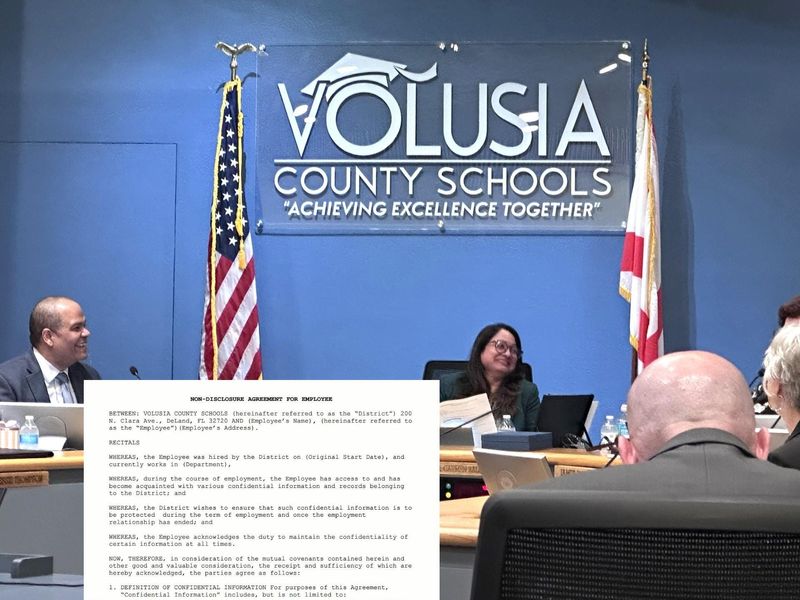
More than 100 administrative staff members with Volusia County Schools have signed “non-disclosure agreements,” which prevent them from sharing information about certain aspects of public school business, much to the chagrin of board member Donna Brosemer.
Brosemer argued during an Aug. 26 meeting that the NDAs go too far and violate Florida’s open records laws. She got pushback from Superintendent Carmen Balgobin and the district’s general counsel, Gilbert Evans, Jr., but the board agreed to further discuss the NDAs at a future workshop.

The agreements require employees to keep from public view some information that is already, by Florida law, confidential, such as records about students, employees’ healthcare, and security protocols. But more problematically, it also covers information regarding “the District’s financial operations, including budgets, funding sources and allocation of resources” and “strategic planning documents.”
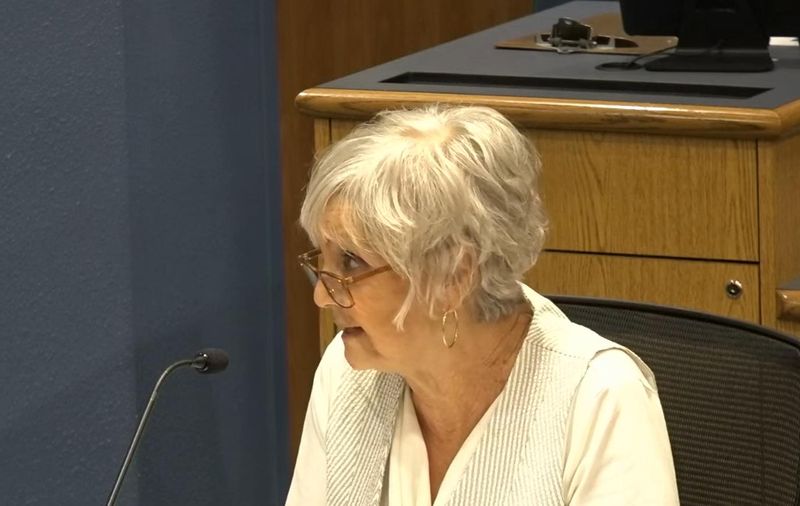
Brosemer expressed her concerns about the NDAs during the board member comments portion of the meeting, sharing with other board members a copy of the NDAs and a “legal memo” that she wrote. Brosemer, who is not an attorney, said she consulted with lawyers and lawmakers and has a background of working in the legal field.
Brosemer said Volusia County Schools cannot determine what information is to be deemed confidential. She called on board members to vote to rescind the NDAs.
“Either we rescind it, or it will be rescinded for us by a court or by the state, and could result in sanctions,” Brosemer said.
“In addition to the Constitution, we have violated Florida’s legal doctrine against unconscionable contracts, the primary element of which is that one party has such a disproportionate advantage over the other party that the other party effectively has no choice but to sign, like the position our employees were in,” she said.
Board member Ruben Colón questioned whether the board has the authority to rescind a document that was properly executed, in his opinion, by the superintendent.
Another board member, Krista Goodrich, said she doesn’t believe the NDAs were done “under the table,” but supported a workshop to bring the issue more into public view.
“I don’t think transparency is truly in question, but I think for some people it feels like it is,” Goodrich said. “… Let’s just have the workshop, share the information, and that way it clears it up.”
Brosemer’s harsh words: ‘Humiliating’
Brosemer didn’t hold back in challenging the NDAs and the district officials who oversaw their rollout.
“This is humiliating. The district has violated Florida law in a breach of public trust unlike anything I have ever witnessed in 30 years of working with Florida governments and agencies,” Brosemer said. “Some things cannot be defended and this is one of those things.”
She and Evans, the board’s attorney, locked horns.
“It doesn’t matter how many or how few were required to sign,” Brosemer said. “No competent legal counsel would allow it, much less facilitate it.”
Jamie Haynes, the board chair, suggested that Brosemer’s motion had not been on the agenda and was therefore without proper public notice, and no action should be taken until a future meeting.
Evans said a workshop discussion would be appropriate “to actually show Ms. Brosemer where she’s incorrect on several of her assertions here.”
He added: “As a certified attorney in the state of Florida, I’ve also done research on this and consulted with other districts, and I have not seen any violation of Florida law. That’s why I think I need to create a memo for the board and for you all at the next workshop, to validate … the point of the NDA.”
Haynes put in a word for Evans’ character.
“Dr. Evans is one of the most ethical people I have ever met,” she said. “He’s honest. He’s truthful. He’s ethical, and he is not going to do anything that would cause him to be disbarred.”
But Brosemer said the NDA’s problems demand accountability.
“It violates Florida law, severely damages our public standing and reputation, breeds fear in our employees, and creates justifiable suspicion between the district, the public, and the state government,” she said. “That breach of trust will be very difficult to repair.”
How did the Volusia NDAs come to be?
Danielle Johnson, coordinator of Volusia County Schools’ Office of Community Information Services, said in a July 15 email that the district asked employees in multiple departments to sign the documents starting June 11. Most employees have returned signed NDAs.
“In addition to some records that are already confidential, the agreement ensures that software or work product created while working at VCS is the proprietary right of VCS upon separation, and as such must be kept confidential,” Johnson wrote in the email. “Additional provisions like maintaining confidentiality of legal matters ensure that the integrity of legal proceedings is not compromised, as well as maintaining the confidentiality of security plans to ensure the safety of our students and staff is not compromised.”
Johnson noted: “Nothing will be kept confidential which is a public record, unless there is an exception.”
Balgobin said some district employees have in the past created work product, such as software, as Volusia County Schools employees and then attempted to sell that product to other school districts for their own benefit.
Her chief of staff, John Cash, also cited examples of people who work in payroll who might casually share information about employees’ contributions to retirement funds or the number of dependents on their tax returns.
Balgobin: “We’ve had incidents of employees who have left and taken our software to take with them to other locations. We’ve had employees that have worked in the legal department and after they left, they discussed cases.”
Balgobin cited the Family Educational Rights and Privacy Act, which restricts access to student records, and defended the NDAs as an important reminder to employees of keeping confidential information confidential.
“Failure to act, also, when you’re seeing such trailing events taking place, can put our organization at risk,” Balgobin said. “… Our general counsel has contacted many districts, including Miami-Dade, and a few others. This is not unheard of.”
What are NDAs and are they legal?
Volusia County Schools is not the first Florida governmental body that has used the NDA tool to ensure secrecy. The Florida Board of Governors now requires members of university search committees, such as at Florida A&M University this spring, to sign NDAs to ensure confidentiality, the Tallahassee Democrat reported.
Freedom of information advocates say they have heard of instances where the government has legally restricted employees from talking to the public. But they say Volusia County Schools and other local government bodies cannot on their own declare certain information to be non-public or confidential. That power rests with state and federal lawmakers.
Teachers in Volusia County weren’t among the employees asked to sign the agreement. Elizabeth Albert, president of Volusia United Educators, the teachers’ union, reviewed a copy and called it “rather benign,” yet said it raises eyebrows.
“We’re a public entity,” Albert said. “I just think a public school system funded by taxpayer dollars should be fully transparent. It does again make people think like perhaps they’re trying to hide something, but even if it isn’t, it’s just suspicious and we wonder why it’s necessary.”
First Amendment expert weighs in
Barbara Petersen, executive director of the Florida Center for Government Accountability, said while it’s “highly annoying” that a government agency might tell its employees they can’t answer questions from the public, it’s not illegal.
“Under the public records law, an agency doesn’t have to answer questions. The public records law requires that the school board and its employees provide you with access to records. It doesn’t require them to talk to you,” Petersen said.
This article originally appeared on The Daytona Beach News-Journal: Volusia school board member challenges ‘non-disclosure agreements’ placed on staff members
Reporting by Mark Harper, Daytona Beach News-Journal / The Daytona Beach News-Journal
USA TODAY Network via Reuters Connect