University of Florida wildlife researchers are building a better tegu trap, hoping a torrent of artificial intelligence technology will help mitigate the spread of an invasive reptile swarming the Sunshine State.
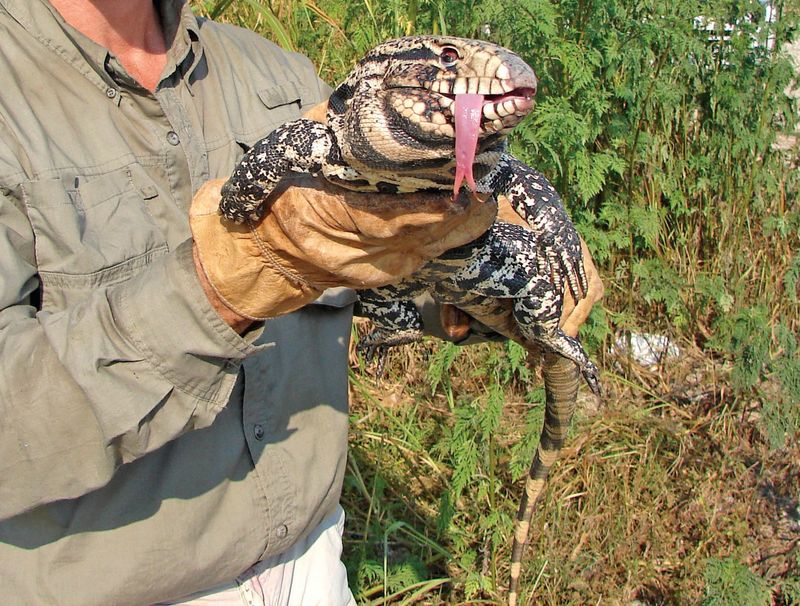
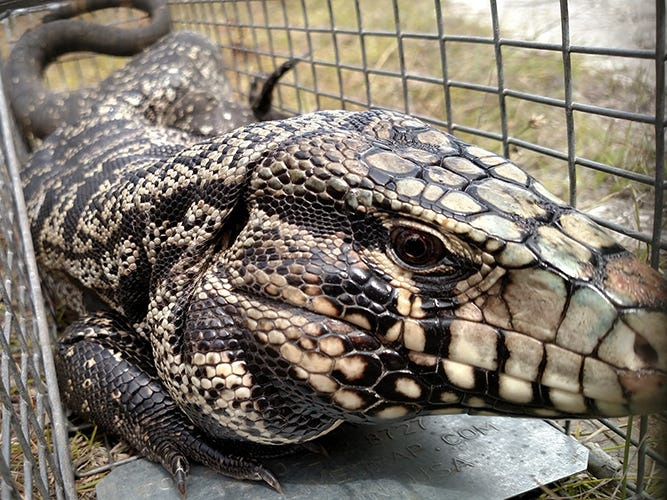
The Argentine black and white tegu’s distinctive pattern, a repetition of speckled bands that stretch from its snout to the tip of its tail, was plugged into AI software trained to recognize it as unique from other critters.

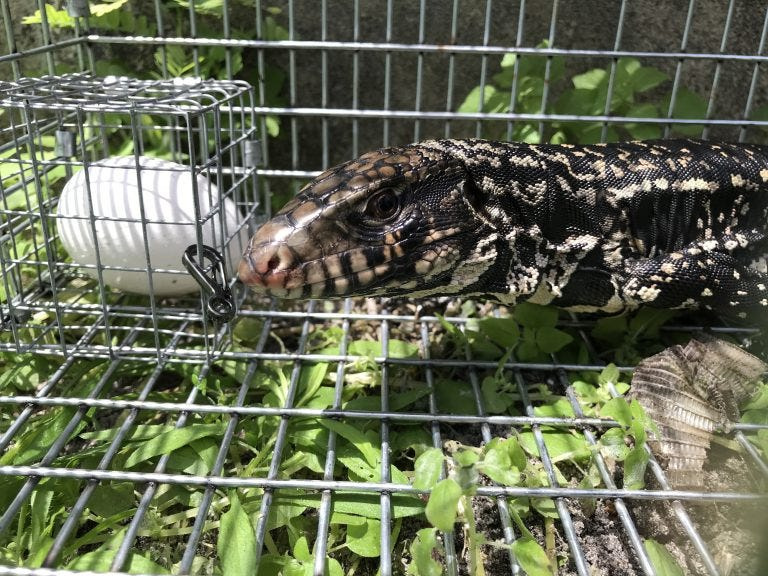
If the AI identifies an animal that wanders into the specially equipped trap as a tegu, it triggers the trap door to close and notifies a researcher via text message that the indiscriminate eater of Florida’s flora and fauna has been nabbed. If a raccoon or possum wanders into the trap, the door stays open.
If the AI mistakenly closes the trap on a non-tegu, which it did once in a test phase on a similarly marked box turtle, researchers can open the door remotely to let the animal out.
That kind of remote monitoring coupled with the AI multiplies the number of traps that can be set because they don’t need to be manually checked every day — a time-consuming process, especially in some of the harder to reach areas of the state.
“It has huge potential for helping to reduce resources in terms of time and money in managing tegus,” said Melissa Miller, lead investigator on the trap project and a wildlife ecologist with UF’s Institute of Food and Agricultural Sciences in Fort Lauderdale.
“With this, you can put out a lot of traps with minimal effort, and to really have an impact, we have to have a sustained trapping effort with a lot of traps for multiple years.”
Tegus, which were added to Florida’s prohibited species list in 2021, can grow to 4 feet long and have been popular household pets for some reptile fans because they can be housetrained and are considered unusually smart. Tegus that were acquired before 2021 were allowed to stay with their owners after being registered.
In the wild, tegus are harmful to native Florida habitat, eating everything from bananas to baby gopher tortoises. A key concern is their appetite for eggs, whether it be sea turtle, crocodile, alligator or bird. The AI traps are baited with chicken eggs.
Also, because tegus are cold-tolerant and will burrow to stay alive during the chilliest winter days, they are believed to be spreading north and multiplying. Eradication efforts of a wild population of tegus are underway in at least two counties in southeast Georgia, according to the Georgia Department of Natural Resources.
In Florida, there were just five black and white tegus reported statewide in 2005, according to the University of Georgia’s EddMaps invasive species tracking system. By 2015 that was up to 840, and last year 1,230 were spotted, caught or found dead.
There are known breeding populations in Hillsborough, Miami-Dade and Charlotte counties. About 50 tegus have been reported in Palm Beach County.
UF wildlife professor Frank Mazzotti, who leads the school’s Croc Docs research team, said he was shocked in 2019 when Palm Beach County residents were asked to help identify Nile monitor lizards in their communities and half of the photos that were sent in were of tegus.
“For all these invasive species, we really don’t have monitoring programs in place to look at the spread and increase in numbers,” Mazzotti said. “It’s like we’re fighting in the dark.”
A more recent discovery has been a growing number of tegus in St. Lucie County, which is where Miller and her colleagues tested the AI traps over a six-month period in 2023. UF worked with the company Wild Vision Systems on the traps. The company won a 2022 Theodore Roosevelt Genius Prize from the U.S. Fish and Wildlife Service for its smart-trapping system.
The traps, which are solar-powered, have a box that sits on top of them that contains the AI software and a camera. Miller said she would like eventually to make the traps generally available to wildlife managers and homeowners.
“To my knowledge, we are the only folks in South Florida that have an operational, fully automated, smart trap on the landscape,” Miller said.
Miller is working to get more money to pay for additional research and to modify the traps to catch other large invasive lizard species. She said the traps, even if modified, probably wouldn’t work with the loathsome Burmese python because it is more of an ambush predator. Large pythons would also be hard to snag in a trap, she said.
But she can see the traps being successful with iguanas and Nile monitors, which are established and breeding in Palm Beach County. Many Nile monitor sightings are along the C-51 canal.
Nile monitors, which are semiaquatic, were also added to the state’s prohibited species list in 2021. The average adult grows to 5 feet in length, according to FWC. Since 2010, about 300 Nile monitors have been recorded by EddMaps in Palm Beach County.
There have been 2,000 EddMaps reports of iguanas in Palm Beach County, but they are so ubiquitous most people likely don’t take the time to officially record or report them.
“There has been an explosion of iguanas and everywhere they are, they are just increasing. It’s going crazy,” Mazzotti said. “Within Palm Beach County, they are occupying more areas, and these semi-cold winters, if anything, just result in more cold-tolerant iguanas.”
Kimberly Miller is a journalist for The Palm Beach Post, part of the USA Today Network of Florida. She covers real estate, weather, and the environment. Subscribe to The Dirt for a weekly real estate roundup. If you have news tips, please send them to kmiller@pbpost.com. Help support our local journalism: Subscribe today.
This article originally appeared on Palm Beach Post: Argentine black and white tegu trap powered by artificial intelligence and sunshine
Reporting by Kimberly Miller, Palm Beach Post / Palm Beach Post
USA TODAY Network via Reuters Connect