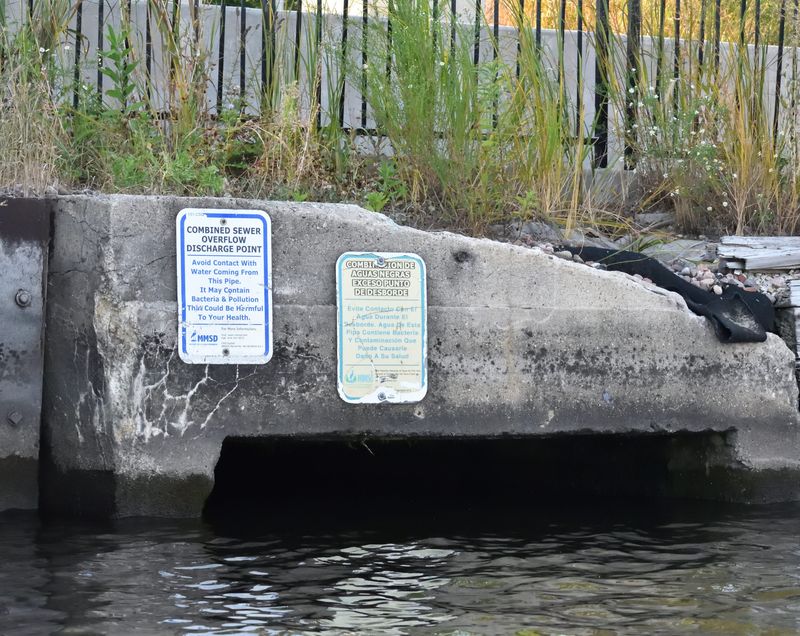
The historic 1,000-year flood that dropped upwards of 10 inches of rain in some areas led to the largest combined sewer overflow since the Deep Tunnel went fully into operation in the early 1990s.
The torrents of rain led to about 5.14 billion gallons of untreated wastewater being discharged into nearby waterways and Lake Michigan. The Milwaukee Metropolitan Sewerage District initiated the overflow at 9:55 p.m. on Aug. 9. It lasted 78 hours, after ending at 3:55 a.m. on Aug. 13.

The Deep Tunnel went into operation in Aug. 1993. Prior to it going into operation that year, 8 billion gallons of untreated wastewater were released, and 9 billion gallons were released in 1992.
The last sewer overflow of a similar magnitude to this occurred in 1999, when about 4.4 billion gallons was released.
Milwaukee uses a combined sewer system, where stormwater and wastewater from homes and businesses travel through the same pipes to treatment facilities. During heavy rain, if the treatment plants and deep tunnel reach capacity, the sewerage district may have to release untreated water into Milwaukee’s rivers and Lake Michigan to prevent backups into homes and businesses.
While most of the untreated water released during an overflow is a mix of groundwater and water from the storm sewers rushing right out of the system, there is a chance of bacteria flowing into the bodies of water that receive releases.
Given the massive rain event the areas impacted were extensive. They included:
This has been the only combined sewer overflow so far this year. However, in March approximately 10,000 gallons of wastewater was mistakenly released by contractors of the sewerage district into a storm sewer rather than the sanitary sewer. In April, about 1,000 gallons of wastewater leaked into Lake Michigan due to a broken pipe inside of the South Shore Water Reclamation Facility.
At least $23 million in damages and growing in Milwaukee County
The Aug. 9 to 10 storm ranks second for a two-day rain event since the National Weather Service began recording that data in 1871. The storm was so rare, it’s considered a 1,000-year flood event, meaning it has a 1-in-1,000 change of occurring in any given year.
Floods are Wisconsin’s second-most frequent disaster declaration, resulting in $123.7 million in damages since 1999, according to a new report released by the Wisconsin Policy Forum. That number does not include southeastern Wisconsin’s most recent flood event.
Milwaukee County estimates that damages to infrastructure, like roads, park systems, bridges and waterways from the historic flood event will be at least $23 million.
More than 11,500 requests for flood-related services have come in to 211 from across Milwaukee County and the surrounding Waukesha, Ozaukee and Washington counties as of the afternoon of Aug. 14. Of that number, roughly 85% of the requests for service came from Milwaukee alone.
MMSD has spent more than $580 million to prevent flooding, overflows
The sewerage district serves 1.1 million people across 28 communities, including the city of Milwaukee and many surrounding suburbs. By federal law, the sewerage district is allowed six overflows per year. The district has been able to capture and clean an average of 98.6% of wastewater since 1994.
Since 1995, the sewerage district has invested more than $580 million in green infrastructure and flood management project to improve the landscape’s ability to hold onto water, helping to avoid overflows. Green infrastructure helps nature do its job by absorbing and storing rain and melting snow. It protects against flooding and excessive heat as well as improves air, soil and water quality, which can help the city better adapt to a changing climate.
The district has an additional $712 million in future flood management projects planned.
Residents can sign up for alerts to learn when overflows are happening by texting WATERDROP to 414-296-4422.
Vanessa Swales, Alison Dirr and Sophia Tiedge contributed to reporting on this story.
Caitlin Looby covers the Great Lakes and the environment for the Milwaukee Journal Sentinel. Reach her at clooby@gannett.com, and follow her on X @caitlooby.
Caitlin’s work is supported by the Brico Fund, Fund for Lake Michigan, Barbara K. Frank, and individual contributions. Grants and donations help make this reporting possible. The Journal Sentinel maintains full editorial control.
To learn more about our community-funded journalism initiatives, or to make a tax-deductible donation, visit https://givebutter.com/milwaukee-journal-sentinel. Checks can be addressed to Local Media Foundation with “JS Environment” in the memo, then mailed to: Local Media Foundation, P.O. Box 85015, Chicago, IL 60689.
This article originally appeared on Milwaukee Journal Sentinel: Historic 1,000-year flood led to largest sewer overflow since Deep Tunnel installed
Reporting by Caitlin Looby, Milwaukee Journal Sentinel / Milwaukee Journal Sentinel
USA TODAY Network via Reuters Connect