The Department of Natural Resources says August is the time of year for residents to help stop the invasive Asian longhorned beetle from taking hold here and destroying Michigan’s maple trees.
As part of the DNR’s efforts, officials are asking residents to report any sightings.

“Each year, (Animal and Plant Health Inspecetion Service) declares August as Tree Check Month because this is the most likely time to see the beetle and the damage it causes to trees,” the DNR said in an Aug. 7 release. “Everyone can help look for signs of this destructive beetle by checking trees on their property and in their community for damage.”
The Asian longhorned beetle is an invasive species across North America that accidentally was imported from Asia. It will feed on and breed in numerous hardwoods, but seems to prefer maples, according to a University of Vermont study.
Populations are known to be present in areas of southern Ohio, Massachusetts and New York. The species has not been detected in Michigan, however, if they become established in the state, they would devastate native trees, prompting significant tree removal, the DNR said.
“Discovering early signs of infestation can prevent widespread damage to the state’s forest resources, urban landscapes and maple syrup production,” the release said.
In August, the beetles tend to emerge from trees by chewing holes from the inside. They often target maple, elm, horse chestnut, birch and willow trees.
The Asian longhorned beetle has been successfully eradicated from Illinois and several areas of New Yorkand New Jersey, the University of Vermont said in a report.
Here’s what to know about the Asian longhorned beetle.
What does the Asian longhorned beetle look like?
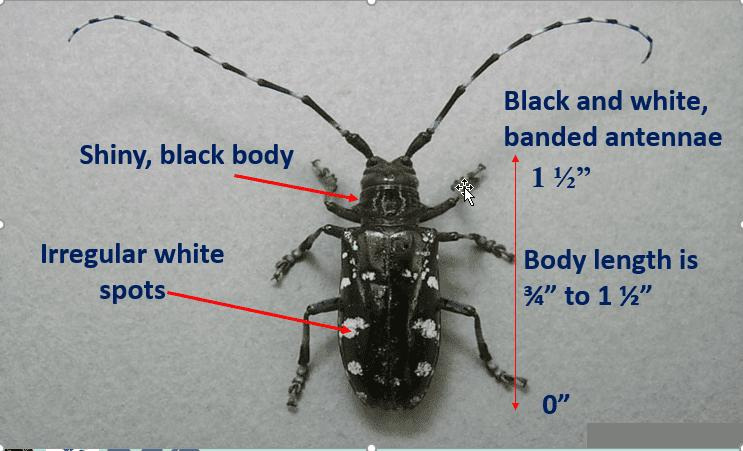
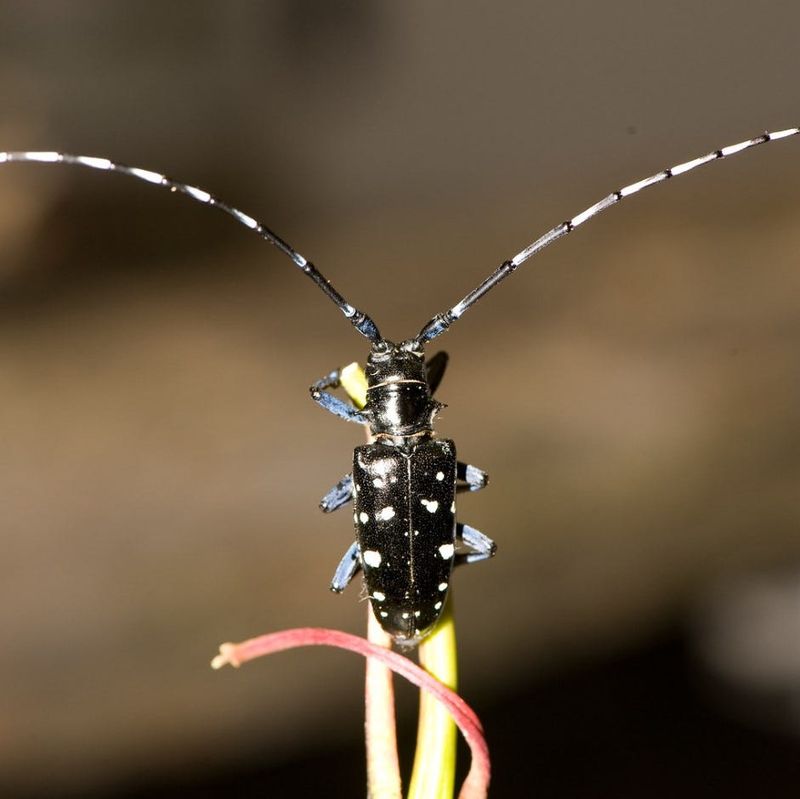
The Asian longhorned beetles (Anoplophora glabripennis) have long antennae that can be longer than the body, which is three-quarters to 1.12 inches long.
Adults have a shiny, black body with white spots, about the size of an almond.
Adults have six legs that can appear with a blue-ish color.
What are the signs of Asian longhorned beetle activity?
The Asian longhorned beetle is an insect that attacks and kills maple and other hardwood trees, the USDA says. The insect grows inside trees and feeds on the living tissues that carry nutrients. Trees cannot heal from the damage it causes. Infested trees can become safety hazards since branches can drop and trees can fall, especially during storms.
Here are the signs of Asian longhorned beetle activity in a tree:
Adult females will chew a hole into a tree to lay an egg inside the bark, the University of Vermont said. The shape of the pits will vary based on the thickness of the outer bark, ranging from circular, to oval, to just a slit on thin-barked trees. Mandible (teeth) marks are often visible on the outer edges of the pit. The color of the pit depends on the host tree and age of the pit. Generally, freshly chewed pits are easier to see because the inner bark contrasts with the outer bark.
Eggs hatch in 10 to 15 days and the larvae feed on the wood of the tree. Larvae frass, appearing like sawdust, may collect on an infested tree.
Adult beetles will feed along the vein lines of leaves.
Look-alikes: Which beetles are mistaken for being the Asian long horned beetle?
Oftentimes, bugs and beetles native to Michigan get confused for being the Asian longhorned beetle.
Here are the look-alike species and their distinguishable characteristics:
What should I do if I see an Asian longhorned beetle in Michigan?
If you may have spotted an Asian long horned beetle, the DNR asks residents to take note of the location, snap a photo of the beetle and/or the tree damage and collect the beetle in a container and freeze it for preservation.
Residents can report their potential sighting to the ALB hotline at (866) 702-9938, or submit an online report through the ALB website.
Why would Asian longhorned beetles be a problem in Michigan?
More than 1 billion maple trees grow in the Michigan, of which are the beetle’s favorite tree. If the beetle is found in native trees it would result in a costly eradication.
“Tree removal is unpleasant, but it has been successful in eradicating ALB populations in New Jersey, Chicago and Toronto. Early detection is critical,” the Michigan Invasive Species program said.
How can I help prevent the spread of Asian longhorned beetles?
Residents can help the aid in limiting their distribution by checking trees, reporting signs and traveling or camping with only local materials.
“When traveling, leave firewood at home and purchase what you need locally or choose certified, heat-treated firewood to help prevent this destructive pest from showing up at your favorite places,” DNR’s release said.
Contact Sarah Moore @ smoore@lsj.com
This article originally appeared on Lansing State Journal: Michigan officials want you to help count these insects if you see them. Then kill them
Reporting by Sarah Moore, Lansing State Journal / Lansing State Journal
USA TODAY Network via Reuters Connect