

Jerry DeCaire will be at several branches on July 8 and 9
By Barb Pert Templeton

Popular Comic Book Artist Jerry DeCaire, who’s known for his work on iconic characters like Wolverine, Thor, and Deadpool for Marvel Comics, will bring his talents to several branches of the St. Clair County Library System in early July.
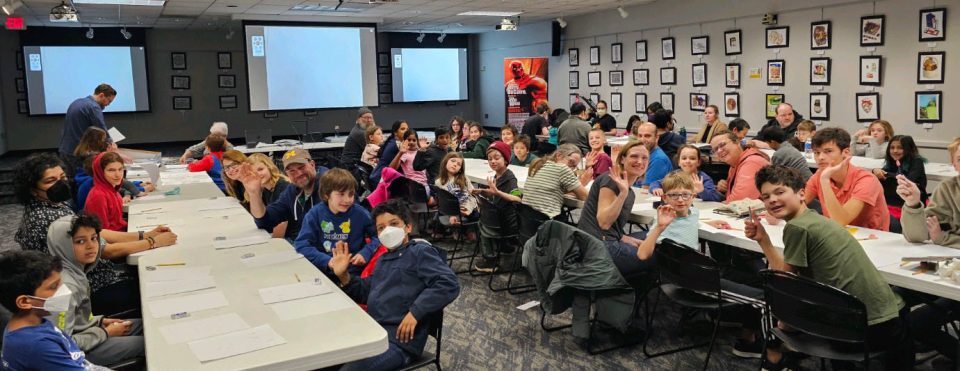
Four hands-on art workshops will have DeCaire demonstrating his unique approach to comic illustration, blending art with math. A library press release states “participants of all ages will learn tips and techniques to bring their own drawings to life.”

On July 8th DeCaire will be in Capac from 10 a.m. to 1 p.m. and then in Yale from 3 to 6 p.m. Then on July 9th he will host workshops in Marysville from 10 a.m. to 1 p.m. and in Algonac-Clay from 3 to 6 p.m. All four programs are for all age groups and registration for the workshops is required by contacting the branch the participant plans to go to.
DeCaire, who was born in Saginaw, Michigan, grew up there on a 20-acre corn farm along with his parents and two sisters. He attended the Tri-Cities Delta College and took some courses at Saginaw Valley State University before later getting his undergraduate degree from Central Michigan University. DeCaire currently resides in Mount Pleasant, Michigan.

Comic Book Artist Jerry DeCaire.
He noted that he has “lived virtually everywhere” including Hollywood, Los Angeles, Houston, Fort Worth, and has visited 47 of the 50 states. DeCaire said he’s been married twice but never had any children.
Blue Water Healthy Living caught up with the artist via email to pose some questions about his amazing career as a comic book artist.
Blue Water Healthy Living: When did your interest in being a comic book artist start?
Comic Book Artist Jerry DeCaire: My interest in art, and especially drawing, was sparked by observing a drawing of a German Shepherd hanging on my mother’s living room wall. I was only eight at the time. I can even remember the first focused and serious drawing I have ever done. After a prayerful chat with God at my bedside, asking for the gift of art, I took a Halloween mask of a clown and traced it on a tablet of paper. I then set the mask aside to my left and detailed its values on the paper to my right. At this time, I was also reading Marvel’s superhero comics, but it wasn’t until I was a young man that I merged the two interests and considered a career as a comic book artist. It was quite a turn from my original intent of being the next Michelangelo or a graphic designer for a studio.
BWHL: Is yours a natural talent or something you had to keep practicing over the years?
DeCaire: I would argue, both. I would also add that it isn’t enough to have talent because the competition is fierce. You must always continue in your practice to make the best of your gifts.
BWHL: Do you have any formal education in cartooning/drawing?
DeCaire: I studied art education and the life sciences, but I never pursued a formal education in cartooning. Drawing, yes, but I never went through a program on comic art. All of that is self-taught while leaning on the publications of Andrew Loomis and the well-known library edition, “How to Draw Comics the Marvel Way,” by Stan Lee and John Buscema.
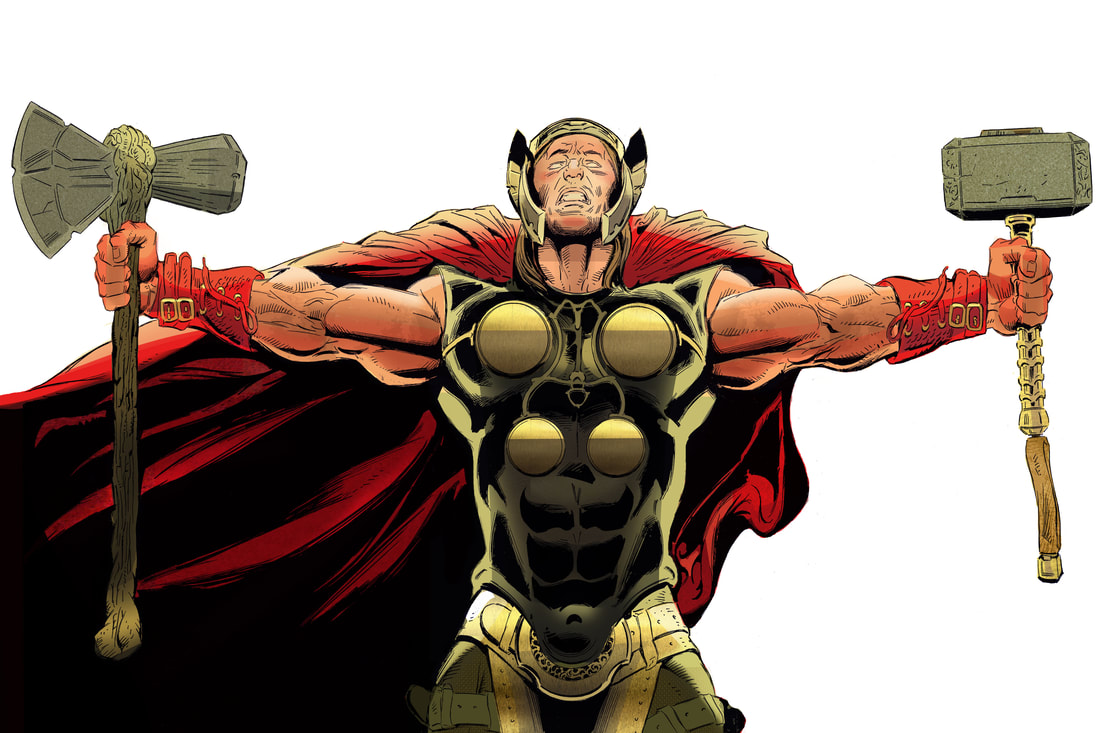
This character called “Galactus-Slayer Thor” was illustrated by Jerry DeCaire for “Thor Annual #19” for Marvel Comics.
BWHL: How did you become an artist for Marvel Comics?
DeCaire: In 1991, I was staying at the YMCA in Saginaw and submitted six pages of continuity art to Marvel’s Submission Editor. It was October of 1991 when I received the life-changing call from the editor of the X-Men, Bob Harris. I was assigned a short story for X-Men Annual #15.
BWHL: Can you tell us a little about your work for Marvel – do you create characters for the pages or do they assign outlines for characters they want to feature in their publications?
DeCaire: Virtually all of the books I have illustrated for Marvel Entertainment featured characters that were properties of the company before I was ever assigned any books to draw. The one character I have made a substantial contribution to would have to be the nemesis of Deadpool called Malachi, who was originally featured in the Secret Defenders series. The writer thought her up, and I came up with her costume and appearance. It was akin to a Stan Lee/ Jack Kirby relationship in regards to the creation process.
BWHL: Have you published your own comic books or created an entire comic book for Marvel that features all of your work? Which one?
DeCaire: I’m currently working on my own production, the time-traveling vigilante, The Which-When Man. I’ve also illustrated many books for Marvel including titles like Thor, Deadpool, Wolverine, etc.
BWHL: Do you have a favorite character that you never get tired of drawing?
DeCaire: Strangely enough, the one character I enjoy drawing the most is a character I have never illustrated for a book publication, The Silver Surfer. He’s all figurative with no goofy costume messing with his streamlined presentation. He moves with the grace of a ballet dancer and capturing that can be mesmerizing.
BWHL: When did you begin hosting programs for the public and how did that come about?
DeCaire: I did, maybe a couple of events starting in 2007, but it was in 2012 that things really took off. I presented to schools for The Bureau of Lectures and Concerts and traveled the entire USA from coast-to-coast. I then went off on my own, and the rest is history.
BWHL: What part of the public programs do you enjoy the most?
DeCaire: I love to draw live for the audience with the assist of my document camera. There’s this line from the famous musician, Jackson Browne, that best reflects my ups and downs with hosting public programs; “The audience was heavenly, but the traveling was hell.”
BWHL: What advice would you share with a child that’s really interested in becoming a comic book artist?
DeCaire: You have to remember that superhero comics isn’t like drawing Charlie Brown. If you want to draw Spiderman, first learn to draw a real person. Then read and listen to the giants on tips on how to layout a page and how to tell a story in pictures. As a comic book artist, you’re not just an artist, you’re a film producer.
BWHL: Is the profession a lucrative one or more about the joy you find in drawing?
DeCaire: If you’re just starting out, it can be brutal. You’re paid in two ways; a basic page rate and the residuals acquired from book sales. It takes time to get the kind of experience you need to get a namesake and to be able to demand a decent page rate. If you’re a big-name Joe, your page rate will be higher, and sometimes much higher. As for residuals, some character lines command a more popular readership. For example, I got some pretty hefty residuals for X-Men and Wolverine, but not so much for Thor. I, personally, am a fan of Thor, but not everyone is.
