CROSS PLAINS — Was Conan the Barbarian a Depression-era hero?
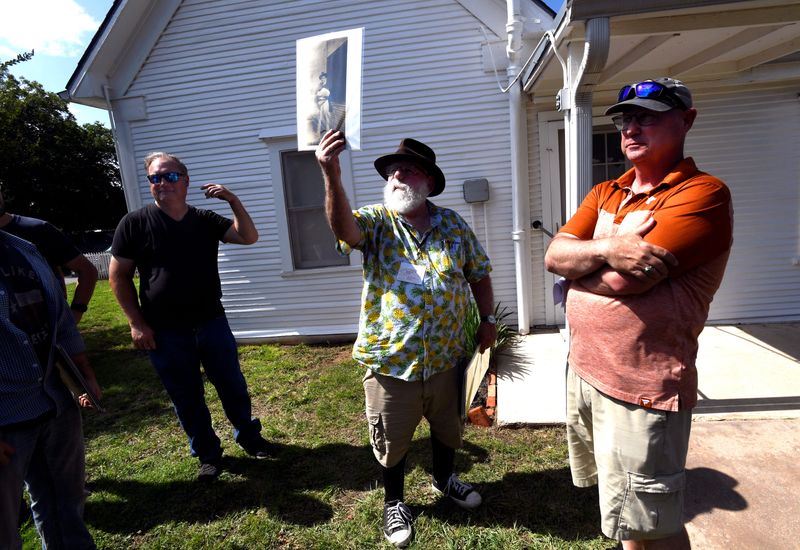
“One hundred percent,” said Jeffrey Shanks.

A professional archeologist, Shanks is also one of the directors on the board of the Robert E. Howard Foundation.
Howard, arguably this small Texas town’s most famous son, created Conan, Kull the Conqueror, Solomon Kane and a host of other memorable characters for pulp magazines from the 1920s until his death in 1936.
From June 12-13, a group of Howard scholars, enthusiasts and the merely curious gathered as they have every year at this time to celebrate the author’s work and his impact on speculative fiction. The weekend is sponsored by Project Pride, a civic organization that also maintains Howard’s home as a museum, and the Howard Foundation.
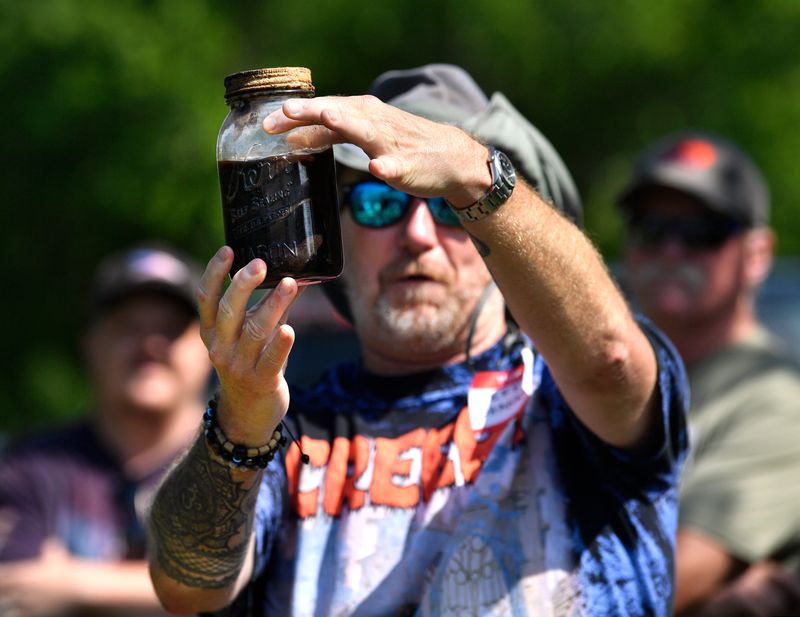
“Let’s unpack this a little bit, right?” Shanks said, diving into his dissection. “Howard is writing in the Depression. He’s writing in the early 1930s. This is a time when the institutions of civilization have failed most people.”
With the economic rug pulled out from beneath them, simply surviving was the tallest order of the day. This was the era of soup lines and “The Grapes of Wrath,” bank runs and an overall evaporation of stability.
It was also the era — particularly in Texas — of daring criminals like Bonnie and Clyde, John Dillinger and Pretty Boy Floyd.
“These were the folk heroes of the 1930s,” Shanks said. “The bad guys weren’t the bank robbers. They were the bankers.”
An American idea
Living with his mother and father, the former perpetually in poor health and the latter a country doctor, Howard developed a cynicism for institutions. You could see it manifest within the characters populating his work, particularly in Howard’s Hyborian Age where his Conan stories were set.
“You see the corrupt magistrate, or the priest that takes bribes and is really a fence,” Shanks said. “All of those institutions of politics, economics, religion, that are supposed to hold society together, what Howard was saying is that’s all a façade. At its heart, it’s corrupt.”
Conan, as a “barbarian,” comes from a place outside of those institutions, which when cast through the lens of Howard’s worldview, allows the character to be uncorrupted by them. Conan finds he can not only navigate those systems but use them to make his fortune.
In truth, it’s a very American idea.
“Very American,” Shanks agreed. “Look at the times in our history when Conan comes back into popularity, the late 60s, early 70s, a time when we were cynical and questioning authority.”
Shanks said interest in Howard’s Conan has begun to rise once more. It’s rooted not only in the desire to read a ripping good yarn but indicates a connection to the public’s deeper reaction regarding the state of our current world.
“Regardless of what your political beliefs are, we’re living in another era of cynicism,” Shanks concluded. “I think everybody is pretty cynical about the institutions of power in the world today.
A family reunion — with swords
That’s heady stuff for a Saturday afternoon in the Big Country. But if you envisioned this gathering of Howard scholars as a rural Callahan County Comic Con, you’d be wrong.
Mostly.
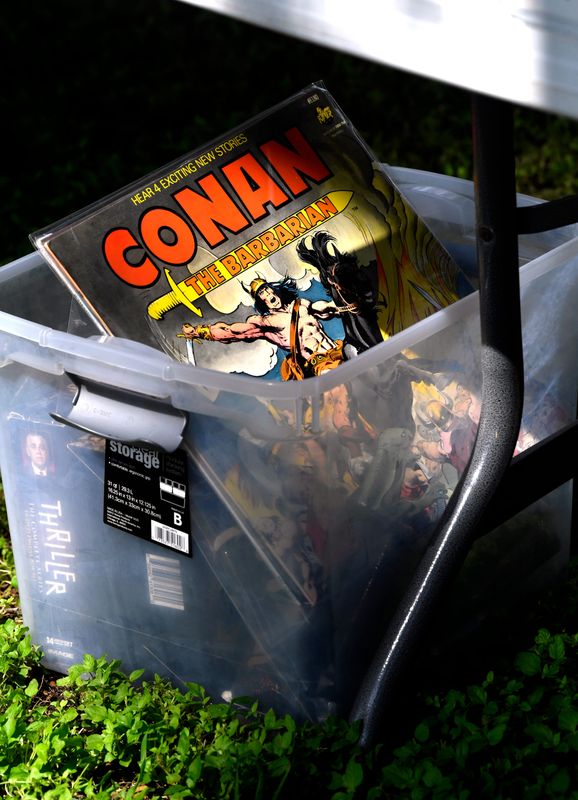
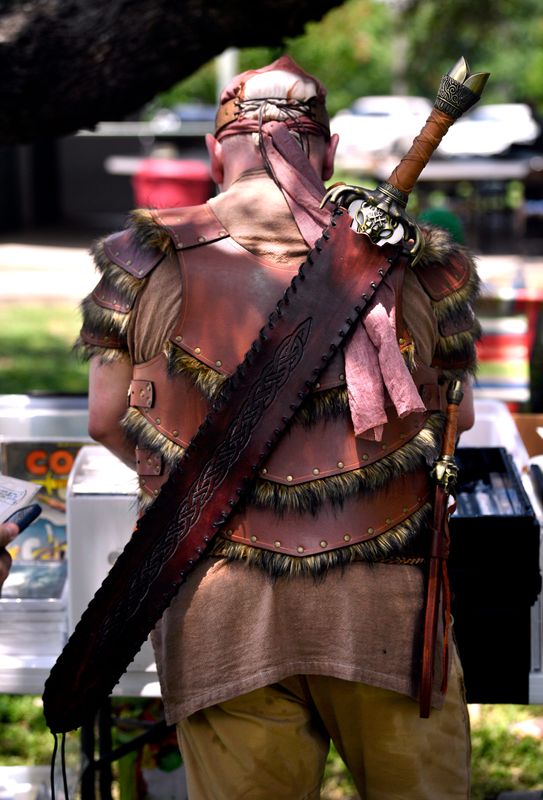
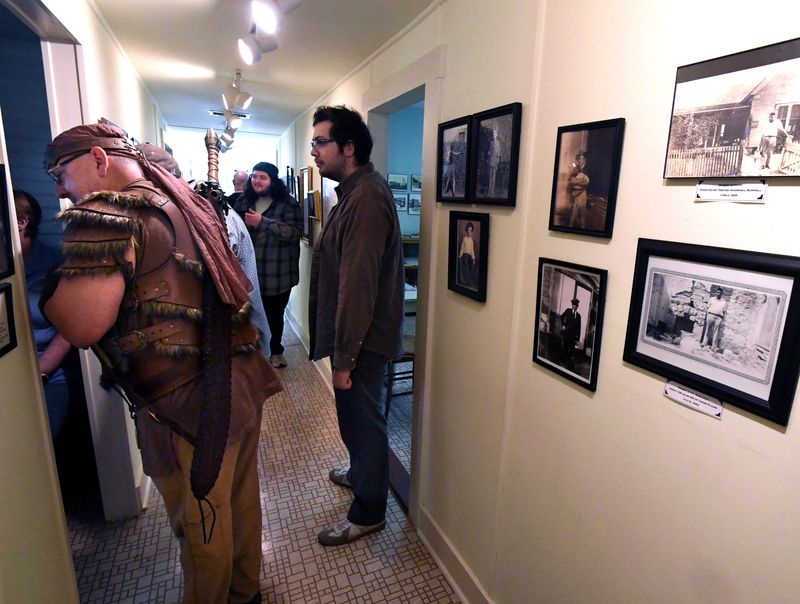
“There was a guy here today dressed as a barbarian,” Shanks said. “That’s certainly welcome, but it’s not like your typical con. It’s really more like a family reunion.”
I’d reached the same definition about an hour earlier over a bowl of homemade chocolate ice cream offered by one of the attendees. The vibe I got felt closer to the shindig my uncle used to throw every summer on his Iowa farm rather than a convention.
This year’s event celebrated the 100th anniversary of the publishing of Howard’s first story, a 1925 tale called “Spear and Fang” published in the July edition of Weird Tales.
An early horror fiction, horror fantasy magazine, Weird Tales was one of the “pulps” Howard made his living writing for, named for the cheap paper they were printed with.
“A number of fairly famous writers, like H.P. Lovecraft, wrote for Weird Tales,” Shanks said. “Tennessee Williams, of all people, actually had a story in the same 1928 Weird Tales issue that Solomon Kane debuted in. He was only 16 years old.”
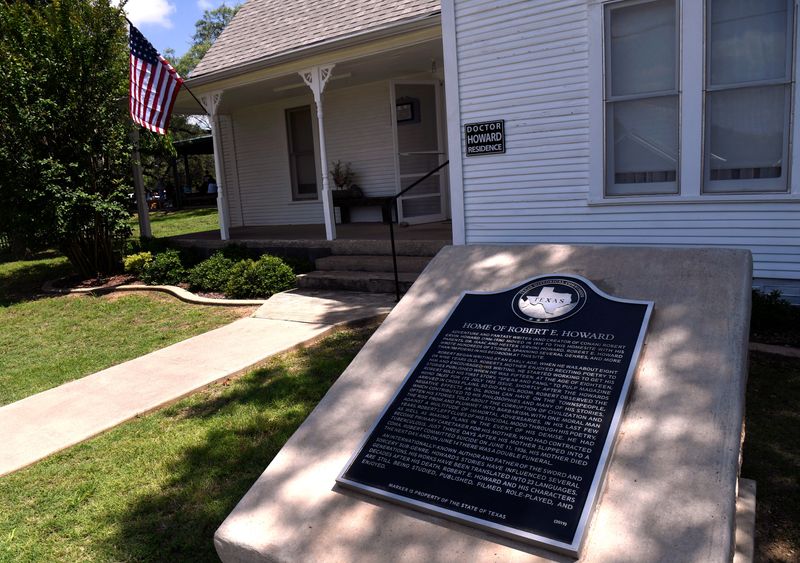
Howard’s family house is also the home for the gathering. The building was purchased by Project Pride in the 1980s with the mission of not only restoring the house to resemble how it looked when the Howard family lived there but also as a vehicle for promoting pride for Cross Plains within the community.
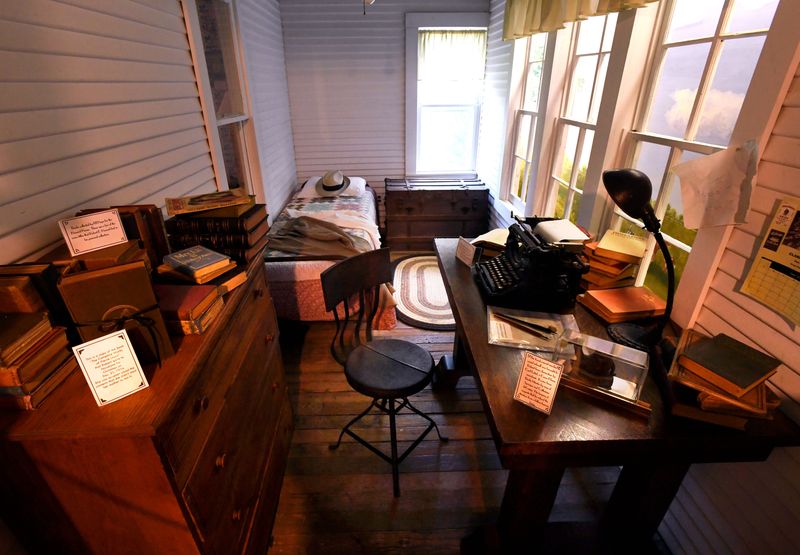
You can see the small room where Howard slept and worked. The Underwood typewriter isn’t the same one he used but the table upon which it rests was the original one upon which the author hammered out his tales.
Outside the home, a covered pavilion is nestled within the shade of large oaks. During the author’s life, that same spot was occupied by a neighbor’s house, but when it came to being neighborly, you might call Howard a work-in-progress.
‘Die!’
“Mrs. Howard was always very nice to the next-door neighbor’s kid, Leroy Butler. She called him son,” said Paul Herman, the secretary and treasurer of the Howard Foundation. “But then one weekend after he’d gotten married, he was over to visit, and Mrs. Howard seemed rather cold.”
In fact, Howard’s mother seemed downright unfriendly. Butler soon learned that his own mother and Hester Jane Ervin Howard had a falling out over her son’s expressive writing habits.
“To get the sound right for his story, (Howard) would shout out loud whatever he was thinking about,” Herman said. “And he didn’t really care if the neighbors liked it or not.”
Leroy Butler’s mother wasn’t the only person to be startled by Howard’s determination in finding the perfect epithet for his protagonist’s voice.
A young woman was sent running once after she rounded a car beside the home only to hear the author bellow at the top of his lungs, “Die you son of a dog! Die!”
In his defense, Herman explained that was simply part of Howard’s creative process.
“He was screaming out loud to get the pungency, to see if it sounded right,” Herman said.
Two-fisted process
The author was infamous for writing day and night for perhaps three days straight with little sleep, the story burning through him, before collapsing into bed for a few days and then doing it all over again when he’d recovered.
As boxing stories were some of Howard’s biggest sellers, he accordingly built his physique so he could learn to box and then started frequenting the town’s ice house to fight in amateur bouts.
“In Prohibition, the ice house was where you stashed all the beer to keep it cold. It kind of functioned like a rural speakeasy,” Shanks said. “Everybody would go down there; all the roughnecks from the oil fields, the farm hands after work. They’d drink beer, put on the gloves, and they would box.”
Howard would draw from those experiences to craft his stories.
“He’d be walking down the street, suddenly go into a stance, and you’d see him start boxing,” Herman said. “This fist there, duck here, twist, step-step, punch-punch, just as he’s going down the street to the post office.”
Herman laughed, “And people are like, ‘What the hell is he doing?’ They don’t know.”
But others did.
“That’s just Bob Howard,” they’d tell each other.
For a man who earned a living writing stories of all things, glimpsing Howard bob-and-weave down Main Street was just another Tuesday.
On the other hand, Howard’s reputation as a local boxer was that he never lost. He’d take on anyone willing to fight.
But it took a young fighter who wouldn’t stay down to get Howard to quit.
“This kid got back up, and Howard knocked him down again,” Herman said.
Howard knew how dangerous “iron men” could be to their own bodies, he’d seen it before.
The young fighter staggered to his feet, lifted his fists for another go, and Howard said no.
“’I’m not going to hit him,’” Herman said, quoting the author.
The men running the fight disagreed and told Howard he had no choice. There was money on this.
Howard threw down his gloves.
“No, I’m done,” he said and walked out, never to return.
The original mash-up
As the pulps grew in popularity, they became more specialized in their genres. For Howard, that became an opportunity.
The author would mash-up the genres. His boxing stories would range from serious to funny to spooky.
His credit as the father of the Sword and Sorcery genre is drawn from marrying a swashbuckling adventure like “The Three Musketeers” with gothic or Lovecraftian horror elements. If one pulp wouldn’t take a story, it was likely another would.
The weird Western was likely another Howard creation.
“He wanted to write westerns, but he would include a supernatural element, because he knew if he couldn’t sell it to a western pulp, he could always sell it to Weird Tales,” Shanks said. “So, you end up getting a Texas gunslinger fighting a vampire. That was the beginning of the weird Western genre.”
Building out the REH legacy
Bringing those stories to light is a large part of the Robert E. Howard Foundation’s mission. Since the mid-2000s, the rights for Howard’s work has been managed by a group called Heroic Signatures. While Del Rey Books gets to release the name-drop stories featuring Conan, Kull and the like, the foundation publishes the rest.
“Twenty-three volumes: letters, poetry, pirates, about four volumes of boxing, two of the funny Westerns, all kinds of different things,” Herman said.
Shanks said the original mission was to get all of Howard’s work in print in authoritative versions not only for fans to read but also for scholars studying the author’s work.
“You need authoritative text,” Shanks said. “Many of the texts of our stories over the years were heavily edited by various hands.”
Now the larger goal is to promote Howard’s life, his works and honor his legacy in whatever way they can.
An imagination inspired by Texas
Maybe you’re scratching your head. How did laid-back Cross Plains inspire Howard’s wild characters?
“This was an oil boom town at the time, a fairly rough place,” Shanks said. “You would see horrible bloody accidents, and people working hard to live.”
Born in 1906, Howard lived in an era where the Texas frontier, gunfighters like John Wesley Hardin and Comanche chiefs like Quanah Parker were still within living memory.
“He’d tell those stories to H.P. Lovecraft,” Herman said. “And somebody like Lovecraft, who is up in New England where it’s been settled for hundreds of years, just has no idea all that could be so close.”
Howard took it all in, pressing and shaping it into something larger than life.
“These great adventure stories were rooted in gritty, primal realism,” Shanks said. “Because he experienced that living here in early 20th century Texas.
“He must have had the most incredible imagination.”
This article originally appeared on Abilene Reporter-News: Fans celebrate a bold century of published work from Conan’s creator, Robert E. Howard
Reporting by Ronald W. Erdrich, Abilene Reporter-News / Abilene Reporter-News
USA TODAY Network via Reuters Connect