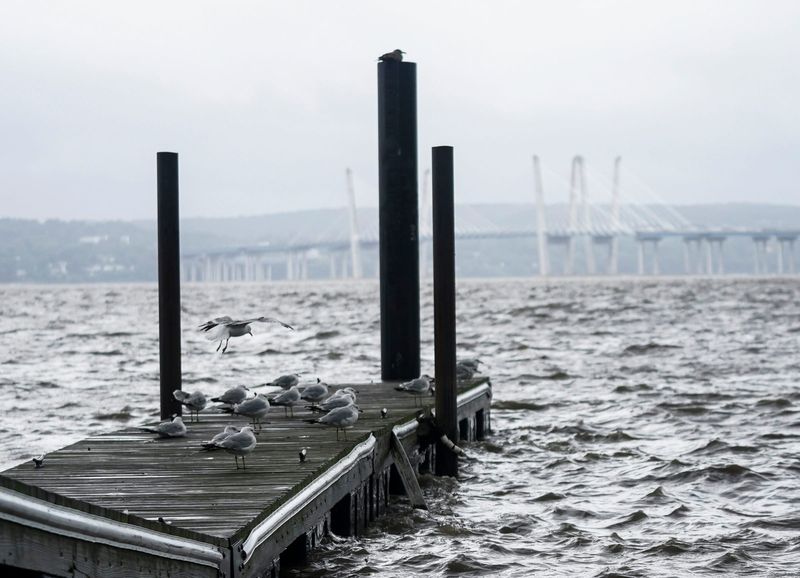
The 2025 Atlantic hurricane season started Sunday, June 1, and much like last year, weather forecasters are predicting another above-normal season, though possibly less intense than 2024.
Luckily, the Lower Hudson Valley did not face the brunt of most hurricanes during the 2024 season. The most severe impacts in the New York metro area came from heavy rainfall during Hurricane Debby, a Category 1 storm from August 7 to 9, and dangerous ocean currents resulting from Hurricane Ernesto, a Category 2 storm from August 17 to 18.

This year, the National Oceanic and Atmospheric Administration says there is an 60% chance of around 13 to 19 named storms that could form, with wind gusts 29 mph or higher.
2024 broke records for Atlantic hurricane season
In 2024, 17 to 25 storms were predicted for the season and 18 official storms were named. Of the storms that were named, 11 became hurricanes and five storms caused major damage with winds 100 miles per hour or more.
Accuweather meteorologist and lead hurricane expert Alex DaSilva said the reason for such an intense season in 2024 involved a number of factors including “near-record” warm temperatures in the Atlantic Ocean, El Niño weather patterns in the Pacific Ocean, and record rainfall and wind gusts.
The same story is expected for hurricanes in 2025, despite a lower chance of El Niño or La Niña weather patterns during this “neutral” season.
“A rapid intensification of storms will likely be a major story yet again this year as sea-surface temperatures and ocean heat content (OHC) across most of the basin are forecast to be well above average,” DaSilva said.
2024’s strongest storm in the U.S. was Hurricane Helene, which devastated much of Florida, North Carolina and South Carolina from September 26 to September 29. Wind gusts reached up to 140 miles per hour and 251 lives were lost.
A typical Atlantic hurricane season sees about 14 tropical storms, seven of which turn into hurricanes. The highest number of storms in a single year was in 2020, where 30 named storms formed.
What New Yorkers need to know about the 2025 season
This year, it also appears that New York may be mostly spared from major hurricane damage. However, the National Weather Service (NWS) says that the New York metro area, including the lower Hudson Valley, would be more susceptible to heavy rains and winds from tropical storms and remnants of hurricanes, much like 2024.
States expected to have the highest risk of hurricane impacts in 2025 include Texas, Louisiana, Florida, North Carolina and South Carolina. The Atlantic coast of Canada is also expected to have serious hurricane impacts this year.
This year’s hurricane season lasts from June 1 to Nov. 30, with the most storm activity seen from mid-August to mid-October. Names slated for the first round of storms include Andrea, Barry, Chantal and Dexter.
Of the predicted named storms in 2025, six to 10 are predicted to become hurricanes with winds of 74 mph or higher, and three to five may become major hurricanes with winds 100 mph or higher.
Despite the lower number of predicted storms compared to 2024, National Weather Service Director Ken Graham said the storms have a high probability of being stronger and longer than storms during previous seasons.
“This outlook is a call to action: be prepared,” Graham said. “Take proactive steps now to make a plan and gather supplies to ensure you’re ready before a storm threatens.”
New York’s most intense storms in recent years have been Tropical Storm Ophelia, which brought significant flooding to Westchester County in 2023, Hurricane Ida, which caused landslides, property flooding and road damage to the lower Hudson Valley in 2021. Other storms of note over the last 15 years include the destructive Hurricane Irene in 2011, and the deadly Superstorm Sandy in 2012, which devastated a majority of the southern part of New York.
Make a hurricane plan, stock a disaster supply kit or ‘Go Bag’
Be sure to prep for incoming storms by creating an emergency plan, securing your home, gathering supplies, and staying informed. A report from USA TODAY recommends knowing your evacuation route, keeping up with the latest weather reports, and stocking a disaster supply kit.
The kit should have enough non-perishable food, water and medicine to last each person in your family a minimum of three days (store a longer than three-day supply of water, if possible), USA TODAY reports. Depending on the strength of the storm, electricity and/or water could be out of commission for days or even weeks.
In addition to three day’s worth of non-perishable food and water, the Westchester County Department of Emergency Services recommends packing a “Go Bag” with the following supplies:
Funding cuts threaten NOAA and National Hurricane Center
President Donald Trump’s administration has made significant cuts to federal programs in 2025 as part of a campaign to shrink federal spending through the Department of Government Efficiency (DOGE), including capacities of the NWS and the National Oceanic and Atmospheric Administration (NOAA).
The Washington Post reported in May that seven NWS regional forecast offices stopped their 24-hour service desk after over 600 NWS employees were laid off as casualties of the DOGE cuts in February.
That means many offices would not have the staff necessary to cover overnight shifts in case of weather emergencies.
The National Hurricane Center (NHC) also saw cuts, Graham reassured the public in the NHC’s 2025 weather outlook that the quality of the agency’s research and models has not waned.
“In my 30 years at the National Weather Service, we’ve never had more advanced models and warning systems in place to monitor the weather,” said Graham.
However, after backlash from local governments and the public, the NWS has been given the green light to rehire 100 employees starting in early June, just in time for the anticipated hurricane season.
“As we witnessed last year with significant inland flooding from hurricanes Helene and Debby, the impacts of hurricanes can reach far beyond coastal communities,” said Acting NOAA Administrator Laura Grimm. “NOAA is critical for the delivery of early and accurate forecasts and warnings, and provides the scientific expertise needed to save lives and property.”
This article originally appeared on Rockland/Westchester Journal News: Hurricane season is here: What New Yorkers should know about 2025 storms, how to prepare
Reporting by Alexandra Rivera, Rockland/Westchester Journal News / Rockland/Westchester Journal News
USA TODAY Network via Reuters Connect