

By Jim Bloch

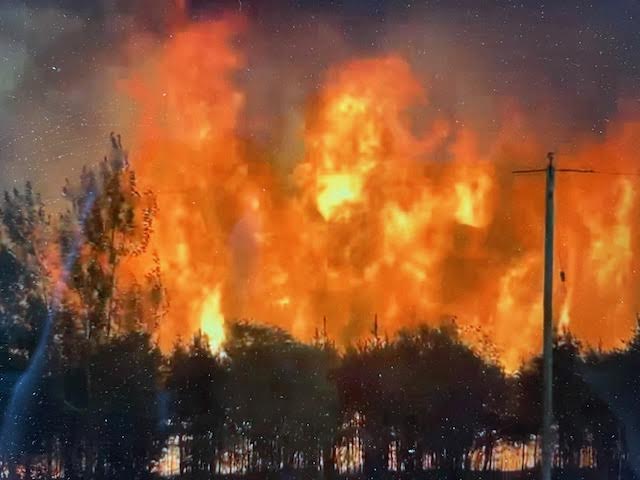
For now, St. Clair County in southeastern Michigan appears to have been spared the thickest, most toxic smoke from the Canadian wildfires in Manitoba, Ontario, Alberta and Saskatchewan. In western Michigan, especially in the northern Lower and Upper peninsulas, the view is hazier.
In the city of St. Clair, the air quality index stood at 63 or “moderate” as of 11 p.m. June 2 and had dropped to 40 12-hours later. It was a different story on Beaver Island in northern Lake Michigan at the western edge of the Eastern Time Zone where the air quality index was 153 and “unhealthy” at 11 p.m. June 2, worse than 24 hours earlier; it had dropped to 81 or “moderate” 12 hours later.

“Smoke from Canadian wildfires continues to spread across the skies … of much of the Great Lakes,” according to the Gaylord Forecast Office of National Weather Service, June 2. “The smoke may dim the sun and create colorful sunrises and sunsets. Where the smoke is the thickest and reaching the surface, reduced visibilities and a campfire smell may be evident at times. The smoke may create air quality issues at times, mainly for sensitive groups.”
It’s been two years since the U.S. was last inundated with Canadian wildfire smoke.
“The 2023 wildland fire season was historic,” according to Natural Resources Canada. “Over 230,000 people were evacuated because of potential dangers to life and health. 6,623 wildland fires burned more than 15 million hectares of Canada’s managed forest.”
A hectare is roughly 2.5 acres.
In a normal year, 2.1 million hectares burn in Canada.
As of May 30, among many other blazes, a fire in Ingolf/Whiteshell Provincial Park was listed as “out-of-control” by the National Wildland Fire Situation Report. The fire is burning 31,300 hectares in Ontario and 3,700 hectares in Manitoba.
Also in Manitoba, the Bird River Fire is burning 124,000 hectares and is out-of-control. Residents of Bird River, Tanco Mine and Bissett have been evacuated.
The Flin Flon fire in Manitoba is burning 38,000 acres and is out of control. Four communities have been evacuated.
The Edith Lake Wildfire in Alberta is out-of-control and burning 17,153 hectares.
Nine of the 20 wildfires in Saskatchewan were “not contained” and 18 evacuations have been ordered according to the provincial government. The 300,000 hectare Shoe Fire in the north is the largest.The province is facing its “worst wildfire season in decades,” according to the CBC.
Climate change and the fires
Heat, drought and atmospheric conditions are interacting to trigger the fires, according to Climate Central, the nonprofit organization that studies the impacts of climate change globally.
“Climate change is fueling this early-season heat, making high temperatures in parts of central Canada at least five times more likely than they would be in a world without climate change,” said the organization in its May 30 report “Climate Change-driven heat fuels dangerous wildfires in Canada.”
Climate change is caused by the human burning fossil fuels, which emits heat-trapping gasses such as carbon dioxide, into the atmosphere, warming the planet.
The Canadian wildfires were the single largest contributor to new carbon dioxide in atmosphere in 2023.
In Saskatchewan, temperatures are 11.8-20.4 degrees Fahrenheit above average, reaching as high as 91 in late May.
In Manitoba, temperatures have topped average by 22-24.3 degrees Fahrenheit.
“This intense heat is tied to an unusually strong, stationary high-pressure system centered over central Canada,” the report said. It’s aggravated by drought conditions classified as “abnormally dry” to “moderate drought.”
“Climate change is causing more frequent fire weather,” the report said. “Warming temperatures and increasingly dry air, vegetation, and soils make it easier for fires to spread, and harder to fight or prevent.”
Jim Bloch is a freelance writer based in St. Clair, Michigan. Contact him at bloch.jim@gmail.com.
