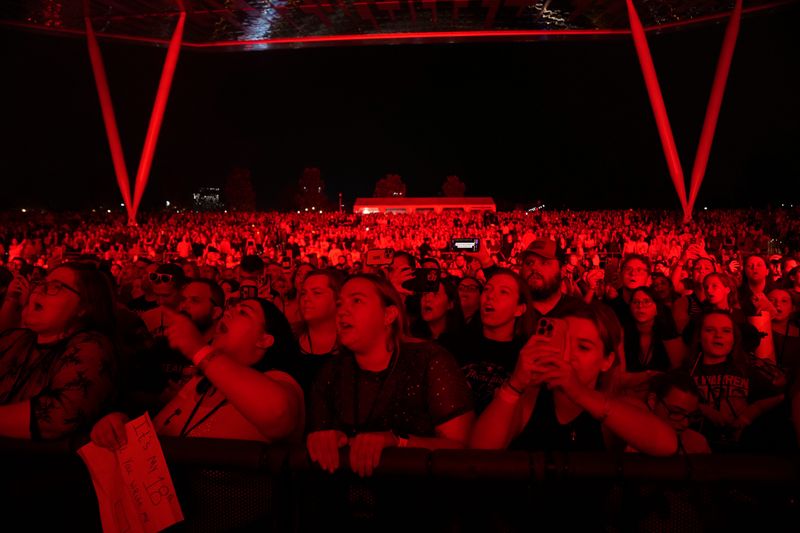
A crop of Live Nation venues are set to fall under new ownership after the entertainment powerhouse settled an antitrust lawsuit from the U.S. Department of Justice — but no Indiana properties are included in that deal.
Live Nation has agreed to sell up to 13 of its amphitheaters and relinquish much of its exclusivity to other promoters as part of the settlement, which a senior Department of Justice official confirmed March 9 to USA Today.

According to court documents obtained by IndyStar, Live Nation will not sell any of its four Indiana venues.
While some music fans hoped that the settlement would lead to lower ticket prices and open the live events market to other sellers, promoters and venues, those in the music industry say it’s not likely to bring any significant change.
Longtime opponents of the Live Nation/Ticketmaster conglomerate say the terms of the settlement aren’t strong enough to meaningfully temper the company’s dominance and allow other venues and promoters to break through, which could theoretically lead to more competition and lower prices.
Stephen Parker, executive director of the National Independent Venue Association, called the settlement a “failure of the justice system” in a statement.
“This is not treated as a step. This is treated as ‘this is it,'” Parker told IndyStar. “This settlement does little to actually deliver meaningful change.”
Live Nation controls roughly 70-80% of the live events landscape in the country and had $25 billion in revenue at the end of 2025. The company owns or has booking rights for more than 460 venues worldwide, according to its annual report.
Under the settlement’s terms, Live Nation also must establish a $280 million fund to settle claims and civil penalties. Ticketmaster, Live Nation’s ticketing arm, must also offer its technology to other selling platforms like SeatGeek and cap service fees at Live Nation events at 15%. The agreement is binding for eight years.
Live Nation did not respond to requests for comment.
The entertainment giant owns downtown Indianapolis’ Old National Centre and Everwise Amphitheater at White River State Park, as well as Ruoff Music Center in Noblesville. The company plans to construct a new 4,000-seat venue across from Gainbridge Fieldhouse, slated for completion in 2027. Live Nation also produces major concerts at Gainbridge Fieldhouse and Lucas Oil Stadium.
None of the Indiana venues are included in the list of properties outlined on the case’s terms sheet, filed in the United States District Court for the Southern District of New York March 9. Below are the 13 venues Live Nation will part ways with, per the court documents:
The settlement with the Justice Department comes after long-standing allegations that Live Nation holds a monopoly over the live events industry, specifically thanks to the company’s merger with Ticketmaster in 2010. Exorbitant ticket prices for major touring artists and increasing frustration with the purchasing experience on Ticketmaster, punctuated by the platform’s infamous crash during Taylor Swift’s Eras tour presale, triggered the Department of Justice to take legal action in 2024.
The department officially levied an antitrust lawsuit against Ticketmaster and Live Nation seeking to break up the entities, which went to trial March 3. Attorneys general from 40 states, including Indiana, co-signed on the class action lawsuit. More than two dozen of them refused to sign the settlement as of March 9 and indicated they will continue pursuing legal action against Live Nation, Politico first reported.
As of March 9, Indiana Attorney General Todd Rokita had not announced whether he will join 26 other states in seeking further legal action or sign the settlement with Arkansas, Iowa, Mississippi, Nebraska, Oklahoma, South Carolina and South Dakota.
The settlement is one component of a flurry of legal action seeking to rein in what many see as an unregulated events and ticketing industry. The U.S. Federal Trade Commission and seven states sued Live Nation and Ticketmaster last year, arguing the company allowed scalpers to hijack sales and increase ticket prices on secondhand platforms. If the U.S. Congress passes the proposed Transparency In Charges for Key Events Ticketing, or TICKET, Act, it will require sellers to include normally hidden fees in the upfront ticket price.
The Justice Department, however, is hopeful the settlement will lead to lower ticket prices with other concert promoters and ticket platforms in the mix, USA TODAY reported.
“It basically opens up markets for other competitors, which will allow for competition that previously didn’t exist in primary ticketing and in the live entertainment space,” a senior official told the press. “What you’re going to see there is that competition is going to have a direct impact on prices coming down.”
Other critics, however, aren’t sold on the settlement’s effectiveness. Along with the several attorneys general who are intent on further action against Live Nation, Brian Berry — executive director of the Ticket Policy Forum — said the agreement was a “token tap on the wrist.”
“It appears the DOJ has once again failed to protect live event fans and market competition with a settlement that will equate to less than a speed bump for the Live Nation-Ticketmaster monopoly,” Berry said in a statement. “The only winners are Live Nation shareholders and the company’s lobbyists.”
Contact IndyStar Pop Culture Reporter Heather Bushman at hbushman@indystar.com. Follow her on X @hmb_1013.
This article originally appeared on Indianapolis Star: Live Nation to sell venues after DOJ settlement. Are Indiana’s for sale?
Reporting by Heather Bushman, Indianapolis Star / Indianapolis Star
USA TODAY Network via Reuters Connect