Publix financial filings this week show a grocer still in growth mode but with slower sales growth mostly caused by factors it cannot control, such as inflation.
Inflation was among several factors seen as a threat to its retail grocery business. Compared with 2024, tariffs were listed as a new threat reported in the filings for 2025.

Among Publix’s strengths and unlike some of its peers in the grocery business, it has been able to meet its cash requirements without the need for debt financing, its financial reports said.
Publix’s 2025 annual SEC filing gives an overview of financial health
In Publix’s 2025 10-K annual report, about 50 pages, the company provides an overview its finances as of December.
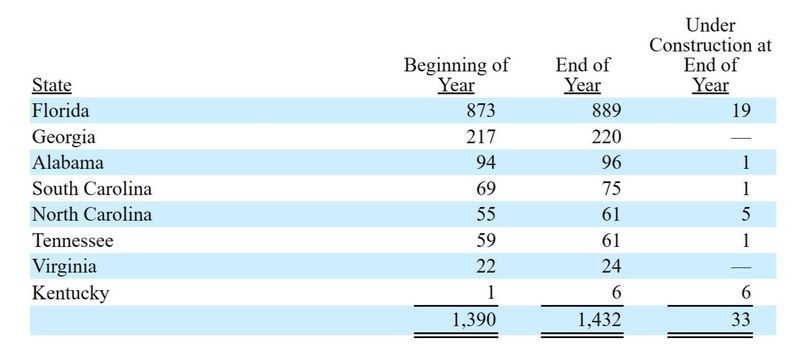
Publix also reported the following activities regarding its stores in 2025
Publix operated 1,432 supermarkets across the southeastern U.S. as of Dec. 27, with Florida remaining its largest market.
Some notable context for the annual reported results
According to the Publix website:
Publix provides information to holders of common stock
Because there is no public trading of Publix common stock on an established securities market, the market price of the company’s common stock is determined by its board of directors.
As part of the process to determine the market price, an independent valuation is obtained, including a comparison of Publix financial results to peers that are publicly traded.
Companies included in the peer group are Ahold Delhaize, Albertsons, Kroger and Weis Market.
Publix’s fourth quarter sales increased but growth in sales lagging
According to a report by GroceryDive.com, Publix showed signs of slowing growth in sales.
Recent filings with the SEC included Publix’s financial performance for the fourth quarter of 2025, ending Dec. 27:
Adjusted net earnings (excluding unrealized gains):
“The retail food industry is highly competitive,” its annual report said. “The Company’s competitors include national, regional and independent supermarkets, as well as nontraditional competitors, such as supercenters, membership warehouse clubs, mass merchandisers, dollar stores, drug stores, specialty food stores, restaurants, convenience stores and online retailers.”
Increased competition could adversely affect the company’s bottom line, Publix said, adding that the Florida market is also seasonal.
“The historical influx of winter residents to Florida and increased purchases of products during the traditional Thanksgiving, Christmas and Easter holidays typically result in seasonal sales increases from November to April of each year,” the report said.
“Additionally, certain weather events, such as hurricanes, may affect the Publix’s sales,” it said.
Other adverse economic conditions might reduce consumer spending
Outside of competition, other challenges included:
“Reductions in the level of consumer spending could cause changes in customer demand from discretionary or higher priced products to lower priced products or shift spending to lower priced competitors, which could adversely affect the Company’s financial condition and results of operations,” Publix said.
The company’s core strategies focus on customer service, product quality, shopping environment, competitive pricing and customer convenience.
“The Company continues to implement strategic business and technology initiatives, and assesses the use of artificial intelligence, as part of the execution of these core strategies,” Publix said. “The Company believes these core strategies and related strategic initiatives differentiate it from its competition and present opportunities for sustained market share and financial growth.”
About Publix Super Markets Inc.
Lakeland-based Publix Super Markets, Inc. operates retail food supermarkets in Florida, Georgia, Alabama, South Carolina, North Carolina, Tennessee, Virginia and Kentucky.
Publix operated 1,432 supermarkets in the southeast region of the United States as of Dec. 27.
It is the largest employee-owned company in the U.S. with more than 260,000 employees.
Publix supermarkets are often located in shopping centers where the they are the anchor tenant. The majority of its supermarkets are leased. Both the building and land are owned at 473 locations. The building is owned while the land is leased at 77 other locations.
The grocery chain supplies its supermarkets from 10 primary distribution centers in Lakeland, Miami, Jacksonville, Sarasota, Orlando, Deerfield Beach and Boynton Beach, Florida; Lawrenceville, Georgia; McCalla, Alabama; and Greensboro, North Carolina.
Publix operates six manufacturing facilities, including three dairy plants in Lakeland, Deerfield Beach and Lawrenceville; two bakery plants in Lakeland and Atlanta; and a deli plant in Lakeland.
The company also operates three prepared-foods facilities in Lakeland, Deerfield Beach and Lawrenceville.
Publix’s corporate offices, primary distribution centers and manufacturing facilities are owned with no outstanding debt, its filings said.
This article originally appeared on The Ledger: Publix posts strong results in 2025. Still lowers stock price
Reporting by Paul Nutcher, Lakeland Ledger / The Ledger
USA TODAY Network via Reuters Connect