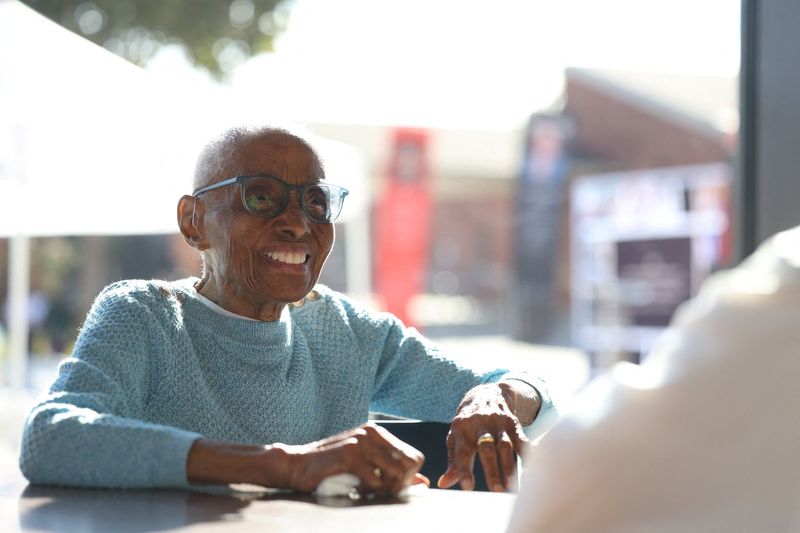
By Donna Bryson
Jan 5 (Reuters) – Edith Renfrow Smith grew up in the 1910s hearing her grandparents’ stories of surviving slavery, including a grandfather who escaped bondage with a group led by abolitionist John Brown. She was still alive more than a century later, having witnessed two world wars and the birth of penicillin, television and artificial intelligence — as well as the end of statutory racial segregation in the United States.

Asked in 2023 how much history she had witnessed, she sighed: “A lot, a lot, a lot. A lot of good, and a lot of bad.”
Renfrow Smith, a secretary turned public school teacher, lived a life directly connected to America’s history of slavery as well as to the progress made in the 20th and 21st centuries.
“This has been the greatest century we have seen,” Renfrow Smith told WGN, a television station in Chicago, where she lived most of her life. “There have been so many changes.”
She died at home in Chicago on January 2, aged 111, her friend Tamara Beauboeuf-Lafontant told Reuters on Monday.
‘THE LOW MAN ON THE TOTEM POLE’
Edith Renfrow was born on July 14, 1914, two weeks before the start of World War One, in Grinnell, an Iowa town that like its college was named after white abolitionist minister and politician Josiah Bushnell Grinnell. But the town’s anti-slavery roots did not mean its Black residents escaped racism or segregation.
“If you’re the low man on the totem pole, you get stepped on, don’t you?” she said of growing up there. “When you’re Black, you’re invisible — and that’s what we were.”
Renfrow Smith told Beauboeuf-Lafontant, a professor at Grinnell College: “I come from a family of fighters.” She credited her mother, born Eva Pearl Craig, with steeling her against prejudice by repeatedly telling her that “no one is better than you.”
Renfrow Smith would eventually turn that mantra into a book — “No One is Better Than You: Edith Renfrow Smith and the Power of a Mother’s Words,” published in 2024 — in collaboration with her daughter Alice and the author Monique Shore.
UP FROM SLAVERY
Her grandfather, George Craig, died in 1924, when Smith was 10 years old. According to an interview with George Craig that was the basis of a Grinnell Herald article in 1895, he was born enslaved in Missouri and sold to Louisiana slave traders aged 19, in 1857. He recounted tricking the Louisianans into believing his eyes were defective.
After being returned to Missouri, he escaped in 1858 to neighboring Kansas, where pro- and anti-slavery forces were fighting and slave catchers were hunting Black people. Craig hid in tunnels and cellars for a year before heading to Iowa with abolitionist Brown. Later that year, Brown, who was white, led a raid on a federal arsenal at Harpers Ferry, Virginia, with the intention of arming slaves for an uprising. Brown was quickly captured, then hanged.
In Iowa, Craig married Eliza Gilbal. Their daughter Eva Pearl, born in 1875, married Lee Augustus Renfrow, also the child of former slaves, in 1901. Edith Renfrow was born of that union 13 years later.
A HARD-EARNED EDUCATION
Eva Pearl insisted that all six of her children receive the university education she was denied. She repeatedly told them that an education was the one thing no one could take away.
The older children graduated from the University of Iowa and from Fisk and Hampton, historically Black universities. Once they started working they contributed their earnings to their parents, a laundress and a cook, so that their younger siblings could also study. “Everybody helped each other,” Renfrow Smith told NPR in 2023.
Renfrow Smith, the fifth child, earned her bachelor’s in psychology from Grinnell College in 1937. She was the first Black woman to graduate from the school, which in 2019 awarded her an honorary doctorate. Grinnell’s Renfrow Hall, named in her honor, opened in 2024.
In a statement announcing the death to students and staff on Monday, Anne Harris, the school’s president, called her “one of Grinnell College’s most inspiring and beloved alumni.”
While at the university Renfrow Smith played badminton, ring tennis, basketball and field hockey. She attended a talk by Amelia Earhart there, a decade or so before the aviation pioneer disappeared over the Pacific. “It was a delightful visit,” Renfrow Smith recalled.
During the Great Depression, Renfrow moved to Chicago, where Grinnell had helped her secure a job as a receptionist at the local Young Women’s Christian Association. There she met another great: poet Gwendolyn Brooks, the first Black American to win a Pulitzer Prize.
She called the decade-long economic crisis that began in 1929 “very, very strenuous, because we (Black citizens) were the last ones to receive what was offered.”
GUIDING HERBIE HANCOCK
She met Henry Smith in Chicago. They were married in 1940 and raised their two daughters in the city’s South Side neighborhood.
Jazz musician Herbie Hancock grew up nearby. “Mrs Smith was a dear friend of my mother’s,” he said in 2023, adding that she was like an aunt to him. “She had a regal kind of presence,” he recalled.
She was a major influence on Hancock’s decision to study at Grinnell, where he double majored in music and electrical engineering. He would later pioneer a sound that fused jazz with electronic music.
‘HIS WONDERFUL WORLD’
Renfrow Smith worked as a secretary for Chicago politician and real estate businessman Oscar De Priest, who in 1928 won a seat in the U.S. House of Representatives. He was the first Black American to serve in Congress in the 20th century, in which capacity he repeatedly introduced legislation against racial discrimination.
In an example of debates within the Black community, Renfrow Smith called Jesse Jackson “a rabble-rouser,” saying in 2023: “We only wanted peace and quiet where I was, and that is all I wanted for my children, so I did not march.” Jackson was a community organizer in Chicago and a national and international political leader whose two runs for the U.S. presidency in the 1980s were the most prominent by a Black candidate until Barack Obama’s victory in 2008.
Jackson marched in the 1960s with Martin Luther King, Jr. Renfrow Smith also saw the civil rights activist and Baptist minister, when he gave a talk at a synagogue in Chicago.
De Priest encouraged Renfrow Smith to become a teacher. She taught in Chicago public schools from 1955 until her retirement in 1976.
She had two daughters: Alice and Edith. Edith died in 1998, her husband Henry in 2023.
Renfrow Smith outlived all of her siblings by several decades. The last of them died in 1997.
Asked aged 109 what wisdom she might share, she said: “Have a goal. Never let anyone tell you that you can’t.”
She herself made the most of her retirement. “I used it to volunteer and to help because I had gotten so much help for my entire life,” she said. As for daily life, she advocated: “Wake up every morning and thank the good Lord that you are alive and able to look at His wonderful world.”
(Editing by Olivier Holmey)