(Editor’s note: This is the fourth installment of UAW Candidate Q&A, a six-part series asking questions directly to candidates running to be president of the United Auto Workers union. The Detroit Free Press will publish responses from all candidates.)
Come late August, hundreds of thousands of members of the United Auto Workers union will have a choice: Reelect sitting president Shawn Fain, or opt for a new face to lead one of the nation’s most historic labor unions.

Five members are challenging Fain, a popular president and political figure. Fain was at the helm of the union in 2023 when it secured handsome raises after a simultaneous strike of all three Detroit automakers (Ford Motor Co., General Motors and Stellantis). The upcoming election was complicated by news that Fain is facing a grand jury investigation directed by the U.S. Department of Justice over allegations that he improperly used his post to seek benefits for his family members. Fain has denied the allegations.
According to the UAW’s court-appointed monitor, who oversees the union’s elections, ballots will be delivered to members “on or about” Aug. 21. Ballots must be returned by Oct. 5, and tabulation will commence on Oct. 6.
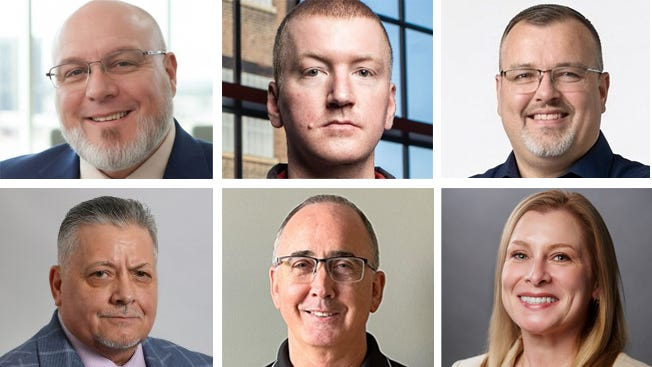
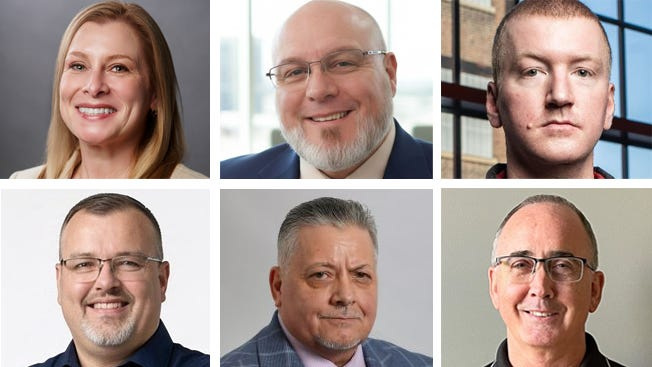
The candidates are:
Brian Keller, 57, a 27-year automotive worker and member of the union represented by Local 1248 in Warren.
Will Lehman, a 38-year-old Mack Trucks employee from Local 677 in Macungie, Pennsylvania.
Greg Mooney, a 46-year-old recording secretary from Local 2147 in Lima, Ohio, where he has worked in the aerospace and defense sector of the union for four years.
Rich Boyer, the 63-year-old vice president of the UAW who rose out of Local 140 in Warren.
Shawn Fain, the 57-year-old incumbent president of the UAW, hailing from Local 1166 in Kokomo, Indiana.
Tricia Geiger, 43, a 20-year UAW member who is currently an international servicing representative at UAW Local 977, a GM union hall in Indiana. Geiger got her start in the union at UAW Local 651 in Flint.
The Free Press offered each candidate the opportunity to answer six detailed questions, in their own words, for publication. Candidate responses were limited to 1,000 characters for the sake of brevity.
In the first installment, candidates explained what they see as the key issue facing the union. In the second, candidates explained why they are running for the office. On Tuesday, candidates outlined their plans for the 2028 contract negotiations with the Detroit Three automakers. Today, the Free Press asks:
Union membership is a fraction of what it used to be (392,447 active members in 2025 compared with 1.5 million in 1979). Do you believe the UAW needs to grow? If so, how would you accomplish growth?
Keller: Absolutely. Growth is essential, but real growth means winning elections, securing first contracts, and building active dues-paying membership. We must organize aggressively in auto, EV, battery, suppliers, health care, higher education, and the public sector while also taking better care of our current members. Strong representation is the best organizing tool we have.
Boyer: The UAW has historically fought to ensure quality jobs that benefit workers, the economy, and society. To preserve American jobs and standards, a strategy that maximizes our ability to fight for high-quality jobs in all sectors is needed.
The failure to organize will also adversely impact bargaining because our power to maintain and improve contracts depends on having strong union density.
Most foreign-owned plants, which make up half of the American auto industry are nonunion and many UAW auto-sector workers are employed in facilities that are in “right-to-work” states. In order to have stronger leverage to equitably shape the industry, the more workers we represent, the better.
We need to adopting new organizing strategies that make bold demands of employers and harness the initiative of our most committed members by supporting worker-led organizing efforts. We need to adopt new strategies of organizing.
Fain: Our union will either grow or it will die. It’s as simple as that. We’ve added nearly 100,000 new members in just the past four years, many of whom are still fighting for first contracts. From Volkswagen to IPS to higher education, we’ve got tens of thousands of new members, but we can’t stop there.
In its first decade, the UAW grew from 25,000 members to over a million. The union inspired the entire working class to join a movement, not just sign a union card. We need to inspire millions of working-class Americans to fight for a better life, and turn that inspiration into organization.
I’m proud that delegates to the recent Constitutional Convention laid the groundwork to take on the fight ahead by dedicating over a billion dollars to strike and defense, $100 million to organizing new workers and bargaining great contracts, and raising strike pay. We’re not just talking about taking on these issues, our union is prepared for the mission ahead.
Mooney: Yes, the UAW needs to grow. A smaller union means less bargaining power and a weaker ability to protect our members.
However, we cannot continue the current model of spending tens of millions of dollars with very little return.
If elected, I would focus on three core strategies:
First, win stronger contracts. When nonunion workers see better wages, benefits, and job protections, they will want to join. Along with creating better incentives like UAW Cares.
Second, organize strategically in sectors with real growth potential, such as IPS suppliers, energy, and skilled trades, instead of wasting resources on low-success campaigns or declining industries.
Third, restore the union’s integrity. Many workers hesitate to join because they see internal corruption, retaliation, and political bias. When we clean up our house and fight for all workers, more people will want to be part of the UAW.
Growth must be built on real results, not empty promises and wasted money.
Geiger: We absolutely need to prioritize growing our ranks by organizing new dues-paying members. As Union density erodes so does worker power. However, we can’t afford to organize at a cost of $5,000 per dues paying member, which is roughly the average under this current administration. As an organizer, I know we need leadership that believes in our membership’s ability and commitment to organizing and provides these opportunities to our members not outsiders, that respects and listens to our organizers in the field, doing the work, and knows the difference between a slogan and a strategy. The hubris of the “UAW bump” has cost us winnable campaigns. We need to get back to foundational best practices and data-driven campaigns that embrace VOC development, network building, work-site mapping, inoculation against the employer campaign, card testing, and new technologies. We shouldn’t prioritize winning elections over the meaningful work of building unions and real power!
Lehman: Growth starts with telling the truth about the decline. The UAW did not shrink from 1.5 million members to under 400,000 by accident. Beginning with the 1979-80 Chrysler bailout, the leadership tied workers’ interests to the profitability of “their” employers. Every concession was justified as saving jobs, and every one was followed by more closures. The apparatus collaborated fully in this assault, and it was rewarded by the companies for it.
It is necessary to transform the UAW into an organization that fights. The battles at Flint and Ford last century were won by a mass movement of workers, not staff-driven campaigns. I call for building rank-and-file committees in every workplace, organized and unorganized alike, linked through the International Workers Alliance of Rank-and-File Committees. We must organize internationally, rejecting the nationalism that divides us from Mexican, Canadian and Chinese workers. The UAW must defend immigrant workers. They are our class co-workers.
Liam Rappleye covers Stellantis and the UAW for the Detroit Free Press. Contact him: LRappleye@freepress.com.
This article originally appeared on Detroit Free Press: UAW Q&A: Can the UAW grow again? President hopefuls share their ideas
Reporting by Liam Rappleye, Detroit Free Press / Detroit Free Press
USA TODAY Network via Reuters Connect
By Liam Rappleye, Detroit Free Press | USA TODAY Network