

Three workers were repairing a machine inside Stellantis NV’s Dundee Engine Plant early on April 7, 2025, when two of them stepped away for a break, leaving their third colleague to toil away on the large industrial washer alone.
When one worker returned from the restroom minutes later, he found Ronald Adams trapped, his body pinned between a robotic arm and a conveyor. Workers sprang into action, court documents show, calling paramedics and a plant electrician who raised the robotic arm off the 63-year-old skilled tradesman.

But it was too late for the father and grandfather, who a medical examiner later determined had suffered “crushing” injuries and “traumatic asphyxia.”
Adams is one of three U.S. Stellantis employees killed in industrial accidents within the last two years — an unusual spate of fatalities for any Detroit automaker in the past decade. The first occurred Aug. 21, 2024, in Toledo, when Jeep factory worker Antonio Gaston, 53, was crushed after he snagged on a piece of equipment. The most recent was two weeks ago in Center Line, when 57-year-old laborer James Brasher fell from the second-story loading bay of a former Mopar office building. All three men were longtime members of the United Auto Workers.
Prior to the recent fatalities, the last time a Stellantis worker died in an industrial accident was 2021, and before that, it was 2015, a review of federal safety records and news reports shows. At least three Ford Motor Co. workers died in such incidents spread out over the past decade, with the most recent in March at a transmission plant in Ohio. General Motors Co. has recorded at least two industrial-related deaths in that period.
Asked whether it was conducting safety reviews or making changes following the recent deaths, Stellantis didn’t provide specifics. But it said employee safety is “at the forefront of every decision we make.”
“We regularly evaluate and strengthen our internal standards and protocols to protect employees across our operations,” said a company statement from spokesperson Jodi Tinson. “Sharing best practices throughout the organization helps reinforce our safety culture and supports consistent performance. Stellantis continues to enhance workplace safety and ensure all sites meet or exceed regulatory requirements.”
Lawsuits filed by family members in both the Adams and Gaston cases, however, point to several concerns inside the plants.
Safety feature ‘purposefully defeated’
The Gaston suit states that the conveyor system that snagged the father of four — before he was crushed by a moving Jeep Gladiator chassis — lacked crucial equipment that protects against pinch points. The case filed by his widow, Renita Shores-Gaston, is proceeding in federal court in Ohio and names Stellantis and conveyor supplier Dearborn Mid-West Company.
An Occupational Safety and Health Administration investigation came to a similar conclusion about insufficient machine guarding at the Toledo plant. OSHA issued a “serious” violation and initially fined Stellantis about $16,000, but the automaker contested the amount and settled for about $11,000. The agency’s investigation said Gaston, whose job involved delivering parts to the assembly line, had reached across the conveyor to retrieve a pail of components when he was caught.
Employees have flagged safety concerns inside the Toledo plant since Gaston’s death. A memo to workers last fall raised concerns about a series of 25 recordable injuries at the plant over a two-month period — accounting for roughly a third of all such injuries across the company’s 75-facility North American footprint. The memo, first reported by The Toledo Blade, urged employees to be more careful and follow training.
A Wayne County lawsuit filed by Adams’ widow, Shamenia Stewart-Adams, also states there was a lack of critical safety guards and safe work practices that allowed the robotic arm to pin and crush the longtime Dundee employee while he worked alone in the “danger zone.”
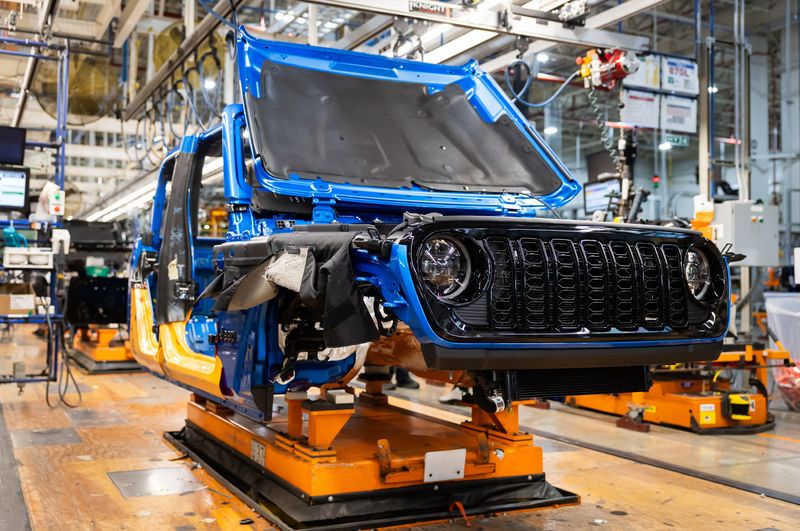
Adams, a U.S. Air Force veteran who lived in Detroit and previously worked as an aircraft mechanic for Northwest Airlines, was part of a group retooling the idled Dundee plant as it prepared to start producing a new Stellantis four-cylinder engine. At the time of his death, the repairman was working on a large industrial chamber washer that cleans engine components. The conveyor and robotic arm help bring the components to and from the washer.
At the heart of the case is a safety mechanism for the washer that court records say was “electronically bypassed” with a special cheater key — allowing work to take place even as dangerous machinery, including the robotic arm and conveyor, stayed energized.
Attorneys for Fives Cinetic Corp., which supplied the washer and is named in the suit, wrote the accident would not have happened if the safety features were not “purposely defeated” and Stellantis had “followed recognized, safe work practices.”
There might have been other factors at play, court filings indicate. One worker said he reported a hazardous issue with the robotic system that killed Adams two days prior to the accident, adding the machinery unexpectedly moved while in “dry run” mode. A supervisor denied having knowledge of the problem.
Chris Camper, an attorney for Stewart-Adams, said in an interview that Dundee employees accessing “cheater” keys that can bypass safety mechanisms represents broader safety and cultural concerns in the plant. He said there was “no evidence” that Adams was the one who had used the key to disable the safety features before his death.
Stellantis lawyers earlier this year sought to have the case dismissed and heard, “if at all,” before the state’s Worker’s Compensation Agency. Judge Catherine Heise denied the motion. A Michigan OSHA investigation into the fatality continues.
Stellantis declined to comment on either the Ohio or Wayne County cases.
A state OSHA investigation has also begun in the Aug. 1 death of Brasher, the Center Line worker. Authorities said the more than 30-year employee was discarding old office furniture and equipment from a second-story loading bay at the automaker’s former Mopar parts distribution offices when he fell from the open door, striking his head on a dumpster located 25 feet below, killing him instantly.
He was wearing a safety harness, but it was not attached to the tether at the time of the fall, Center Line’s director of public safety previously said.
A GoFundMe page raising money for Brasher’s wife described the 57-year-old as someone who “fiercely loved” his family, friends and country, and who was a “true patriot in every sense of the word.” He appeared passionate about politics, having spoken at a President Donald Trump campaign event in 2020 to thank the president for preventing Mopar jobs from going to Mexico, while also meeting the president and other senior officials on several occasions. Brasher’s family declined to comment through a friend.
‘Carried him to the stretcher’
Rich Boyer, a UAW vice president who oversees the union’s Stellantis department, said the fatalities “shouldn’t happen” and underscored the need for robust health and safety procedures inside plants.
The union is conducting its own probe of the Brasher case and previously promised to look into the Gaston and Adams cases, though it has not released findings in those cases, and Boyer said he wasn’t sure what their status was. He said there did not appear to be a “common denominator” tying the three together. A union spokesperson didn’t respond to a request for comment.
Rick Neitzel, a University of Michigan professor who directs the Center for Occupational Health and Safety Engineering, said a company the size of Stellantis — with roughly 80,000 North American employees — is statistically more likely to have workplace fatalities than a small firm. Yet the string of deaths should nevertheless raise internal questions for the automaker.
“I’d say it’s not a smoking gun that Stellantis is necessarily doing something wrong,” he said. “What it is, at least, is kind of a clarion call to review what’s happening at Stellantis facilities and make sure, number one, that their safety and health policies are in place, appropriate, actually being enforced, that the workers understand what’s expected of them.”
Manufacturing fatality and non-fatal injury rates have declined over the last 20 years in the United States, Neitzel said. But the improvements have not always been evenly distributed across companies. Several trouble areas remain, including ergonomics, lacerations and noise exposure.
Inside the plants where the Stellantis workers died, interviews and court documents indicate many workers were affected — in some cases jumping in to help or watching the aftermath as emergency responders arrived.
After Adams was discovered pinned by the robotic arm at about 1:20 a.m., workers, security, EMTs and police quickly converged on the scene.
“Ron was hunched over with his right arm … on conveyor,” one worker wrote in a statement shortly after the incident. The robotic arm called a gantry “had his right shoulder pinned.”
Three workers then helped a paramedic move Adams from the conveyor to a stretcher. He died after arriving at a hospital, a police report said.
“I held his upper body and we had a guy on each leg,” recalled another worker, in a written statement. “We carried him to the stretcher and the EMT took it from there.”
lramseth@detroitnews.com
This article originally appeared on The Detroit News: Stellantis sees 3 workplace deaths in two years. Is there a problem?
Reporting by Luke Ramseth, The Detroit News / The Detroit News
USA TODAY Network via Reuters Connect


By Luke Ramseth, The Detroit News | USA TODAY Network
