Detroit — Exotic and practical, progressive and conservative, modern and traditional. The all-new 2026 Lexus ES has a dual personality: it’s offered in electric and gas models while sporting flashy design for customers shy on the latest tech.
Rolling into Supino’s Pizzeria in Eastern Market to satisfy my appetite for the best Brooklyn pie in town, my electric ES 350e turned heads.

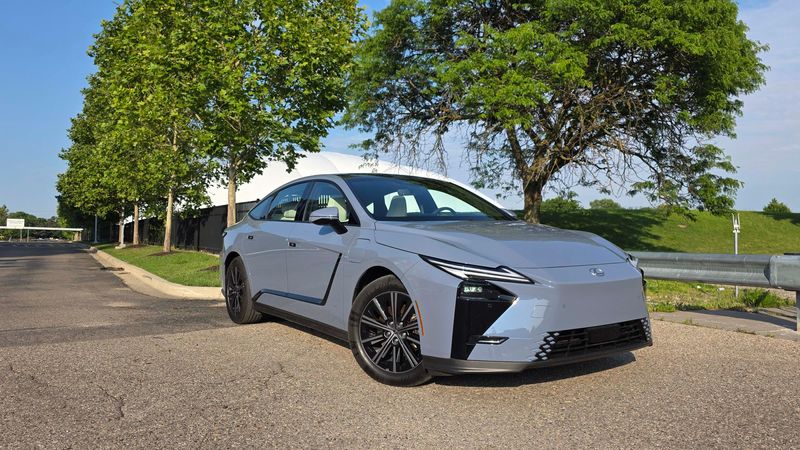
If Lexus has been known for its expressive Spindle grilles, the electric ES’s design (and its hybrid ES 350h doppelganger) is inspired by the Lexus LF concept. Goodbye gaping mouth, hello dark sideburns. It’s a striking evolution from the last-gen Darth Vader fascia, and more pleasant to my eye.
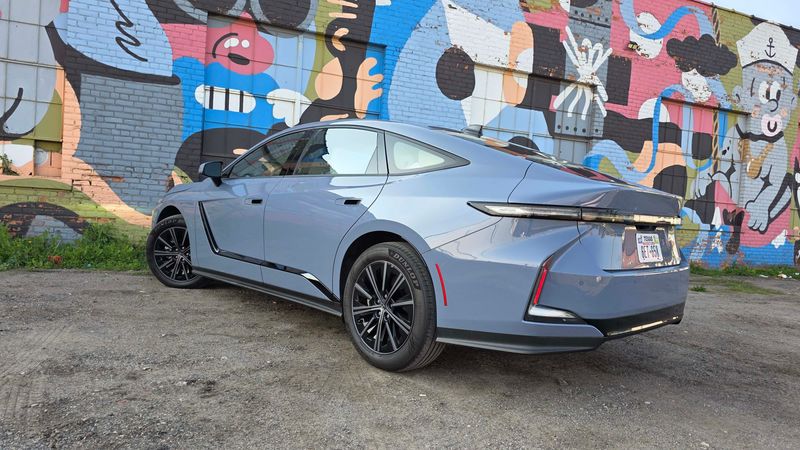
Jagged L-shaped (for Lexus) LED daytime running lights remain, but have been separated from the headlights and integrated into the sideburns below. L-design elements are everywhere, from the black traces along the side flanks to vertical rear strakes under the horizontal taillamps.
“What is that you’re driving?” asked a passerby outside Supino’s.
“Lexus ES.”
“Oooooh, looks different. I like it.”
Design
Batteries and fascia aren’t the only big changes. ES is bigger than the last-gen as Lexus consolidates its sedan lineup and drops the full-size LS in the Age of the SUV. After 2026, ES will be the only Lexus sedan offering along with the compact IS. ES comes in front-wheel drive and all-wheel drive for both gas and EV models.
The rear seat is enormous. Nearly 41 inches, which is full-size pickup territory. At 6’5”, I could sit behind myself with more room to spare than a first-class airline seat. With laptop open, I munched on a slice of pepperoni and caught up on email at the end of a busy day.
How far Lexus has come.
Jump in the Wayback Machine to 1990 and LS is what jump-started Toyota’s luxury brand. A design clone of the 1990 Mercedes S-class, LS wrapped impeccable service and Toyota reliability in a Germanesque package to create a U.S. juggernaut.
That juggernaut continues today, except that Lexus has found its own design groove.
“How do you like the new Spindle grille?” I asked a female friend in 2013 of her new Lexus RX.
“I park it nose first I my garage, so I never see it,” she said. “I love my Lexus dealer.”
With the 2027 ES, Lexus owners can love the front end, too.
Charging
Some Lexus owners will venture north in summer to second homes and vacations.
“Hey, Lexus,” I commanded of the voice recognition system. “Navigate to Charlevoix, Michigan.”
With a claimed 307 miles of range, my front-wheel-drive 350e tester is shy of a comparably priced, rear-wheel-drive Cadillac Optiq (also with a healthy 39 inches of rear-seat space), and therefore technically able to make the 272-mile trip. But on this day, I had 160 miles of range left on the 67-kWh capacity battery.
The four-hour trip in the sibling gas-electric hybrid ES 350h (range: 638 miles) would take three hours and 50 minutes. In the ES EV? Six hours and 53 minutes, according to the Lexus navigation system.
What the … ?
Looking more closely at the two charging stops, the nav-system had routed me to a 240-volt, Level 2 Red E charger for two hours. This even though Lexus has outfitted the 350e (500e is the AWD model) with a NACS charging port (like the Caddy) to take advantage of Tesla’s ubiquitous, reliable Supercharger network.
With its more sophisticated Google Bult-in operating system, the Cadillac is more efficient at route planning. Though, to be fair, not many Tesla chargers are accessible to non-Tesla brands in the Midwest. The Lexus does offer Android Auto — unlike Caddy — so I accessed the ABRP (A Better Route Planner) phone app to plot my trip.
Ah, that’s better. ABRP routed me on a two-stopper to a Tesla charger and then a We Charge fast charger in West Branch.
If all this charge planning makes your brain hurt, then your ‘lectric Lexus might best be used locally (in a two-car garage with a gas vehicle for trips) where the EV’s smooth power application is most appreciated along with its big back seat for a couple’s night out.
Otherwise, the gas-electric model sports superior dexterity (it can make a round-trip to Charlevoix without stopping for gas). The twins are nearly identical otherwise inside and out (you’ll know the hybrid by the mail slot in its front fascia), though you won’t get the liquid-smooth power of the EV in the hybrid.
DROOOONE went the CVT transmission when I accelerated on to M-14. It’s a less-than-luxe symphony.
Take a road trip in an electric Cadillac or Tesla, and their superb hands-free systems make highway driving easy and fatigue-free. Lexus doesn’t offer a hands-free option.
Tech
Nor does Lexus want to compete on corner carving.
Drive north to twisted M-32 and the Optiq and midsize Tesla Model S will engage with instant acceleration — ZOT! — and tight handling despite their heavy, battery-laden chassis. The Lexus demurs. Those paddles on the back of the steering wheel? They’re not shift paddles; they’re for adjusting brake regeneration.
The ES is a boulevard cruiser with a soft, yacht-like ride and big back seat. On a cloverleaf entering I-94 west to Metro Detroit, my ES 350e resisted my efforts to pull g-loads.
On I-94, I activated adaptive cruise control with lane-keep assist and cruised with one hand as I would in my wife’s $32K Subaru Impreza RS, ACC creating a safety bubble around me.
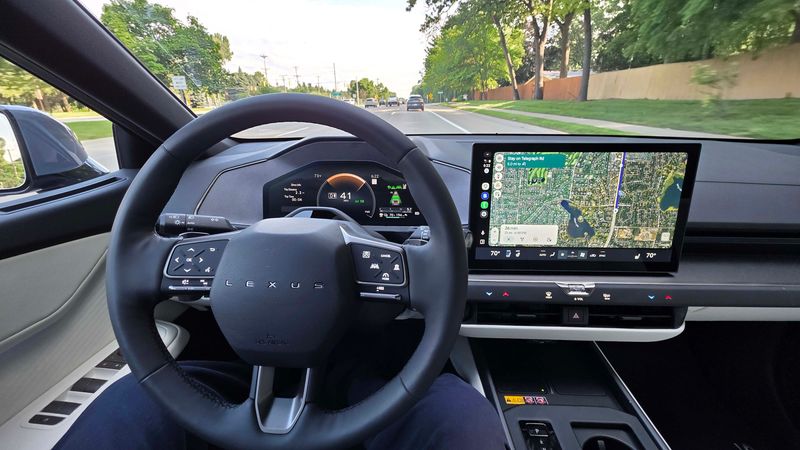
Waiting for my son at the United Arrivals curb, I surveyed the spartan cabin. The last-gen ES’s dash was as expressive as its grille, but the 2026 model takes a page from Tesla.
Where Caddy EVs are bling-tastic with dash-spanning displays, jeweled dials and floating consoles, the Lexus boasts a simple, horizonal dash interrupted only by a 14-inch tablet above the console and a small, thin hexagonal screen behind the steering wheel. No knobs, no jewelry.
Adding to the spartan aesthetic is a small, Porsche-like chiclet shifter and haptic Nissan Ariya-like climate controls stamped into the dash. It’s techy, cutting-edge and contrary to Lexus’ conservative approach when it comes to hands-free driving and face-flattening acceleration.
“It’s really cool looking,” commented my son upon arrival. “Though traditional Lexus buyers who like knobs may find it off-putting.”
We placed our phones on the standard dual wireless charging pads that anchored the console. Good for keeping charge on navigated trips. The huge boot swallowed my son’s suitcase with ease. I gave him the keys. As we rounded the car, I thought about climbing in the back seat and having him chauffeur me home.
Just what Lexus ES was designed for. L for limo.
2026 Lexus ES
Vehicle type: Front- or all-wheel-drive, five-passenger gas-electric hybrid or full-electric sedan
Price: $51,095-$57,295 (hybrid) or $48,795-$60,195 (EV) including $1,395 destination charge as tested ($51,095 ES 350h and $51,795 ES 350e as tested)
Powerplant: 74.7 kWh, lithium-ion battery pack mated to single/dual electric motors
Power: 244 horsepower (hybrid); 221-338 horsepower (EV)
Transmission: Continuously-variable automatic (hybrid); Single-speed automatic (EV)
Performance: 0-60 mph, 7.3 seconds (hybrid, mfr. as tested); 7.4 seconds (EV mfr. as tested); top speed, 124 mph (hybrid), 99-112 (EV)
Weight: Hybrid, 4,001-4,134 pounds (4,001 pounds as tested); EV, 4,608-4,928 pounds (4,663 as tested)
Range: EPA est. 48 city/44 highway/46 combined (FWD), 47 city/42 highway/44 combined (AWD); 272-307 miles on full charge (307 as tested). Max. range, 696 miles (hybrid); 307 miles (EV)
Report card
Highs: Distinctive design inside and out; NACS charger designed for Tesla Superchargers
Lows: Lags competitor tech; few compatible Tesla chargers in Midwest
Overall: 3 stars
Henry Payne is auto critic for The Detroit News. Find him at hpayne@detroitnews.com or @HenryEPayne.
This article originally appeared on The Detroit News: Payne: On the town with the hybrid/EV Lexus ES twins
Reporting by Henry Payne, The Detroit News / The Detroit News
USA TODAY Network via Reuters Connect
By Henry Payne, The Detroit News | USA TODAY Network