

Democratic nominee for governor and Secretary of State Jocelyn Benson announced last week that she selected Michigan Senate Majority Leader Winnie Brinks as her running mate. Brinks, the first woman to lead the state Senate, brings more than a decade of legislative experience and considerable institutional power to the ticket.
Republican nominee Rep. John James, R-Shelby Twp., made a different choice. He selected state Rep. Jay DeBoyer, R-Clay Twp., chairman of the Michigan House Oversight Committee and former St. Clair County clerk, as his running mate.

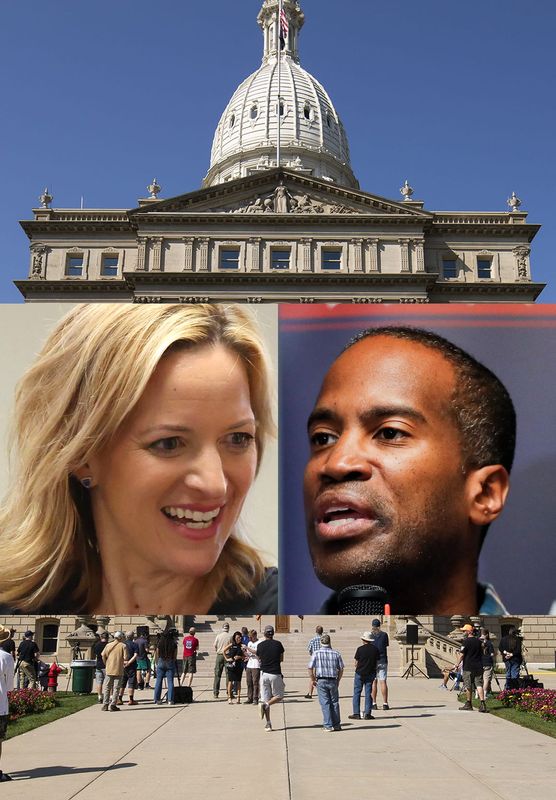
Now, Michigan voters have to choose between two tickets that depict very different stories. Two women on one ticket. Two men on the other. But the deeper story is more complicated than gender. And it should be, because James himself is making history.
As a Black man carrying the Republican nomination for governor, James represents the continuing demolition of a racial barrier that, for most of Michigan’s history, would have been almost unimaginable. Whatever one’s politics, that fact deserves recognition over partisan dismissal.
But history cannot merely be something we celebrate when it benefits us. That is why James’ selection of DeBoyer raises a question larger than whether his running mate is White or male.
The question, perhaps, is when someone who has broken through a barrier finally acquires the power to open a door for somebody else, what does he do with that power?
James undoubtedly had political and strategic reasons for choosing DeBoyer. His running mate has legislative experience, has served as a county clerk and now chairs the House Oversight Committee. James praised him as someone who represents the principles of integrity, competence and trust that he wants in his administration.
Those are legitimate considerations. But governing is about more than assembling a resume. It is about revealing your imagination of who belongs in the room.
Benson’s choice of Brinks also sends an unmistakable message. Brinks is not simply a woman placed on the ticket to satisfy some demographic calculation. She has wielded actual power. Since 2023, she has been at the center of Michigan’s legislative agenda.
Benson and Brinks will be the first major-party ticket with two women running together for governor and lieutenant governor in Michigan history. That matters because women spent generations looking at the highest levels of political power and seeing themselves represented everywhere except in the chairs where the consequential decisions were made.
But Democrats should resist the temptation to congratulate themselves too quickly, because representation without transformation can become another form of political theater. The moral significance of Benson-Brinks, therefore, cannot simply be that two women might occupy the state’s two highest offices. The question is what they will do once they get there.
The same question belongs to James. For Black Michigan, his candidacy presents an especially interesting moment. James should neither receive a pass because he is Black nor face a higher burden. He should be judged by the same standard we ought to apply to anyone seeking enormous public power: what they intend to do with that power.
Michigan deserves something deeper from both candidates. The question of this election is not whether Michigan will elect a woman or a Black man as governor; it is whether the person who becomes governor will recognize the forgotten Michiganians in Detroit, Flint, Benton Harbor, rural Michigan and other places, who will never have their names placed on a ballot and will never enter the rooms where decisions about their lives are made. X (formerly Twitter): @BankoleDetNews
bankole@bankolethompson.com
Bankole Thompson’s columns appear on Mondays and Thursdays in The Detroit News.
This article originally appeared on The Detroit News: Michigan’s historic governor’s race is about more than breaking barriers | Opinion
Reporting by Bankole Thompson / The Detroit News
USA TODAY Network via Reuters Connect
By Bankole Thompson | USA TODAY Network
