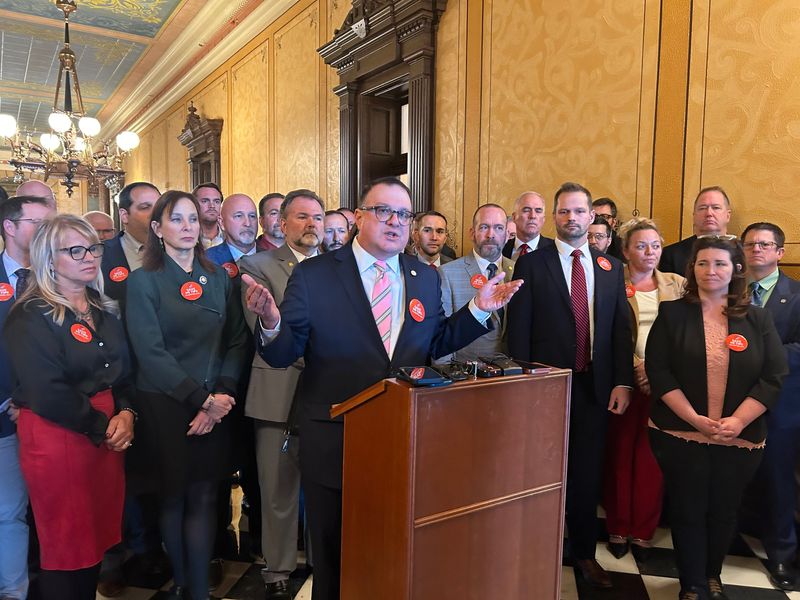
Dozens of Michigan lawmakers who obeyed their leader’s call to boycott the Legislature’s most recent lame duck session — typically the most productive period of their term — nevertheless apparently sought mileage reimbursements for driving to Lansing.

I say “apparently” because the Michigan Legislature and governor are exempt from the state’s Freedom of Information Act, which means you and I are not entitled to the vast majority of records that would provide valuable insights into how lawmakers operate.
The House Business Office, citing a mandate in the state’s Constitution, releases a very limited amount of financial data — including how much representatives are paid for their travel to the Capitol.
I’ve been meaning to request this information ever since the Republican boycott effectively killed any chance of getting a slew of important bills through the state House and, in some cases, to the governor before lawmakers went home at the end of 2024.
The Detroit mayor’s race took up most of my time in 2025, but some significant legislation died when representatives’ two-year terms ended on Dec. 31, 2024. So, I figured it was still worth digging into who got paid for going to work without doing arguably the most important thing we sent them to Lansing to do: Vote on legislation.
As you’re about to see, my investigation — like most efforts to find out what politicians in Lansing are up to — was about as easy as untangling a ball of yarn.
With your feet.
While wearing silk stockings.
Before we dive into who got paid without playing — unless, of course, you consider political gamesmanship a good use of your tax dollars — here’s a quick recap on what lawmakers didn’t vote on because Republicans and state Rep. Karen Whitsett, a Detroit Democrat, refused to attend House sessions:
The beginning of the end came on Dec. 18, 2024, when House Republican leader Matt Hall held a news conference at the Nuthouse, which sounds like a euphemism for the statehouse, but is really just a bar and restaurant near the statehouse.
Hall warned that Republicans would not attend House sessions unless then-Speaker Joe Tate put some of their favored legislation up for a vote. The GOP members apparently were not satisfied with the Detroit Democrat’s response to their threat. And the subsequent walkout by the 54 Republicans, along with Whitsett’s boycott, left Tate without enough representatives present to conduct business.
My analysis of the financial records provided by the House Business Office indicates that 17 — and as many as 38 — of the 54 Republicans who refused to attend House sessions during the lame duck period may have requested and received mileage reimbursement for traveling to the Capitol.
I wish I could be more definitive, but because of the way the information I requested was disclosed, who did what is as clear as a frog’s fart in a mud puddle.
And just as pleasant.
For the record
There are three ways you pay members of the Michigan House of Representatives.
Their salary is $71,685 a year.
They get an annual expense allowance of $10,800, doled out on a monthly basis.
And they are entitled to mileage reimbursement for one round-trip journey to the Capitol each week, unless they live close to Lansing. The amount they get is based on the distance from their home to the Capitol, and is determined by the State Officers Compensation Commission.
To qualify for the reimbursement, lawmakers must actually make the trip to Lansing, as well as fill out and submit a reimbursement request. Of course, there is an expectation they will do the People’s Business while they’re in town. That can range from drafting legislation, serving on a committee, attending a hearing, meeting with colleagues and constituents, responding to correspondence, and getting wined and dined by lobbyists. (That last one isn’t mandatory, though many lawmakers seem to think it is.)
One thing that is not required — and you’ll hear more about this in a minute — is actually attending a House session.
So what’s the big deal?
For those of you who know more about sports than politics, think of it as playing a season that lasts for two years and is filled with workouts, practices, studying playbooks, negotiations, film sessions, meetings with coaches, team meals (not provided, in this case, by lobbyists), game planning, strategizing and huddling — and then skipping the playoffs.
Before I explain how I tried to determine which of the AWOL reps requested mileage reimbursement during the lame duck session, let me tell you what a lame duck session is in 10 words:
The worst way to get things done in a democracy.
Few people understand deadline pressure as well as reporters, so I appreciate how urgency can help get things done. And one of the few things Republicans and Democrats agree on these days is that there’s nothing quite like the desperation that comes in the last month or so of a two-year legislative session to inspire lawmakers to push bills across the finish line. This lame duck period is also when legislators who are retiring, term-limited, or just lost a reelection bid in November, find the courage to cast votes in December they avoided before it was certain their next move involved packing their bags.
The problem is that trying to get things done before Dec. 31 means bills can get rammed through without hearings or deliberations, deals get cut without your knowledge (or input), and lobbyists and lawmakers can hold legislation hostage until colleagues desperate for their support agree to add or subtract pet issues that may not be relevant to what they’re trying to get passed.
Lame duck is, essentially, a necessary evil for anyone hoping lawmakers will tackle tough issues before their term expires, because the alternative is to start all over in January when the next two-year session begins — often with a raft of new and unpredictable lawmakers.
Yet, rather than show up to cast ballots on legislation that did go up for a vote, Hall, with help from Whitsett, essentially cut the traditional lame duck period short by directing all 54 Republicans not to attend House sessions for the rest of the year.
Even though Whitsett is a Democrat, she also blamed Tate for not giving her issues proper consideration. And with half the 110 representatives AWOL, there were not enough lawmakers present to do business. Adding insult to injury, Hall allowed Whitsett to hang out in his office during a crucial moment when Tate was looking for her.
Differing philosophies
Of the 54 Republican reps who participated in the December boycott, 17 received the same amount of mileage reimbursement in November and December, an indication they sought mileage reimbursement during the portion of the lame duck sessions when they did not attend House sessions.
Another 21 GOP representatives received more in mileage payments during December than they got in November. That could be because they also submitted a slew of reimbursement requests for trips they took earlier in 2024, and were trying to get caught up before the end of the year.
Alas, because there is virtually no transparency in Lansing when it comes to legislators and the governor, it’s difficult to be definitive.
So, on March 19 — during Sunshine Week, when journalists and other delusional do-gooders encourage greater transparency in government — I sent an email to each of the 47 Republican representatives who still are in office from that lame duck session. I identified myself as a Free Press reporter, asked whether they sought mileage reimbursement for those weeks in December when they did not attend session, and inquired whether they thought it was appropriate for lawmakers to be paid for going to Lansing if they did not attend sessions.
Emails sometimes get overlooked, so I followed up by calling every lawmaker’s office and asking the same questions.
I got a lot of voicemails. But since it was a session day, and since Hall is now Speaker of the House, the Republicans were in the Capitol, and I connected with a lot of their aides.
Representatives Dave Prestin, David Martin and Brad Paquette were among the lawmakers paid more mileage in December than November.
An aide to Prestin, who lives in Cedar River, said his boss “chooses not to speak” on reimbursements for his trips from the Upper Peninsula to the Capitol. He said he would let me know if Prestin’s scheduled opened up. (I’m still waiting.)
An aide to Martin, who lives in Davison, sent me an email that said: “Thanks again for reaching out about this. Rep. Martin has no comments at this time.”
An aide to Paquette, who lives in Niles, acknowledged in an email that Paquette was reimbursed for commuting from southwestern Michigan to Lansing during the boycott.
The email also said: “I came to town on the 18th in case the democratic majority was willing to work with republicans. After the walkout the week before, I held out hope that the democratic majority would come to the middle to work with us. That did not happen and is why we did not check in on the floor in continuance of the session walkout. An important note which affected my decision to not check in the following week is that I was restricted from speaking on the house floor in opposition to very controversial bills the week of the walkout. I remained willing and was in town if the majority were to choose to return to a working relationship on the floor. I had much to speak in opposition to that was on the potential lame duck docket.”
Rep. Mike Hoadley, who lives in Au Gres, got the same mileage reimbursement in November and December for his trips from northeastern Michigan to the Capitol. An aide told me they saw my email query and “we’re going to pass on it.”
Most of the lawmakers I contacted didn’t respond to the messages I left, sent automated responses, or failed to address my questions or follow-ups.
Three of the representatives who received less mileage in December than November were refreshingly and, perhaps not surprisingly, more helpful. Two of them even sent me copies of their reimbursement paperwork.
State Rep. Donni Steele, of Lake Orion, only sought reimbursement for the first two weeks of December — the portion of lame duck before Hall called for the walkout.
An aide to Steele attached her boss’ paperwork to an email that said: “Thank you for reaching out to the Office of Representative Steele regarding your inquiry into legislative mileage reimbursement. We appreciate your efforts to promote transparency and accountability, particularly during Sunshine Week!”
State Rep. Mark Tisdel, of Rochester Hills, told me he was in Lansing during the walkout, but takes a conservative approach to mileage reimbursement. His paperwork shows he was paid only for the first two weeks of December.
Tisdel had a long career in sales before he ran for the state House at age 65. He said he never forgot how one of his predecessors got fired for padding his expenses.
“You learn to manage an expense account,” he said. “And you see what happens when you try to pad it.”
Tisdel added that he has no problem with colleagues who went to Lansing, but boycotted session, seeking mileage reimbursement.
“If they’re doing legitimate work that’s a part of their job as representing their district, whether you’re in session or not, or whether there’s session or not … that’s up to each individual,” he said.
An aide to state Rep. Mike Mueller, of Linden, who received less mileage reimbursement in December than November, said Mueller only sought reimbursement for the first week of December.
“If someone’s not here, there’s no way in hell they should be putting in for that,” Mueller’s constituent relations director Michael Moon told me about being paid for traveling to the Capitol but not attending session.
Moon said that Mueller, who lives in Linden, is a former Livingston County Sheriff deputy who sets high standards for himself. Even though Mueller was in Lansing during the walkout, Moon said he chose not to seek reimbursement for traveling to the Capitol that week.
“He doesn’t care who does what,” Moon said, “He’s just going to do the right thing.”
When I told Moon I was going to quote him, but hoped he wouldn’t get Mueller in trouble with his fellow Republicans, he told me: “Mike doesn’t do the party thing. What’s right is right, what’s wrong is wrong.”
Hall, by the way, received less in mileage in December than November.
But the Speaker still wouldn’t speak to me about it.
M.L. Elrick is a Pulitzer Prize- and Emmy Award-winning investigative reporter, director of student investigative reporting program Eye On Michigan, and host of the ML’s Soul of Detroit podcast. Contact him at mlelrick@freepress.com or follow him on X at @elrick, Facebook at ML Elrick and Instagram at ml_elrick.
This article originally appeared on Detroit Free Press: Lame duck lawmaker no-shows still collected reimbursement dough
Reporting by M.L. Elrick, Detroit Free Press / Detroit Free Press
USA TODAY Network via Reuters Connect