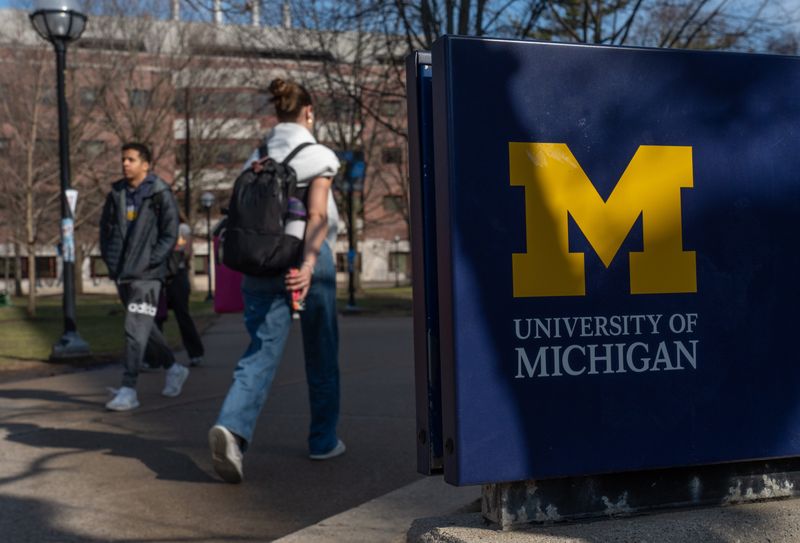
Another Chinese citizen is facing smuggling charges from the federal government, the third in a week, this time accused of bringing biological materials related to roundworms into the U.S. for her work at a University of Michigan laboratory.
Chengxuan Han is charged with smuggling goods into the United States and making false statements, according to a criminal complaint in U.S. District Court in Detroit. She made an initial appearance June 9 in federal court and was temporarily detained. A detention hearing is set for June 11, according to court records. Her attorney, Rhonda Brazile, had no comment after the detention hearing.

Han is pursing a doctoral degree from the College of Life Science and Technology in the Huazhong University of Science and Technology in Wuhan, China, according to an affidavit filed with the complaint.
From September 2024 to March, it indicated, she was listed as the sender of four packages of concealed or mis-manifested biological material addressed to two people associated with a lab at U-M.
The affidavit did not name the lab or individuals, but it indicated the lab studies sensory biology, including mechanosensation, thermosensation, chemosensation, photosensation and nociception, and focuses on sensory transduction, sensory processing and sensory regulation of aging.
The court filing indicated that Han’s offer letter from U-M states she was invited as a visiting scholar to the lab. One recipient of the packages is listed an active member of the lab, and the other is listed as a member of the faculty and staff of the Life Sciences Institute at the university, according to the affidavit.
The packages did not contain the correct documentation and were not imported per correct U.S. Department of Agriculture or U.S. Customs and Border Protection regulations, according to the affidavit.
Han arrived at Detroit Metro Airport from Shanghai on a J-1 visa June 8 and customs officers conducted an inspection and interview. She denied sending the packages to members of the lab, according to the affidavit, but when pressed, admitted to shipping them, with the materials from her research lab at the Chinese university.
She initially told customs officers the packages were plastic cups, instead of petri dishes, the affidavit indicated, and a book “(omitting the envelope with suspected biological materials concealed in it.)”
She then admitted sending packages containing “nematode growth medium (NGM) (in the petri dishes) and plasmids (in the envelope),” according to the affidavit. In the filing, the FBI agent wrote that it was unlikely the petri dishes solely contained NGM, which is used to cultivate nematode worms in lab settings, because it is readily available and inexpensive in the United States.
Customs officials also found that she deleted the content of her electronic devices three days before arriving in the U.S., according to the affidavit. It indicates that she told authorities she deleted the content to “start fresh” while in the United States.
After a customs inspection, FBI and Homeland Security Investigations agents interviewed Han, who admitted to sending the four packages to members of the lab, with the packages containing plasmids and petri dishes of C. elegans (nematode worms) from her research lab at the Chinese university. She also admitted to making false statements to customs officers, according to the affidavit.
It indicated that Han was listed as the shipper for a parcel manifested as a letter to one of the recipients at an apartment in Ann Arbor in September. The package was seized by customs, with an inspection revealing a biological sample that appeared to be plasmids, according to the affidavit.
A second shipment in September was manifested as plastic plates, but an inspection showed eight petri dishes with what contained biological materials. In October, a third shipment revealed plasmids, according to the court filing.
The fourth shipment, to the other recipient, in March was manifest as a letter, but an inspection showed a book with an envelope tucked in the middle of the pages, with a handwritten note with 28 shapes and a labeling scheme with each shape, according to the affidavit. It indicated the nomenclature of the labels are consistent with biological materials related to C. elegans research.
Han estimated sending five to 10 packages to the United States, according to the affidavit. She was told by Chinese couriers several were lost in transit. The second recipient contacted her regarding the fourth shipment and told her U.S customs contacted him regarding its contents, according to the court filing.
Eastern District of Michigan U.S. Attorney Jerome Gorgon Jr. stated in a release that the alleged smuggling “is part of an alarming pattern that threatens our security. The American taxpayer should not be underwriting a (People’s Republic of China)-based smuggling operation at one of our crucial public institutions.”
John Nowak, acting director of field operations for customs and border protection, added: “The guidelines for importing biological materials into the U.S. for research purposes are stringent, but clear, and actions like this undermine the legitimate work of other visiting scholars.”
According to the affidavit, Han’s research aims to understand how animals detect sensory cues, such as touch, light, chemicals, and temperature and how the neural circuits and synapses process sensory information to produce behavioral output. She has been a co-author of two articles relating to research with the use of C. elegans and listed a professor as her adviser at U-M.
Her post-study plans were to return to China, where she planned to complete her doctoral dissertation defense between June and September of 2026, according to the affidavit.
Last week, Yunqing Jian, 33, and her boyfriend, Zunyong Liu, 34, were charged with conspiracy, smuggling goods into the United States, false statements and visa fraud in a separate case unsealed June 3. They are accused of smuggling a fungus that causes a disease in wheat, barley, maize and rice so that Liu could research the pathogen at a U-M lab where Jian works.
Jian is being held pending a detention hearing June 13 in federal court. Liu is accused of smuggling the fungus into the country at the airport in clear plastic baggies in his backpack July 27. Customs officers denied him entry and processed him for expedited removal back to China, according to an affidavit in that case.
Prosecutors indicated in a news release that the fungus is Fusarium graminearum, which scientific literature classifies as a potential agroterrorism weapon. It causes “head blight,” a disease of the crops, and is responsible for billions of dollars in economic losses worldwide each year. The toxins the fungus produces can cause vomiting, liver damage and reproductive defects in livestock and humans, it indicated.
The federal government also has charged a former U-M student from China, Haoxiang Gao, with voting illegally in the 2024 presidential election, then fleeing the country a day before President Donald Trump took office in January, according to the U.S. Attorney’s Office.
(This story was updated with new information.)
Contact Christina Hall: chall@freepress.com. Follow her on X, formerly Twitter: @challreporter.
Support local journalism. Subscribe to the Free Press.
Submit a letter to the editor at freep.com/letters.
This article originally appeared on Detroit Free Press: Feds charge another Chinese citizen with smuggling biological materials for lab work
Reporting by Christina Hall, Detroit Free Press / Detroit Free Press
USA TODAY Network via Reuters Connect