An offseason of change will force the Detroit Pistons to explore new lineups this fall.
Gone are two of their most important rotation players from last season, Tobias Harris and Isaiah Stewart. Pistons coach J.B. Bickerstaff will not only have to find a new starting lineup, but make substantial tweaks to the units that powered a surprise 60-win season before their playoff exit in the second round to the Cleveland Cavaliers.

Here are three intriguing lineups the Pistons could deploy in 2026-27.
The (likely) new starting five: Cade Cunningham, Duncan Robinson, Ausar Thompson, John Collins, Jalen Duren
The Pistons largely stuck with the same starting lineup through all 82 games last season – Cunningham, Robinson, Thompson, Harris and Jalen Duren. This season, Cunningham, Thompson and Duren are locks to start, and it seems unlikely that Robinson, who anchored the unit with his elite outside shooting, will have his spot threatened.
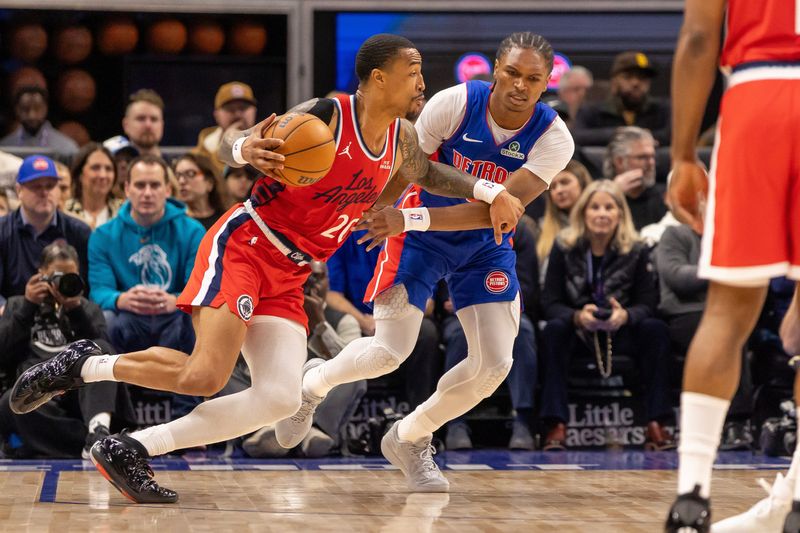
So who will replace Harris, who signed with the San Antonio Spurs after two seasons as Detroit’s starting power forward? The safe guess is 6-foot-10 big John Collins, who the Pistons acquired from the Los Angeles Clippers in a sign-and-trade. His strengths as an outside shooter and interior finisher, plus his rebounding and length, make him a likely fit at the four.
Harris was a lynchpin for the Pistons in various ways, taking on opposing big wings and forwards on defense while providing spacing and some shot creation on offense, for himself and others. Collins is a different player – not as good a passer and more reliant on his teammates to create his opportunities, but also better at capitalizing on the shots he gets.
It’ll be an adjustment going from Harris to Collins, but the veteran in his 10th season should be able to jell with the Pistons thanks to his ability to space the floor and finish lobs.
Defensive disruption: Cade Cunningham, Javonte Green, Ausar Thompson, Ron Holland, Paul Reed
Chaos fueled the Pistons last season, as they led the league both in steals and blocks per game. Their disruption on the perimeter was driven primarily by four players – Green, Thompson, Ron Holland and Paul Reed. All four ranked among the top 13 in the league in steals per 100 possessions, and Thompson’s two steals per game tied for first with Atlanta Hawks guard Dyson Daniels.
I’m not sure how viable a lineup featuring those four plus Cunningham is, given that Cunningham and Green are the only reliable outside shooters. However, there’s no lineup better-suited to mucking up a game and blowing up an opposing team’s offense. This is a unit that could be deployed in short spurts and perhaps make up for its lack of shooting by living in transition and avoiding halfcourt play altogether.
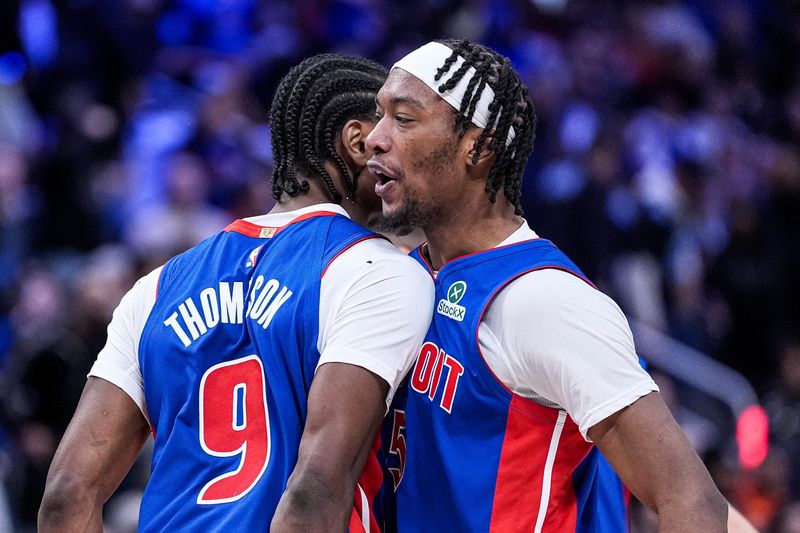
Thompson and Holland, in order, are the top perimeter defenders on the roster. The coaching staff occasionally leaned into pairing the “9-to-5” duo – so nicknamed for their jersey numbers – but the athletic wings’ minutes were more often staggered due to spacing concerns. They only played 64 minutes together alongside Reed, who has been promoted from third center to the primary backup for Duren and should see his playing time increase.
The coaching staff can shuffle things – perhaps swapping Green for either Robinson or Isaiah Joe for more reliable shooting, or replacing Cuningham with rookie Ebuka Okorie for an extra dose of speed on offense and handsy disruption on defense. Pairing Holland and Thompson with Reed more frequently is a possibility next season, as Holland pushes for a bigger role in Year 3, Reed establishes himself as their second big man and the team looks to maintain its defensive identity following the trade of Isaiah Stewart.
Five-out offense: Cade Cunningham, Isaiah Joe, Duncan Robinson, Taurean Prince, John Collins
True five-out lineups have been a rarity for the Pistons, due to a lack of shooters. The front office upgraded their spacing across the board this offseason, and Collins’ arrival gives them a knockdown shotmaker who can be used as a small-ball five. Perhaps for the first time in his career, the Pistons have the ability to surround Cunningham with four dangerous outside threats, .
Collins is a career 36.9% 3-point shooter who has hit 39.1% on those attempts over the past three seasons and around 40% during the past two. He’s arguably their best-shooting big since 2020 by a sizable margin and gives their offense a needed dynamic. Joining him this summer are Joe, a career 40.6% 3-point shooter, and veteran forward Taurean Prince, who shot a scorching 43.8% beyond the arc over his past two seasons with the Milwaukee Bucks.
Last season, the Pistons had one Duncan Robinson-level shooter: Robinson himself. They now have at least three, depending on how you grade Collins and fellow newcomer (and Michigan State alumnus) Gary Harris. A lineup featuring four of the five plus Cunningham would afford the superstar open lanes unlike any he has seen in his professional career and potentially unlock a more potent offense.
[ MUST WATCH: Make “The Pistons Pulse” your go-to Pistons podcast, listen available anywhere you listen to podcasts (Apple, Spotify) or watch live on YouTube. ]
Contact Omari Sankofa II at osankofa@freepress.com. Follow him on X and/or Bluesky.
This article originally appeared on Detroit Free Press: 3 intriguing lineups new-look Detroit Pistons may explore in 2026-27
Reporting by Omari Sankofa II, Detroit Free Press / Detroit Free Press
USA TODAY Network via Reuters Connect
By Omari Sankofa II, Detroit Free Press | USA TODAY Network