

Memphis Public Library welcomes all to free event
By Barb Pert Templeton

Contrary to popular belief, if you’d like to embrace homesteading as a lifestyle or simply a hobby you don’t have to own tons of property or harken back to the Little House on the Prairie days to do so.
In fact, the program ‘Getting Started with Homesteading’ will have Riley Township resident, Jennifer Collins, owner of The Collins Cluckery, sharing tips and tricks on the topic. The program will be hosted on Thursday, May 7 from 5:30 to 7:30 p.m. at the Memphis Public Library.

Blue Water Healthy Living caught up with Collins vie email to post some questions about the subject and her upcoming appearance at the local library.
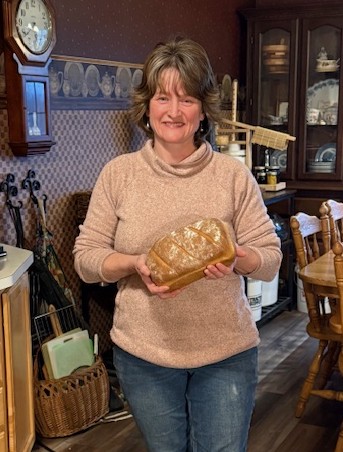
Local homesteader Jennifer Collins, owner of The Collins Cluckery in Riley Township, will host a special program on the topic at Memphis Public Library.
Blue Water Healthy Living: Let’s start at the beginning – in its simplest form what is homesteading exactly?
Homesteader Jennifer Collins: In its simplest form, homesteading is a mindset: a can-do, do-it-yourself attitude, and usually the things they do revolve around providing for many of their own basic needs: growing their own produce, planting their own trees, raising chickens, goats, cows, etc., for eggs, milk, and meat. They may make their own cheese, can their own food, bake their own bread, make their own soap, they may do any or all of these things.
BWHL: Do you consider yourself a homesteader? How long have you been living that lifestyle?
Collins: I do consider myself a homesteader, and the lifestyle has developed gradually, slowly, as I have developed these various skills. I used to be embarrassed to use that term – I often felt like I didn’t quite fit the mold, probably because I “only” have chickens…and in my mind, a homesteader has a cow. But when I look at the lifestyle I live, we raise our own chickens for eggs and meat; I’ve been making my own yogurt for years. I grow much of our own food in a large garden, including berries and fruit trees. I ferment veggies for gut health; can fruits, veggies, meats, and even convenience foods like soups. Nearly all of our bread is homemade, from our traditional Friday Night Sourdough Pizza to our Sunday Morning Biscuits and Gravy.
BWHL: What made you decide to homestead?
Collins: It wasn’t really a decision. It was rather a pull – we moved out to the country in 2005, and I knew I wanted a garden. I had already been toying with fermenting vegetables for gut health even back in the city, when our son had rashes that pharmaceutical creams wouldn’t fix. We had already had to move to organic meat whenever we could find it, as well as starting to avoid sugar and find healthier alternatives in general. We got chickens and I happened across a few books that were really influential, and which I plan to have at the class for folks to peruse.
BWHL: Is this similar to farming?
Collins: There is definitely an overlap, and I loosely call myself a farmer and my homestead a farm. There are those who think of farming, though, as just raising cash crops – corn and soybeans, for instance. So, it’s all in how you define farm. You do not have to farm to have a homestead.
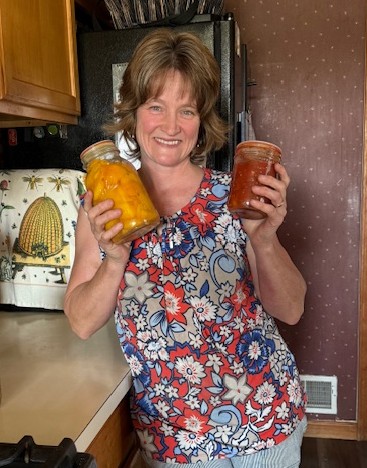
Canning is just one aspect of homesteading that Jennifer Collins embraces at her home in Riley Township.
BWHL: Does the person interested in homesteading have to live on a farm of have substantial property to begin or sustain the practice?
Collins: Absolutely not. In fact, sometimes excess land can be a hindrance, by weighing you down with the idea that you need to be doing more. You get spread too thin. Homestead where you are: that’s my motto.
BWHL: What’s the most important aspect of starting a homesteading lifestyle?
Collins: Hands down, it’s that can-do attitude…the desire to develop skills our modern culture has lost. Homesteaders aren’t stuck in the past…there are a few who take it as far as living off-grid, but most of us just meld it into our everyday, modern lives. Along with the can-do attitude, focus is important. There are SO many fascinating skills you can learn and explore, but if you try to do them all, you’ll fail.
BWHL: Can you share some examples of day to day living that embraces the homesteader lifestyle?
Collins: For me, I have found it works best to have certain days for certain activities. For instance, Thursday is my “bread day” and Tuesday is my “dairy day.” Also, I tend to look at what I have instead of what I can get at the grocery store. For example, if we eat one of our chickens, I’m certainly not going to throw away the bones. They’ll get simmered down into lovely, gut-healing, nerve-soothing chicken broth for sipping or for soup.
BWHL: What made you decide to share your knowledge of this topic with the public?
Collins: Questions. I get so many questions about these things. “What? You know how to make butter?” “What? You know how to make sourdough? I’ve always wanted to make sourdough.’
BWHL: What are some of the biggest challenges for a household that wants to start homesteading?
Collins: It’s almost a little funny to “decide to start homesteading,” since it comes on most of us gradually – either as a pull back to the land, or a desire for cleaner eating, or a feeling that there’s something wrong with the way the modern family all goes its separate ways instead of working together. Anyway, I’d say the biggest challenge is realizing you really can start small. People think they need acres and acres, but they will probably be much more successful long-term if they start close to the heart.
BWHL: What are the advantages and disadvantages of homesteading?
Collins: The advantages are that you live a little more in tune with nature and the rhythms of the seasons. You realize there’s something wrong with being able to get strawberries in December -that’s just weird and that chicken shouldn’t be squishy. Homesteading can bring families together, whether that’s snapping beans on the porch, digging potatoes, or processing chickens. You become more aware of what’s in the food on the shelves, and how nourishing it is not…and how to actually get nourishment back onto your table. The disadvantages are that you have to work really, really hard. It’s easy to get in over your head and start so many projects that you can’t finish them all. Spring is crazy busy, with new chicks arriving at the same time as you’ve got to get your garden in. Harvest is crazy, when things seem to come in all at once.
