

By Andrew Silver
SHANGHAI, Aug 24 (Reuters) – Weight-loss drugmakers, vying to tighten the belts of Chinese consumers, are promoting obesity awareness in metro stations, exercise studios and soccer stadiums as local restrictions prevent the direct advertising of prescription medicines in the world’s second-largest drug market.

China’s rate of overweight or obese people could reach more than 65% by 2030, the country’s National Health Commission has said.
Novo Nordisk, Eli Lilly, Pfizer and local firm Innovent Biologics are competing for market share with their versions of once-weekly GLP-1 weight-loss injections in China. Lilly led the once-weekly GLP-1 sales on Alibaba’s Tmall e-commerce platform and JD.com in the second quarter, according to Jefferies.
China does not allow drug companies to advertise prescription medicines directly to consumers. They can provide information to the public about the risks of specific diseases and recommend that they engage with doctors. Campaigns cannot mention product names, but might indirectly encourage people to seek help.
“Don’t forget to pay attention to Dad’s snoring and promptly visit a respiratory department or sleep center,” a banner with a Lilly logo advised commuters recently at a metro station in Shanghai’s central Jingan district. Snoring is a common symptom of sleep apnea, which is strongly linked to being overweight. Lilly’s GLP-1 drug Mounjaro has been shown in clinical trials to alleviate the condition.
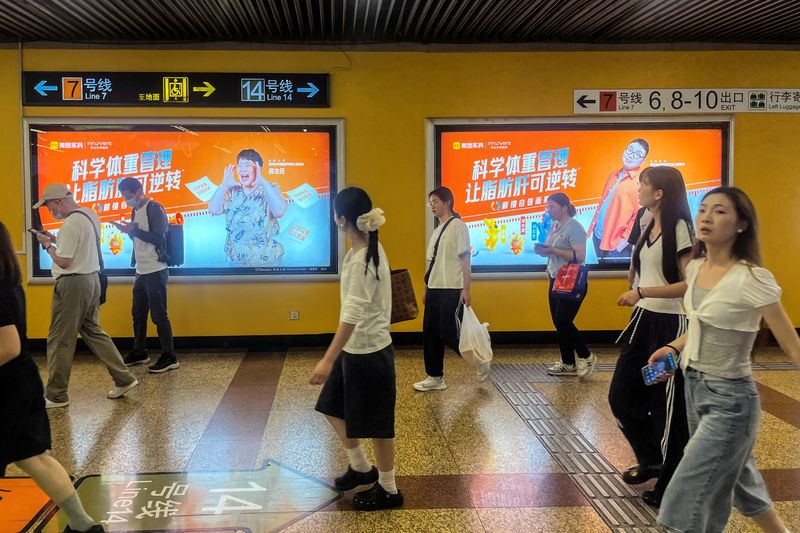
Ads from Innovent and e-commerce giant Meituan displayed on a wall in the same station last month said “scientific weight management” can reverse fatty liver disease. Another ad at a soccer stadium in Suzhou during a July match said “Innovent Biologics weight loss amazing!” repeatedly, a stream on the Weibo social media platform showed.
Gym chain Supermonkey touted via social media platform Xiaohongshu a partnership with Pfizer to launch a “healthy weight loss party” in June and July. A Pfizer employee told a crowd at one such party in Shanghai that the company hoped to help them build a lasting, healthy way of life. Afterward, a trainer led a weightlifting session for attendees, a post by the drugmaker on Xiaohongshu – which was later deleted – showed.
The communication efforts of drugmakers go well beyond campaigns related to other medicines, said Jia Hepeng, a professor of science communication at Soochow University in Suzhou.
“I rarely see pharmaceutical companies promoting prescription drugs for hypertension, tumors, and other diseases in public settings, or even through indirect advertising,” Jia said.
Social media promotions, along with recommendations from friends and family, have led some patients to seek specific weight-loss medicines by name, employees at hospitals in Shanghai and Guangzhou told Reuters. At first, patients asked for Novo’s semaglutide, also known as Wegovy, but recently Lilly’s tirzepatide, also known as Mounjaro, and Innovent’s mazdutide, also known as Xinermei, have been requested more frequently, said Zhao Xiaolong, an endocrinologist at the Shanghai Public Health Clinical Center.
MATCHING COMPETITORS
Novo launched the first once-weekly GLP-1 for weight management in China in late 2024. Lilly and Innovent followed in January 2025 and July 2025, respectively, while the first prescriptions for Pfizer’s Xianweiying were issued in April. Sales of GLP-1 therapies for weight management could reach 30 billion yuan ($4 billion) in the next five to seven years, up from an estimated 3 billion to 4 billion yuan at present, said Yang Huang, J.P. Morgan’s head of China healthcare research.
Novo executive Cai Yan became the firm’s Greater China president in March. She soon heard from doctors in China that the company’s communications were weak compared with its competitors, Cai told Reuters. Some Novo rivals were more bold, talking about the benefits of a drug more directly in their messaging, she said.
“I focus very much on what we should do and what is the right thing to do, what we can learn from competitors,” she said. “If you feel a competitor is much better in communication, layman language to the public, then we have to transform the way, how we communicate, from (a) medical educational perspective.”
She said Novo is changing its approach to not only focus on doctors in hospitals, but to reach patients with information on obesity via different types of media. The drugmaker aims to make the language in its public communication more accessible.
Last month, Novo and state broadcaster CCTV held a health exhibit on a street in Beijing with group dancing, Novo said on WeChat, a messaging app. Text displayed at the exhibit said some GLP-1 therapies have been validated in multiple, large-scale clinical studies, a separate post from one Xiaohongshu user showed.
Some weight-management campaigns could also cross a line into drug advertising, medical and legal experts said. For example, Innovent and Meituan’s subway billboards might lead consumers to associate them with a specific prescription weight-loss drug, said Chen Zhenggang, a partner at DeHeng Law Offices in Beijing.
The billboards did not explicitly display the names of Innovent’s product – Xinermei or mazdutide – but included what appeared to be a mascot with a similar-sounding name: “Madudu.”
“On one side, they’re definitely trying to be compliant … on the other side, you have drugs and you want to sell,” said J.P. Morgan analyst Huang, referring to obesity awareness and educational programs in China.
Earlier this year, Lilly paused its local obesity awareness campaign in India after the nation’s drug regulator said the company’s awareness campaign there had coincided with Mounjaro’s India launch and could potentially promote the drug to consumers.
In a statement, Lilly said its educational activities do not promote any specific medicines and it is “consistent” with China’s health strategies. Pfizer, Innovent, Meituan and China’s market regulator declined or did not respond to requests for comment.
(Reporting by Andrew Silver; Editing by Michele Gershberg and Thomas Derpinghaus)
By Andrew Silver | Reuters | © Copyright Thomson Reuters 2026.
