By Fred Fuller

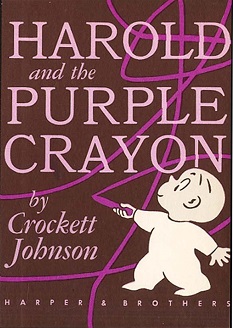
When I was a child, I found the picture book, Harold and the Purple Crayon, very inspiring and empowering. I don’t know how old I was when I first saw it, but it was my favorite book as a young child and the one I remember best.
With his purple crayon, the bald kid, Harold, could create anything just by drawing it with the purple crayon. The book begins with Harold wanting to go for a walk in the moonlight, but there is no moon that night, so he draws one. He had no path to follow, so he draws one. He went on in that book to draw himself many imaginative adventures.

To me, it inspired the sense of a magical ability to accomplish anything I could imagine. It has inspired many other people as well. It was the favorite book of the musician Prince, and it was the reason for his fondness for the color purple.
The book was written and drawn by Crockett Johnson and published in 1955. The book was so popular that Johnson created six more books about Harold’s adventures. The book also inspired several short animated films, some stage shows, an HBO television series in 2001, a Broadway musical now in the works, and a movie of the same name, released in August 2024 after many years in production. The movie features Harold as an adult, with many of his imaginative creations coming to real life. It was not well-received, however, by film critics or audiences.
“Crockett Johnson” was a pen name adopted by David Johnson Leisk, who was born in New York City in 1906. His father was from the Shetland Islands of Scotland, and his mother was an immigrant from Germany. He explained his pen name by saying that Crockett was his childhood nickname, and his surname, Leisk, was too hard to pronounce. He said his nickname was a way of setting himself apart from all the other Davids in the Corona, Queens, neighborhood where he grew up. It was taken from the American folk hero Davy Crockett.
It’s apparently just a coincidence that the hugely popular Walt Disney movie, Davy Crockett, King of the Wild Frontier, was also released in 1955, because Crockett Johnson was using his pen name much earlier. After working as an art editor for several magazines in the late 1920s and 1930s, his first major success was a daily comic strip, Barnaby, which began in 1942 and was syndicated in newspapers for many years. He used his pen name in that cartoon series. It had many followers and was one of the influences on Charles Schulz, who later created Peanuts.
In 1943, Johnson married Ruth Krauss, also a children’s book author. They collaborated on a children’s book, The Carrot Seed, published in 1945. Though the two never had children, they found their biggest fame through creating children’s books.
Crockett Johnson and Ruth Krauss became close friends and mentors of Maurice Sendak, who eventually became famous with Where the Wild Things Are. Krauss collaborated with Sendak on his first popular book, A Hole Is to Dig, published in 1952.
Krauss was herself a noted writer and illustrator of many children’s books, three collections of poems, and two plays in verse for adults. Maurice Sendak characterized her as a giant in the world of children’s literature, saying: “Ruth broke rules and invented new ones, and her respect for the natural ferocity of children bloomed in to poetry that was utterly faithful to what was true in their lives”.
Crockett Johnson was also an artist and an inventor. From 1965 until his death in 1975, he began creating a series of geometric paintings based on the mathematical theorems of Galileo, Euclid, Descartes, and others. The National Museum of American History has 80 of them in its collection. He also had at least one patent, granted in 1952 for an adjustable mattress “having a plurality of selectable surfaces of varying hardness.”
During the “Communist scare” of the 1950s, J. Edgar Hoover’s FBI began investigating Crockett Johnson as a “concealed Communist.” Both Johnson and Ruth Krauss had been radicalized by the Great Depression, which they saw as the result of unrestrained Capitalism, and they held views that some considered Leftist, but they were never members of the Communist Party. However, due to false allegations by informants and the fact that some of their friends were associated with the Communist Party, the FBI compiled an extensive file on them and their activities.
Some of Johnson’s early cartoons, including Barnaby, were published in left-wing newspapers and magazines. He was known as an anti-racist, and he joined the Independent Citizens’ Committee of the Arts, Sciences, and Professions (ICCASP), which some considered a Socialist organization. In the 1930s, he had supported the American Committee for Spanish Freedom, which was formed to oppose the Fascist takeover of the Spanish democracy during the Spanish Civil War. He also attended the controversial Cultural and Scientific Conference for World Peace in New York in 1949. All these associations were considered possibly Communist during the McCarthy Era in the 1950s. Eventually, though, four months before Harold and the Purple Crayon was published, the FBI abandoned its investigation of him.
Sources: New York Public Library: https://www.nypl.org/blog/2024/08/26/10-things-you-might-not-know-about-harold-and-purple-crayon-and-its-creator
Philip Nel, “Crockett Johnson’s FBI File, Part 1,” https://philnel.com/2012/04/24/cjfbi/ https://en.wikipedia.org/wiki/Harold_and_the_Purple_Crayon https://en.wikipedia.org/wiki/Crockett_Johnson https://en.wikipedia.org/wiki/Ruth_Krauss https://en.wikipedia.org/wiki/Barnaby_(comics)