

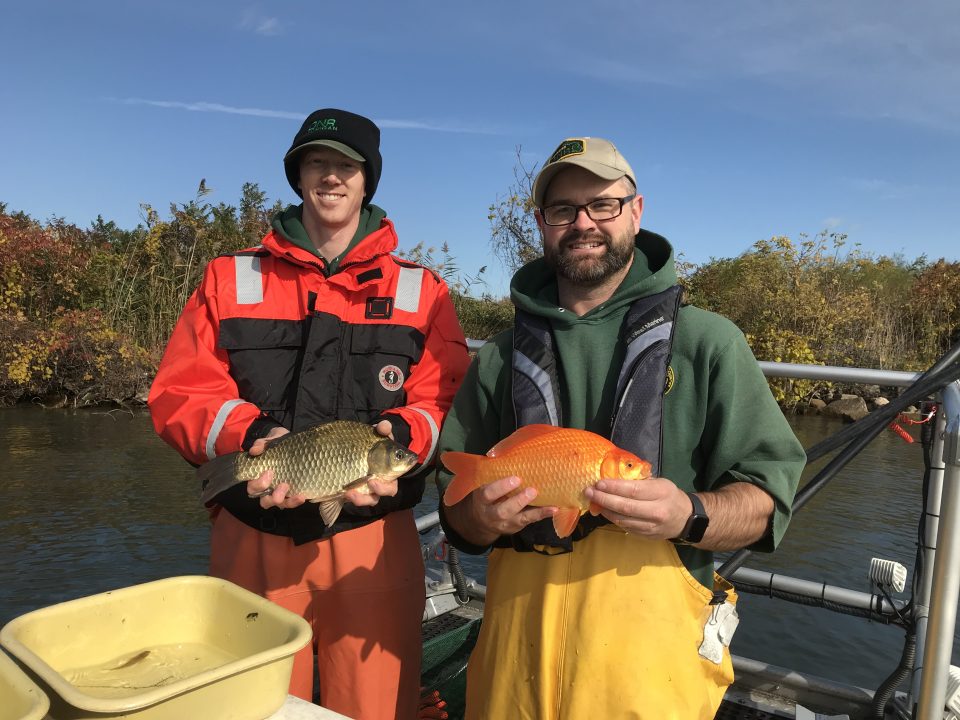
They pose a danger to native fish and plants
By Barb Pert Templeton

It’s long been an easy line for parents to use when their young children want a pet, sure, let’s get a goldfish.
Well, it seems many of those tiny pets are being dumped into local waters including the Great Lakes. Once there, the fish quickly consume much more food via plants and grow to as much as 15 or 16 inches in length. In addition, females spawn in the spring increasing the numbers
considerably.

The population of the bright orange fish has continued to grow in the Great Lakes over the last two decades and those who track the aquatic species and plant life are concerned. Blue Water Healthy Living posed questions about the subject to Lucas R. Nathan, Ph.D. an Aquatic Invasive Species Coordinator with the Michigan DNR Fisheries Division.
Blue Water Healthy Living: When did the Goldfish first become an issue in the Great Lakes?
Dr. Lucas R. Nathan: Goldfish are thought to have been introduced into the Great Lakes the
early 1900’s. They were found in other parts of the US earlier, with 1880 being the earliest
record in the USGS Nonindigenous Aquatic Species database. Additional information on their
occurrences and other information about goldfish can be found on the United States Geological
Survey website.
Blue Water Healthy Living: How did they discover it was occurring with frequency?
Nathan: Observations of goldfish usually come from a combination of scientific surveys,
commercial captures, and public reports.
Blue Water Healthy Living: What happens to regular goldfish once released into the lakes?
Nathan: The recent articles by Michigan State University and the New York Times sum it up
well. In short, goldfish are often limited by their habitat and resources in a tank. Once released,
they are able to grow to much larger sizes up to 14+ inches.


Once the goldfish begin reproducing, they often revert back to their natural brown/golden color and can be confused with small Common Carp.

Lucas R. Nathan, Ph.D. shared some information about the growing goldfish population in the Great Lakes.
Blue Water Healthy Living: Do they breed there? If so, it that increasing population another
problem?
Nathan: Yes, they can reproduce in the wild and that can contribute to increasing populations. Once they begin reproducing, they often revert back to their natural brown/golden color and can be confused with small Common Carp.
Blue Water Healthy Living: What do they eat?
Nathan: They are omnivorous, meaning they feed on a variety of plant and animal matter such as insects, fish and fish eggs, and algae. That typically occurs along the bottom of lakes and
rivers.
Blue Water Healthy Living: Are they a feedings source for other fish already making their
homes in the Great Lakes?
Nathan: Many predator species may eat goldfish on occasion. However, goldfish are able to
grow fast and quickly get big enough where most species wouldn’t be able to eat them. At
natural population levels, our predator species do not seem able to limit goldfish populations.
Blue Water Healthy Living: What’s the harm in having the Goldfish in the Great Lakes?
Nathan: In addition to competition for resources, their feeding behavior can result in uprooted
vegetation and decreased water quality. This can cause diminished habitat quality in areas that
are valuable to some of our native species for spawning or nursery habitat.
Blue Water Healthy Living: What should someone do, if they catch a Goldfish?
Nathan: If you catch a goldfish, please consider reporting it to an online database such as the
Midwest Invasive Species Information Network (MISIN) or the USGS Nonindigenous Aquatic
Species database.
