

By Jim Bloch

St. Clair County residents know better than most the dangers of building tunnels beneath the lakebed of the Great Lakes.
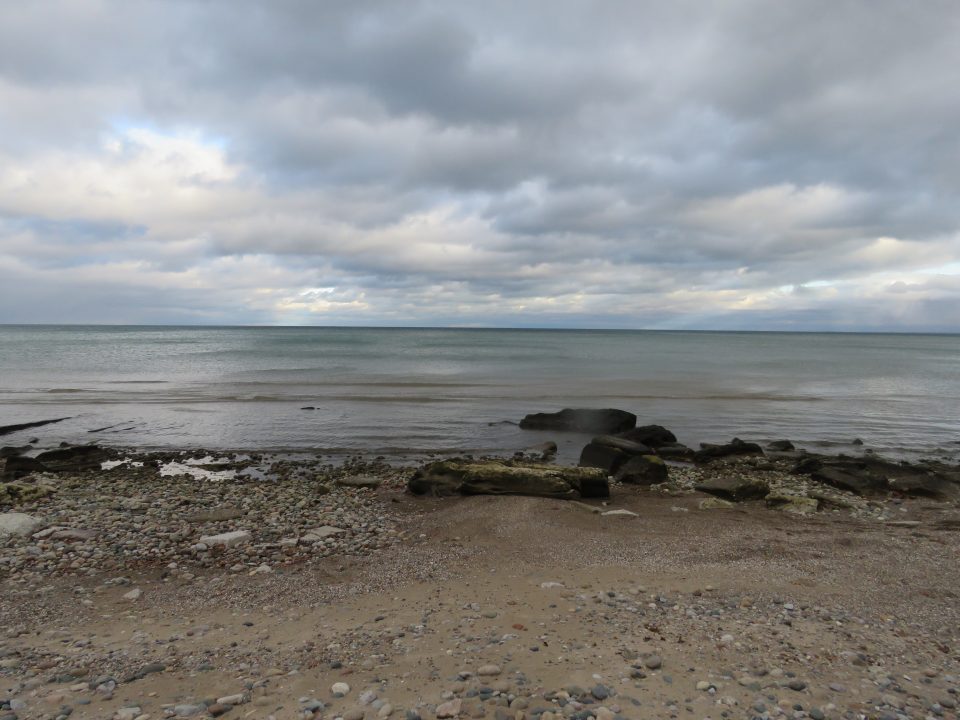
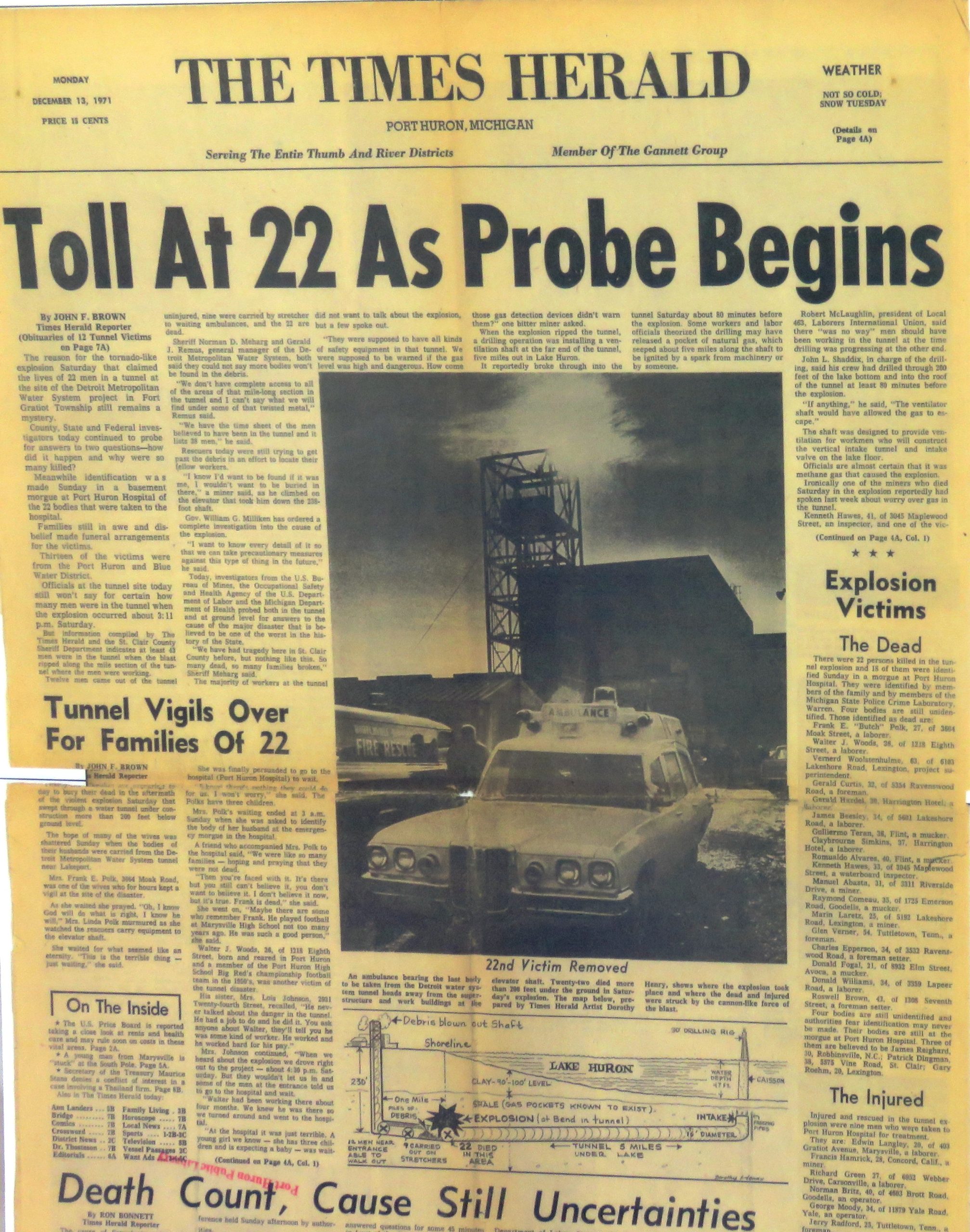
On Dec 11, 1971 at 3:11 p.m., 22 workers died instantly when an explosion ripped through the unfinished water intake tunnel that stretched more than five miles into Lake Huron from the shore of Fort Gratiot Township, north of Port Huron, where Fort Gratiot County Park now lies.

There are a number of parallels between that accident and the dangers of a similar explosion in a 4.5 mile tunnel proposed to be constructed under the Straits of Mackinac to hold Line 5, Enbridge’s controversial pipeline that transports 542,000 barrels of light crude and natural gas liquids per day from Superior, Wisconsin to Marysville, Michigan and under the St. Clair River to Chemical Valley in Ontario.
On Dec. 1, the Michigan Public Service Commission approved Enbridge’s siting permit for the project.
One of the fears of opponents of Line 5 is an explosion in the tunnel.
The Detroit Metropolitan Water Department was nearing the end of a project to build a 5.5 mile tunnel under Lake Huron to create a new source of water for much of Southeastern Michigan. In 1968, it started work on the 16-foot wide tunnel, bored 230 feet under the lakebed and lined with concrete.
Enbridge is proposing to build a concrete-lined tunnel with an inside diameter of 21 feet, routed through bedrock 60-370 feet beneath the lakebed in the Straits.
A methane leak and a spark caused the explosion in the Fort Gratiot water tunnel. Many opponents of Line 5 fear a similar occurrence in the proposed tunnel.
The water tunnel was not yet finished when it exploded, so nothing flowed into Lake Huron. Even if had been operational, the only thing it carried would have been water.
Line 5, if it exploded, could create the largest, most destructive oil spill in the history of the Great Lakes.
The water tunnel
The crews were just weeks away from finishing a massive $123 million project designed to feed the new Lake Huron Water Treatment Facility one mile inland on Metcalf Road. After treatment, the purified water would be pumped through more than 80 miles of water main to serve more than four million residents in Flint, Detroit and its suburbs.
Working on a platform in the lake to construct the water intake crib, the workers drilled a ventilation shaft into the tunnel below, inadvertently releasing methane gas from a deposit of Antrim shale into the tunnel. When the drill bit was ejected, it generated a spark that ignited the gas, triggering the massive explosion.
The concussive waves from the explosion amplified in the tunnel as they rocketed over the four-mile stretch toward shore. Machinery, tools and equipment became projectiles. Twenty-two men were working to put the finishing touches on concrete walls of the tunnel. They died immediately.
“It was an instantaneous thing, a concussive blast,” said Paul Zurek, a spokesperson for the Laborers International Union of North America, talking about the disaster at its 50th anniversary in 2021. Twenty-two laborers survived. They had been working further west in the tunnel. Fifteen of the dead lived in St. Clair County.
The losses could have been greater. “It was shift change,” said Zurek.
A full shift would have seen 74 men working in the tunnel instead of 44.
The petroleum pipeline tunnel
“Data submitted by Enbridge in its permit application reveals the existence of dissolved methane in the groundwater, the aquifer underneath the Straits,” said Brian O’Mara, a tunnel expert who gave testimony to the MPSC in February 2022. “If groundwater infiltrates into the tunnel, methane dissolves into the air. If there is a spark from a machine or other source, it would create a potential danger of explosion and pose a threat to the construction crew.”
O’Mara said the quality of the limestone bedrock in the Straits and in Lake Huron off Fort Gratiot Township is “similar.”
If such an explosion led to an oil spill into the Straits, the damage would be almost unimaginable.
Within 20 days, a million gallon spill would extend 50 miles down the Lake Huron coast, lap up on the shores of Mackinac Island to the east and reach Beaver Island to the west, according to a 2014 study by Eric Anderson, of the NOAA Great Lakes Environmental Research Lab, and David Schwab, of the University of Michigan’s Water Center.
“If you were to pick the worst possible place for an oil spill in the Great Lakes, this would be it,” said Schwab told Oil and Water Don’t Mix, a nonprofit opposed to the pipeline. “The currents are powerful and change directions frequently. In the event of an oil spill, these factors would lead to a big mess that would be very difficult to contain.”
Pipeline spills are not uncommon. Hundreds occur annually, marked by explosions, fires, seeps.
“From 2000 to 2009, pipeline accidents accounted for 2,554 significant incidents, 161 fatalities, and 576 injuries in the United States,” according to Oil and Water Don’t Mix.
Enbridge has had 15 major failures in Line 5 since 1988, resulting in 220,000 gallons of oil and gas spilling into the environment.
An explosion in the Line 5 tunnel, once it was operational, would likely dwarf those spills.
Jim Bloch is a freelance writer based in St. Clair, Michigan. Contact him at bloch.jim@gmail.com.
