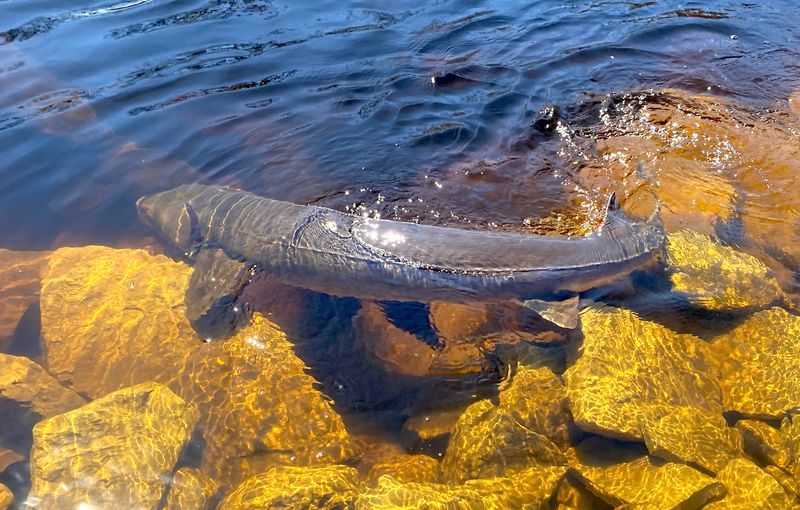
Lake sturgeon stocking festivals are coming to Cleveland on Sept. 19 and Toledo on Oct. 10. An autumn lake sturgeon release is also planned, apparently without fanfare, in the Scioto River.
Hope springs eternal, 18th-century poet Alexander Pope observed in his “An Essay on Man.” Pope didn’t pen verse about sturgeon, but he did mention them. Of course, that was at a time when, unlike now, there was no reason to doubt their future existence.

Currently, the fish is listed as endangered in Ohio. No record exists for lake sturgeon hooked in the state because targeting them is prohibited. Keeping one accidentally caught is likewise taboo.
Sturgeon, which existed in Earth’s waters long before the asteroid strike that ended the age of dinosaurs, aren’t doing swimmingly at this advanced stage of the age of humans.
Beluga sturgeon, the most renowned of 27 existing species because it delivers caviar and grows to a remarkable 3,500 pounds, is considered critically endangered.
Not doing well, either, is lake sturgeon, a species once indigenous to some large Ohio streams, including the Scioto and Ohio Rivers. Sturgeon were so abundant in Lake Erie that commercial netters of the late 19th century, considering them a nuisance, would stack sturgeon bodies for burning.
In short order, overfishing, the damming of spawning rivers and water degradation led to a near wipeout of the fish, whose peak numbers in Lake Erie might’ve been a million.
Netters in Ohio waters reported taking 5.1 million pounds of lake sturgeon in 1885 and a minuscule 5,100 pounds in 1920. Ohio didn’t bar the taking of sturgeon until 1968.
Every now and then, one accidentally gets caught on rod and reel. Netters are required to return incidentals to the lake.
The lake sturgeon could grow far bigger than anything else currently in the Ohio record book, in which a 101-pound blue catfish rules.
The all-tackle world record lake sturgeon was taken from Georgian Bay of Lake Huron in 1982 and weighed 168 pounds. That record won’t be challenged or even challengeable until enough reproducing sturgeon are swimming around to again allow fishing.
Lake sturgeon weighing 300 pounds and measuring 7 feet in length have been documented. A sturgeon weighing 240 pounds and measuring 7 feet was pulled out of the Detroit River in 2021 by a survey team from the U.S. Fish and Wildlife Service.
Successful sturgeon spawning has been confirmed in the Detroit River. Lake Erie’s current sturgeon population probably can be linked to the Detroit River and to successful spawning in the upper Niagara River, researchers say.
Sturgeon have not had much recent success spawning in the Ohio streams they historically relied upon. The Ohio Division of Wildlife’s fish experts, nonetheless, believe that improved stream conditions and advances in restoration techniques offer the strong possibility of reconstituting a viable population.
Using fish gathered from the St. Clair River, which connects Lake Huron to Lake Erie, wildlife officers began stocking the Maumee River in 2018. Last year, initial stockings commenced in the Cuyahoga, Sandusky and Scioto rivers.
The Maumee River annual stockings are thought to be at least partly responsible for an increase in the number of sturgeons turning up in Lake Erie, but the time frame for measuring whether reproduction actually takes place is lengthy.
The stockings will continue for about 20 years at each location. At the end of 20 years, the first of the stocked fish will be approaching the age at which successful spawning can initially take place.
Once in the water, a lake sturgeon can hang around a while. Females might live 427 years, recent research suggests, males 279 years.
This article originally appeared on The Columbus Dispatch: Lake sturgeon to be released in Scioto River, other Ohio water ways
Reporting by Dave Golowenski, Special to The Columbus Dispatch / The Columbus Dispatch
USA TODAY Network via Reuters Connect
By Dave Golowenski, Special to The Columbus Dispatch | USA TODAY Network