

By Yena Park and Jihoon Lee
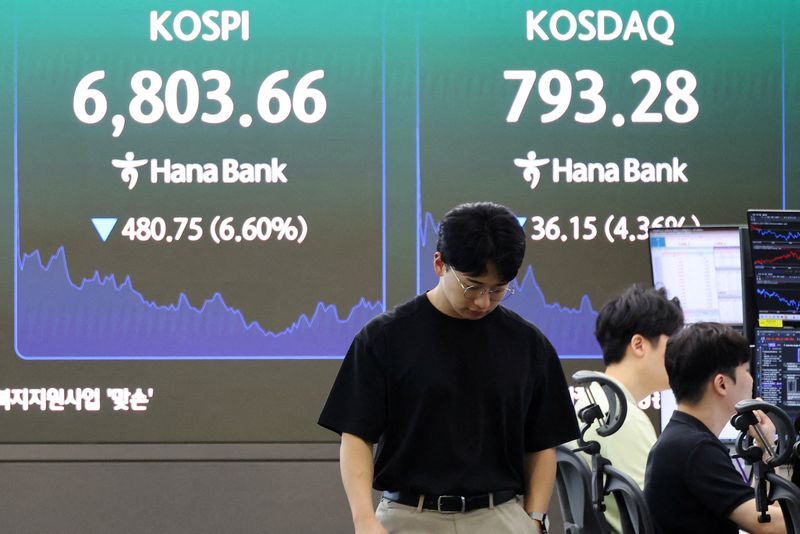
SEOUL, Aug 7 (Reuters) – South Korea’s stock market rout is unravelling a government-backed effort to lure retail ‘ant’ investors home, driving the biggest rush into the U.S. market in six months and reviving a long-standing risk to the won.

In July, as the benchmark KOSPI sagged to its largest monthly loss since the depths of the 2008 global financial crisis, retail buying of U.S. stocks hit $4.6 billion, according to Korea Securities Depository data.
That was well above the $2.7 billion monthly average in 2025, a year in which retail investment in U.S. equities more than tripled from the previous year.
Reuters calculations show those purchases surpassed buying of domestic shares for the first time since February, highlighting how quickly confidence in the local market has evaporated.
The reversal threatens to revive a years-old pattern in which retail investors funnel savings overseas, analysts say, acting as a drag on the South Korean currency and frustrating policymakers trying to deepen participation in the domestic market.
“Outflows slowed because the domestic market was strong, but they re-accelerated as the KOSPI collapsed, fanning investor views that the U.S. is the right decision after all,” said Kwon Ah-min, an FX analyst at NH Investment Securities in Seoul.
“They are tired of the domestic market.”
Small South Korean investors, known locally as “ants” because of their collective behaviour, have long preferred U.S. markets to their own, which has tended to ebb and flow with the fortunes of the country’s export-driven giants in electronics, shipbuilding and manufacturing.
For a few heady months that seemed to have changed, as retail money poured into the soaring KOSPI, encouraged by the AI boom as well as a government sweetener offering tax breaks to investors who sold overseas shares to buy local stocks.
South Korea has also for years been trying to improve shareholder returns by encouraging corporate governance reform, but the bruising selloff of recent months, with the KOSPI down 33% from its June peak, has torched retail investors’ patience.
Chipmakers Samsung Electronics and SK Hynix drove 76% of the KOSPI’s 2,257.8 trillion won ($1.59 trillion) wipeout in market value, as concerns mounted over the durability of AI spending and intensifying competition from Chinese rivals. Volatility was amplified by heavily traded leveraged exchange-traded funds (ETFs) tied to the chipmakers.
The Nasdaq, by contrast, has been more or less flat over the same period.
“If Korean equities continue to lag their US counterparts, we worry that domestic retail outflows could re-emerge,” Bank of America analysts said in a note.
“In other words, the path is very narrow to have a benign portfolio flow dynamics that would support sustained KRW appreciation,” they said, referring to the won.
SHIFTING FLOWS
The won has also encouraged investing abroad as it jumped 8% in July to a nine-month high, posting its best monthly gain since November 2022, propelled by chipmaker SK Hynix raising $26.5 billion and repatriating part of those proceeds.
A stronger won lowers the incentive to bring overseas investments home and can spur fresh foreign asset purchases, particularly as investors expect U.S. interest rates to remain supportive of the dollar.
Retail deposits in the so-called Re-shoring Investment Accounts, introduced in March to offer tax incentives, recorded their first monthly decline in July, according to Korea Financial Investment Association data.
While some money is flowing into funds holding Korean assets, including $319 million invested last month in the Direxion Daily MSCI South Korea Bull 3X ETF, larger sums are heading into U.S. stocks and U.S.-focused funds.
In August alone, retail investors have bought a net $278 million of overseas equities as Wall Street reaches fresh highs amid KOSPI volatility.
Meanwhile, deposits in domestic stock trading accounts, a gauge of demand for local equities, fell to 102.8 trillion won as of Monday, the lowest since mid-February and down from a record 140 trillion won in early June, according to Korea Financial Investment Association data.
($1 = 1,419.4700 won)
(Reporting by Yena Park and Jihoon Lee; Editing by Brenda Goh, Tom Westbrook and Shri Navaratnam)
By Yena Park and Jihoon Lee | Reuters | © Copyright Thomson Reuters 2026.
