Thank goodness it’s summer! LGBTQ+ Pride Month and Juneteenth are truly two of my favorite times of the year. They are powerful reminders of how far we’ve come and, more importantly, how far we still have to go. These celebrations are opportunities to reflect and recommit ourselves to the work of justice and community.
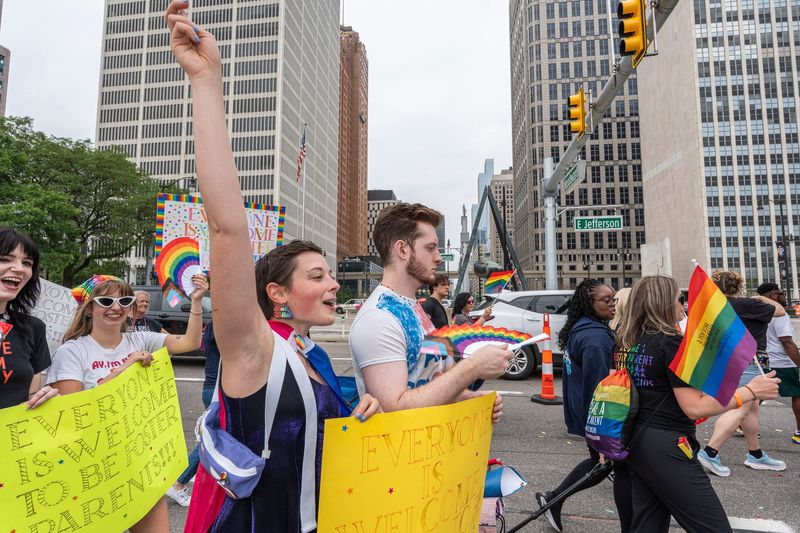
It is also important to remember that Pride, first and foremost, is a protest.

Learning to protest can be a bit overwhelming and a little scary. So this year, here are a few things to remember.
Pride began as protest
Protesting looks different for all of us. Some of us go to big rallies to lift our voices for our families and our community. Some of us protest at the kitchen table, reminding certain family members that we are not just headlines or statistics, but mothers, fathers, sisters, brothers, neighbors and friends. One of our most important forms of protest is at the ballot box, ensuring our voices are heard and our votes are counted.
Michigan’s own history is filled with examples of people turning protest into progress. Here in Michigan, we have our own powerful examples of what to do next.
Ruth Ellis, a Black lesbian Detroiter born in 1899, created a refuge for LGBTQ+ people at a time when openly living as yourself could cost you your job, your safety or your freedom. Her home became a gathering place for generations of LGBTQ+ people seeking community and acceptance. Today, the Ruth Ellis Center carries that legacy forward by supporting LGBTQ+ young people ― particularly youth of color ― throughout our region.
Michigan’s story is also shaped by leaders like Emme Zanotti, whose advocacy helped advance LGBTQ+ equality and political representation across our state, and former state Sen. Buzz Thomas, a longtime Detroit public servant who has championed voting rights, economic opportunity and policies designed to strengthen historically marginalized communities.
Their work reminds us that protest is not only about resistance ― it is also about building institutions, creating opportunities, and ensuring that future generations inherit a more just and inclusive democracy.
Unfortunately, across the country and here in Michigan, we are seeing renewed efforts that could make participation in our democracy more difficult, if not impossible.
Voting barriers threaten vulnerable communities
The federal SAVE Act and Michigan’s HB 4765 would require many voters to provide documentary proof of citizenship ― such as a passport or birth certificate ― to register to vote.
Similar proposals have also emerged that would make it more difficult for everyday Michiganders to use the citizen-led ballot initiative process that has long allowed voters to shape public policy directly.
The potential impacts are particularly concerning for communities that have historically faced barriers to political participation.
Many LGBTQ+ people ― especially transgender and nonbinary individuals ― may have identification documents that do not perfectly match other legal records. Married women who changed their names often face similar documentation challenges.
Our Brown and Black communities, low-income families, seniors and young voters are also less likely to have immediate access to passports and other costly citizenship documents.
Obtaining or replacing these records can require time, money, transportation and bureaucratic hurdles that many families simply cannot afford. Sounds like a poll tax, if you ask me. But this is not the time to agonize; it is a moment to organize and to protest ― in whatever form that looks like for you.
Democracy depends on participation
While the challenges we face can feel overwhelming, history shows us that progress has always been driven by people who choose to act. That action can take many forms: checking your voter registration, making a plan to vote, learning about candidates and issues on your ballot, sharing accurate information with friends, family, and neighbors, volunteering with organizations doing this work, or simply having conversations to remind people their voice matters.
Democracy is strongest when all of us participate.
Protecting democracy means protecting the freedom to vote, protecting the freedom to organize and protecting the freedom of ordinary people to hold our government accountable. Yes, OUR government.
Those principles are at the heart of Pride and Juneteenth.
The leaders who came before us understood something that remains true today: Civil rights, voting rights and human rights are inseparable. Whether we are defending the freedom to vote, fighting for LGBTQ+ equality, or advancing racial justice, we are ultimately fighting for the same thing ― a democracy where everyone has a voice, and everyone belongs.
While that fight may look different for each of us, the goal remains the same: Pride. Justice. Peace. Joy.
So what comes next? I have a few suggestions: Volunteer, vote and be visible!
Roland Leggett is the Election Protection Manager at the Michigan League of Conservation Voters and the former Michigan Democratic Party LGBT&A Caucus Chair. Submit a letter to the editor at freep.com/letters, and we may publish it online and in print.
This article originally appeared on Detroit Free Press: Pride is more than a party. It’s a warning. | Opinion
Reporting by Roland Leggett, Op-ed contributor / Detroit Free Press
USA TODAY Network via Reuters Connect
By Roland Leggett, Op-ed contributor | USA TODAY Network