By Karin Strohecker
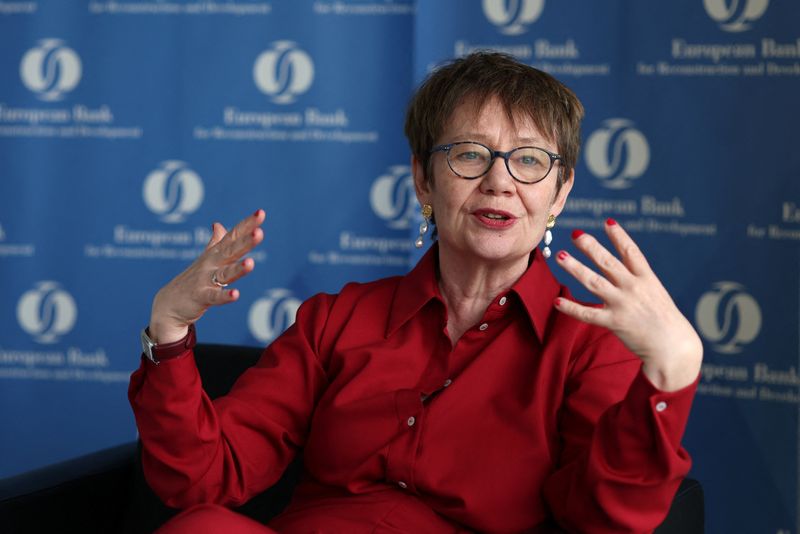
LONDON, June 2 (Reuters) – Government support in emerging economies affected by the Middle East conflict should be temporary and targeted, the head of the European Bank for Reconstruction and Development told Reuters, as tight fiscal space and higher borrowing costs bite.

The warning from EBRD President Odile Renaud-Basso comes in advance of the London-based bank’s annual meeting, which starts on Friday in Riga under the shadow of six years of crisis that began with the COVID-19 pandemic and continued with Russia’s full-scale invasion of Ukraine.
The shocks left many countries with higher debt burdens, Renaud-Basso said, including emerging Europe, Central Asia, the Middle East and Africa – the regions where the bank invests in private sector projects.
Now, energy price spikes and potential fertiliser shortages due to the ongoing war in Iran risk pushing up food prices and inflation further.
“There is less fiscal space in a number of countries,” Renaud-Basso said. “You need to be very targeted, very focused on the most affected people … and avoid very generic across the board measures that could be very expensive.”
The lender will cut its growth outlook and raise its inflation forecast in its economic update due to be published on Wednesday, she said, without giving further details.
The bank had forecast 3.6% growth this year and 3.7% in 2027 in the 41 countries covered in its February forecast.
The EBRD announced in April it would deploy €5 billion into countries hit by the fallout from the Iran war.
She said governments also needed to attract private investment, noting growing interest from institutional investors such as pension funds in the Netherlands and the Nordics.
“For a number of countries it means that if they want to be able to invest in infrastructure, to invest in energy security, to finance the green transition, to develop connectivity, and so forth – they need to rely on the private sector,” she said.
Ukraine will be in focus, with the EBRD hosting a donor meeting on the Chornobyl nuclear plant – site of the world’s worst nuclear disaster whose protective confinement was damaged by a Russian drone strike last year.
Asked about recent turmoil in Turkey, one of the bank’s key markets, she said conditions appeared to have stabilised. Political moves against the main opposition party hit the lira and other assets some two weeks ago.
“A central bank always needs to remain vigilant, and in the current circumstances, a central bank’s job is probably one of the most difficult one, in particular in Turkey,” said Renaud-Basso.
(Reporting by Karin Strohecker; Editing by Susan Fenton)