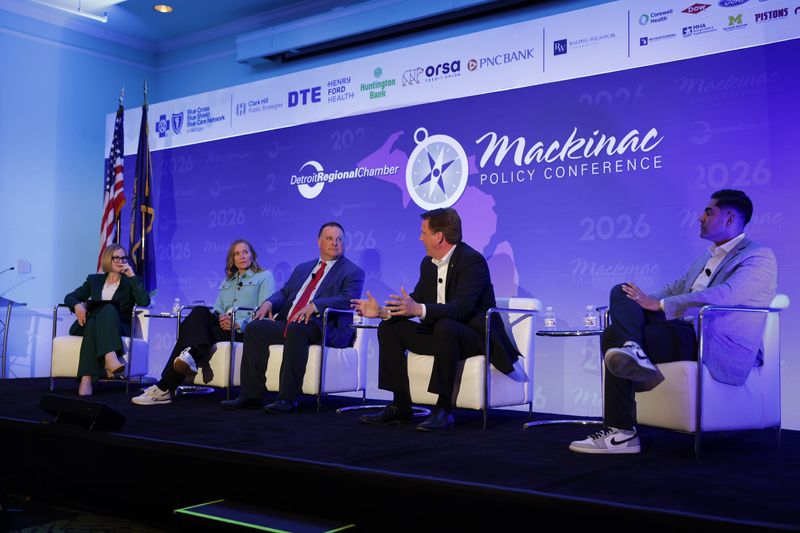
Against the backdrop of a bipartisan gathering focused on common ground, the gridlock and fierce partisan battles that have defined the current era of divided government in Michigan once again came into focus.
At the Detroit Regional Chamber’s annual policy conference on Mackinac Island, Democratic legislative leaders touted the policies they put in place when they had full control of the levers of state government, Republicans blasted that record and no one showed much enthusiasm for working together.

Still, House Minority Leader Ranjeev Puri, D-Canton Township, described compromise as a necessity in split government. And Speaker Matt Hall, R-Richland Township — who called himself “the best dealmaker on this stage” — laid out an ambitious legislative agenda that would keep lawmakers eager to hit the campaign trail to bring an end to divided government stuck in the Capitol instead.
This fall, Michigan voters will decide who will replace Gov. Gretchen Whitmer and whether the next state leader will enjoy a governing trifecta or work with legislative chambers controlled by opposing parties.
Before then, the state budget poses yet another big test to bipartisan cooperation in Lansing. State law requires one by July 1. But last year saw lawmakers blow past that deadline. Senate Majority Leader Winnie Brinks, D-Grand Rapids, said she doesn’t want that to happen again. “We have a lot of work to do but we can do it if folks are committed to getting in a room and making the decisions that need to be made,” she said at the Thursday, May 28 event.
Hall wouldn’t commit to meeting that deadline without conditions: Democrats must agree to a spending deal that doesn’t raise taxes or dip into the state’s rainy day fund, he said. Brinks blasted the House budget proposal, which she said would “blow a $5 billion hole” in state government and castigated Hall’s penchant for dealing insults and barbs as unhelpful to reaching a deal.
In addition to the budget, Hall said he wants to tackle many of the challenges highlighted during the conference, such as education and sluggish population growth in Michigan. “So, with all of those problems facing our state my focus is not to go back and campaign. My focus is to engage with Gov. Whitmer and engage with Leader Brinks and keep them at the table so we can solve more of these problems,” he said.
In an election year, lawmakers prize any spare moment to reach voters with their campaign appeals. This year, that includes Senate Minority Leader Aric Nesbitt, R-Porter Township, who is running in the GOP primary for governor. He used his panel time to make his pitch. “We’re in really tough times here in Michigan,” he said, running through the state’s positioning nationally in job growth, income, reading scores and more. Suggesting Michigan is ripe for new leadership, he said the last eight years when Whitmer has led the state have made it “tougher and tougher to make it in Michigan.”
Contact Clara Hendrickson at chendrickson@freepress.com or 313-296-5743.
This article originally appeared on Detroit Free Press: Michigan’s split government faces big test before the ballot box
Reporting by Clara Hendrickson, Detroit Free Press / Detroit Free Press
USA TODAY Network via Reuters Connect