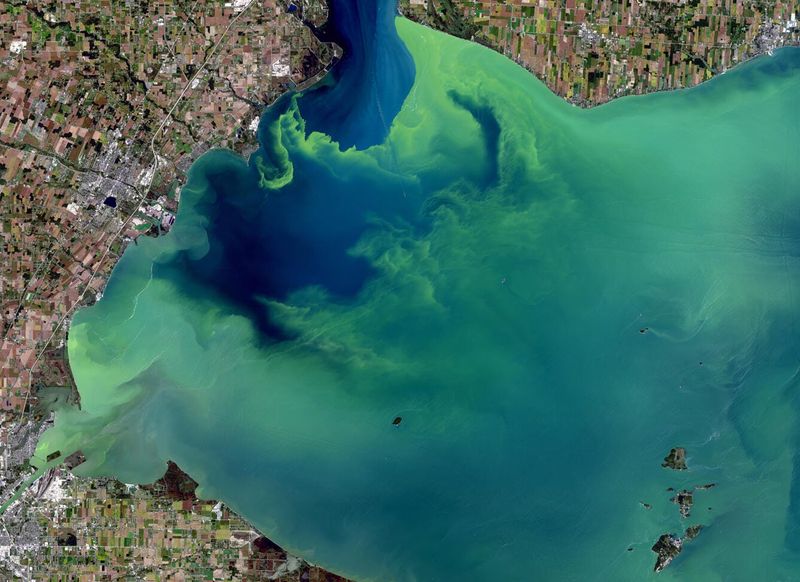
As harmful algal blooms chronically persist in western Lake Erie, communities and federal agencies are relying on the lake’s water monitor for microcystins, a health-harming toxin the blooms can produce.
High levels of microcystin led to the infamous precautionary shutdown of the drinking water supply for nearly 500,000 people in Toledo and southeast Michigan over a weekend in August 2013.

A new University of Michigan study, however, shows harmful algae blooms produce a greater range of toxic compounds than previously known. Known as cyanopeptides, they are short chains of amino acids, the building blocks of proteins, molecules created during various internal chemical processes in the harmful algal blooms.
“We look for those four big, EPA-monitored cyanotoxins, which is still valid; it helps protect public health. But we are probably missing a huge part of the story,” said Lauren Hart, a former doctoral student at U-M and lead author of two studies published this year on the cyanopeptides found in Lake Erie harmful algal blooms, one on their diversity and what may drive their spread, and a second paper showing the toxicity of the cyanopeptides when human cells are exposed to them.
More examination is required, but the research could ultimately help water managers better understand what’s happening during a harmful algal bloom and its potential for toxicity.
Hart and colleagues took water samples from western Lake Erie, collected monthly from May through October from 2016 through 2022 at four National Oceanic and Atmospheric Administration Great Lakes Environmental Research Laboratory sampling stations. They then extracted and sequenced the DNA in the water samples, finding not only known microcystins and metabolites from the harmful algae bloom growth but also new metabolites never seen before.
“You don’t have to know what you are looking for; you get everything,” said Gregory Dick, a professor of earth and environmental sciences at U-M and a co-author on the study. “You are able to reconstruct genes and genomes from organisms that have never been studied before, and that’s a real game-changer.”
Some of the molecules were readily identifiable, like the microcystins that caused the Toledo water crisis nearly 13 years ago, Dick said. But other molecules were discovered that proved concerning for their toxicity to human cells. And the mixture of the different compounds proved more toxic than would be predicted by looking at each one individually, he said.
“And that’s an issue because we don’t monitor for all these different compounds, and most toxicology that’s done is done one molecule at the time,” Dick said.
Nutrients, heat, even invasive mussels help spread harmful algae
Like the other components of a harmful algal bloom, the newly discovered molecules are produced by cyanobacteria, a photosynthetic bacterium colloquially known as blue-green algae. They thrive on nutrients reaching western Lake Erie primarily through farm fertilizer runoff. They bloom more strongly in warm temperatures and lots of sunshine.
Even invasive zebra and quagga mussels are a factor in harmful algal bloom components, Dick said.
“The quagga mussels have taken over, and they selectively feed; they eat the good algae, and they tend to spit out or reject the toxic algae, the cyanobacteria,” he said. “They can actually promote these harmful algal blooms through that selective feeding mechanism.”
While there’s been a heavy focus on phosphorus loads in Lake Erie as a driver of the blooms, nitrogen might be a more key driver in the toxicity of the blooms, said Hart, who graduated from U-M last September and now works as a data and solutions specialist with the environmental nonprofit Texan by Nature based in Austin, Texas.
“These molecules we are talking about are super nitrogen-rich, often over 15% nitrogen,” she said.
There is room for more research on when these molecules coexist during harmful algal blooms, whether particular temperatures, times of year or lake chemistry influence which molecules are produced, when, and to what extent, the researchers said.
“Lauren’s paper was a key advance in this regard,” Dick said. “What’s exciting is she observed that there are these repeating seasonal patterns of these molecules that happen every year, and that there is a certain succession of molecules. That does suggest that there are identifiable drivers of these molecules.”
Algae components proved toxic to human cells
In a study published in January, Hart took cyanopeptides found in the Lake Erie water sampling and exposed human lung, liver and kidney cells to them, “understanding that these are the three organs that microcystins impact.”
The research produced revelations, but also some mysteries. Microcystin and a cyanopeptide known as anabaenopeptin produced toxicity reactions in the human cells, but when the cells were exposed to the full soup of a harmful algal bloom, the concentrations of microcystins and anabaenopeptins were not a great predictor of toxic response.
“That means it’s very likely more intricate combinations are happening that are increasing the toxic response of these mixtures, and also that there’s probably a lot of other molecules in there that are driving a toxic response,” Hart said. “We uncovered the hood on one potential molecule that could be troubling, but there’s this entire consortium of molecules that are interacting with one another that we don’t know about that are also driving toxicity.”
Harmful algal blooms an air problem as well as a water problem
The lake research is being shared with partners such as the National Science Foundation, the National Institutes of Health and the Great Lakes Centers for Fresh Water and Human Health for further human health studies.
“We now know that these toxins can aerosolize and get into the air, so it’s not just the water you are drinking or swimming in, it’s the air that you’re breathing,” Dick said. “That includes the air over the lake, as well as in coastal environments like beaches and coastal communities.”
Better monitoring of blooms for known toxic cyanopeptides, or concerning patterns of change in algal bloom constituents, might help better stave off water crises in the future, Hart said.
“There’s just a lot going on that we are not looking for,” she said.
Report potential harmful algal blooms if you see them
To help Michigan residents alert the state about suspected harmful algal blooms, the Michigan Department of Environment, Great Lakes and Energy has updated its online reporting form to include harmful algal bloom reports. The public will now be able to report suspected blooms by filling out the form at Michigan.gov/HABs. Individuals reporting a potential harmful algal bloom are requested to provide details and upload photos of what they see in the water. Individuals can also make a report by calling EGLE’s Environmental Assistance Center at 800-662-9278.
EGLE staff will review reported information to help confirm whether it’s likely a harmful algal bloom. Reporting helps the state track and understand these blooms and can lead to public notifications to keep people and domestic animals safe if one is detected.
Breathing in or swallowing water with harmful algal bloom toxins may cause illness such as runny eyes or nose, asthma-like symptoms, difficulty breathing, stomach pain, vomiting, diarrhea, weakness, headaches or dizziness. Skin contact may cause rashes, blisters or hives.
“If you had contact with or swallowed water with a suspected HAB and feel sick, call your health care provider or seek medical attention as soon as possible,” said Dr. Natasha Bagdasarian, chief medical executive. “If you have questions about algal blooms and keeping yourself safe, call 800-648-6942.”
Contact Keith Matheny: kmatheny@freepress.com.
This article originally appeared on Detroit Free Press: There’s more harmful stuff in Lake Erie algae than previously thought
Reporting by Keith Matheny, Detroit Free Press / Detroit Free Press
USA TODAY Network via Reuters Connect